

China Is Building A Massive 'Floating Island' That Can Study The Deep Sea In Any Weather
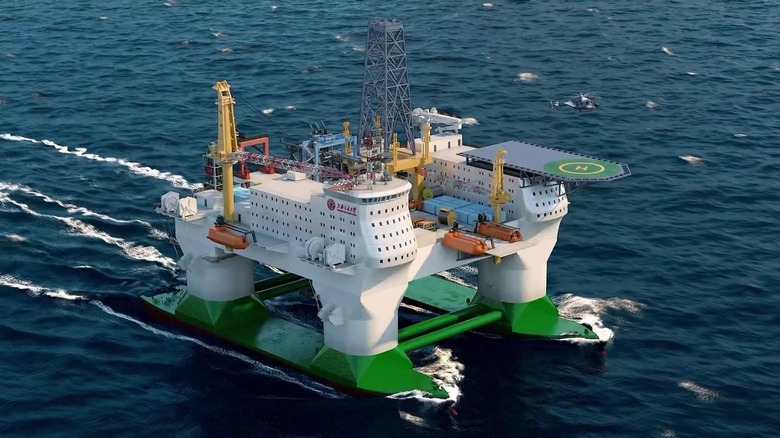
China has begun construction on the world's largest mobile research platform that will bridge the gap between simulated testing in a lab and real ocean conditions. The open-ocean "floating island" can quickly mobilize and deploy to new areas with different testing conditions. Engineers at Shanghai Jiao Tong University designed the research facility with twin semi-submersible hulls that will allow researchers to work in varied environmental conditions while remaining at sea for long periods.
The platform will be used to test mining systems such as drills and deep-sea robots. With China's robotics industry rapidly expanding, the platform could help accelerate the development of underwater autonomous systems, even large ones. It will be able to handle equipment weighing up to 110 tons and can support testing at depths of 32,800 feet (10,000 meters). Compare that to the ocean's deepest point, the Mariana Trench at 36,000 feet (11,000 meters), and it can explore just about anywhere in the ocean.
The project's applications aren't limited to oil and mining research. It can be used for typhoon forecasting, offer insight into marine ecosystems, and even help scientists search for clues about the origins of life like elusive subatomic particles a mile below the ocean floor.
How China designed a platform that's steady like a rig but can move like a ship
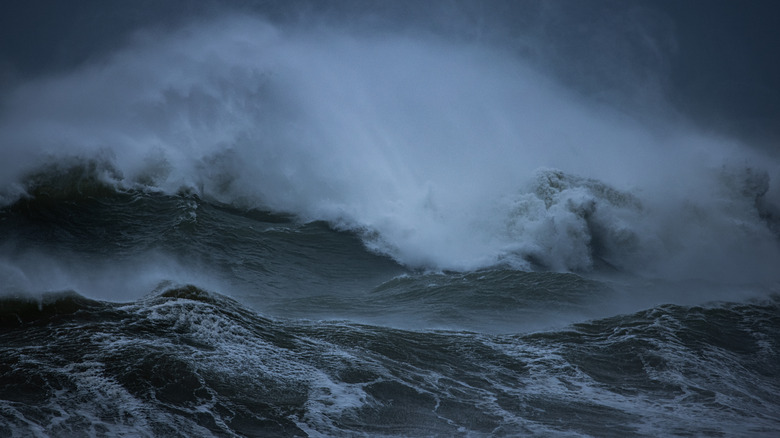
Traditional marine platforms face enormous limitations. Research ships are mobile but can't maintain position in rough seas. Meanwhile, fixed oil rigs are stable but can't relocate. The mobile island, on the other hand, is stable and can relocate if needed. Engineers designed the platform with a semi-submersible twin-hull design that can switch between modes. To remain stable, the hulls fill with water, positioning the ship lower, and making it more wave-resistant. To move, the hulls release the water, allowing it to rise higher. Engineers say it can move and maneuver like a conventional ship.
It will be able to remain anchored in a single position for months, even through typhoon season when the powerful winds can reach 180 miles per hour. Interestingly, though, engineers didn't test the platform's weather resistance in the ocean. They used Shanghai Jiao Tong's Deep Water Test Basin. In the facility, they hammered away at a scale-sized model with hurricane-force winds and tsunami-like waves. They say the platform remained stable because the twin-hull design distributes stress and reduces the pitching and rolling ships face during deep ocean storms. Engineers say the floating island marine research platform will be operational in 2030.