

South Korea's Solar Trees Are Doing Much More Than Generating Electricity
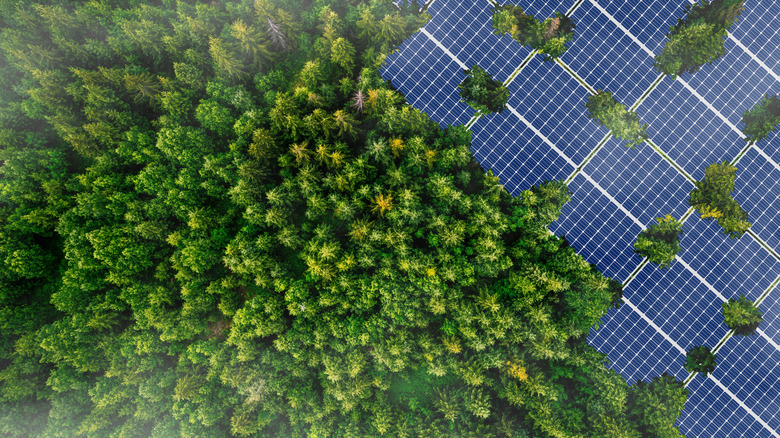
Solar power is considered one of the most promising routes to green energy, thanks to the sun's almost inexhaustible power output. However, adopting it can be difficult, especially if you're trying to do it in any large form. That's because solar panels traditionally take up a lot of space, and you need to make sure they have ample exposure to the sun, or else they won't generate a good amount of power. In places like South Korea, the act of removing large swaths of trees has become somewhat commonplace as solar installations have expanded, but a new type of solar installation called a solar tree could help mitigate this and do more than just generate energy; it could also help save the forests.
According to a new study published in Scientific Reports, setting up traditional solar installations typically eliminates roughly 98% of forest coverage. However, a new design which features panels attached to tall poles that can be blended into the forest canopies could help mitigate this exponentially, leading to a preservation of 99% of the forest cover while still providing an equal capacity for power generation. The new method has been tested both through simulations that used 3D geospatial information, as well as physical test conditions where actual versions of the solar trees were placed in forests located along the South Korean coast.
Large-scale solar installations can undermine climate goals
One of the biggest reasons we're seeing wider adoption of solar energy is to help in the world's efforts to control our losing fight against climate change by minimizing how much we rely on fossil fuels. That's because the drilling of fossil fuels, as well as the burning of energy-producing materials like coal, can add to the greenhouse gases that fill our atmosphere. The problem with replacing all of these other methods with solar, though, is that solar energy takes up a lot of space, as we noted above. While scientists have been coming up with ways to work around this — like blending farming and solar energy installations, a practice being called agrivoltaics — we're still seeing new solutions pop up, like the solar trees being used over in South Korea.
While it is true that solar installations can be placed on top of houses and buildings, which is definitely a practice we already see, when you're creating these arrays to generate energy for a larger grid, you need more space to build them. That's because the more panels you have, the more solar energy you can capture, and that means more electricity can be generated. However, in heavily forested areas, using standard solar array setups means you'll need to deforest large swaths of land, which means fewer trees to help act as carbon dioxide sinks, not to mention the widespread effects doing so will have on the ecosystem in that area.
Solar trees offer a way to control the disruptions
This more confined approach to solar energy gathering sees the panels being installed atop tall poles. This mitigates the damage done to the ecosystem and keeps the forest from being destroyed. And because the researchers involved with it are already reporting promising results that show they can generate an almost equal amount of energy, having to deforest large plots of land does not appear to be required anymore.
The offshore wind parks in Europe are also doing a lot for local ecosystems, so being able to mimic something similarly helpful for the environment using solar energy could help provide more opportunities for solar arrays to pop up around the world without disrupting the local wildlife and natural climate-change controllers like trees. Considering wind turbines can take up to a decade to really pay off, being able to lean into the pros of solar energy sooner could make it more appealing for large energy projects.
A 2021 study from the U.S. Department of Energy found that solar power has the potential to provide at least 40% of America's electricity by 2035, if we follow the right path. And the addition of solar arrays like the solar trees being used in South Korea could be a good way to compliment the already existing larger arrays we're seeing go up across the country, and around the world. Finding new solutions like this is a huge step forward that will hopefully open new doors for how we approach green energy opportunities.