

Not Hours, Not Minutes: China's New 3D Printing Method Takes Less Than A Second
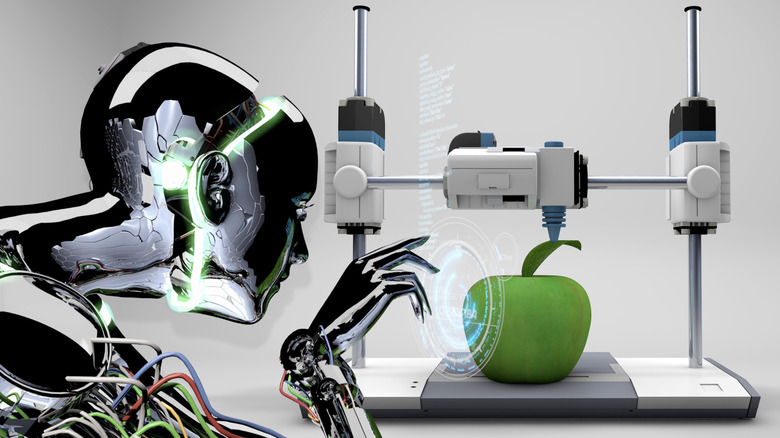
3D printing isn't just a DIY option for hobbyists who want to make useful home gadgets or their own action figures. As a recent study published in Nature points out, 3D printing can have applications in fields ranging from structural mechanics to pharmaceuticals (and plenty of others in between). That study also concedes that various 3D printing methods have demonstrated limitations, often involving slow print speeds. The study's authors, a team of researchers with China's Tsinghua University, describe a new method they've developed that can get print times down to a mere second.
They've named the method "digital incoherent synthesis of holographic light fields," or DISH. This innovation represents a solution to a problem that has stopped an otherwise useful 3D printing method — volumetric 3D printing — from delivering on its full potential. The paper's authors explain how volumetric 3D printing has shown promise as a means of reducing the time it takes to print certain items. This process involves using "controlled 3D light distributions generated by light patterns from different angles" to print entire 3D objects at once, without the layering process that other methods require.
However, this method has traditionally required the rotation of a sample to optimize the finished product's detail and resolution. The DISH method solves the problems inherent to this requirement. With the DISH approach, the team behind the study has been able to 3D print "millimeter-scale" objects in literally less than one second.
DISH method allows for highly-efficient 3D printing
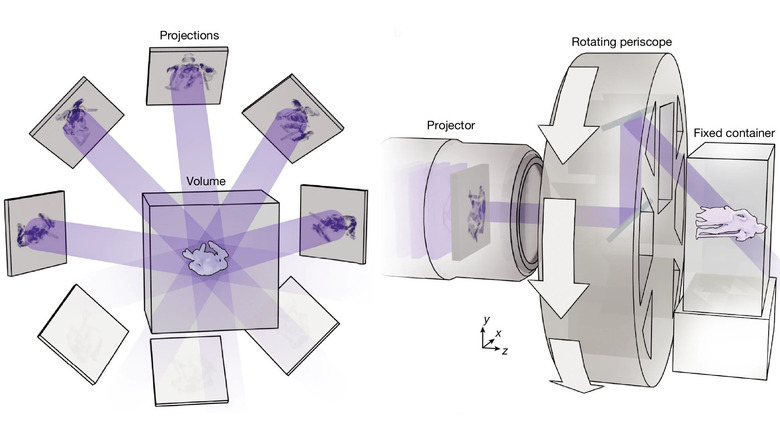
Traditional photopolymerization 3D printing involves exposing liquid resins to particular wavelengths of UV light to polymerize them into solids. This typically requires 3D printing a project layer by layer. Volumetric 3D printing is based on the same principle of exposing a liquid resin to UV light, but it uses multiple light sources shining into a container of liquid to print an entire item at once, instead of one layer at a time. Again, this requires rotating a sample, which presents its own set of limitations. For example, if a sample is rotated too fast, the rotation process could generate mechanical vibrations that might negatively impact the detail or resolution of the item being printed. These vibrations can also affect the overall system's alignment.
The DISH method directly addresses these limitations by using a unique rotating periscope that eliminates the need to rotate the sample object itself. The method also leverages a specialized lens to optimize the finished product's resolution. The DISH approach has already allowed the research team to print highly-detailed objects with features as fine as 0.019 millimeters in just 0.6 seconds.
DISH offers a versatile 3D printing solution
The study's authors point out that DISH offers several benefits beyond speed and high-resolution printing. For instance, DISH works with various materials commonly used in 3D printing projects. This flexibility and versatility may allow the DISH method to be adopted on a wider scale. In addition, the calibration process for the DISH method doesn't require fiddling with the hardware.
That's not to say hobbyists will immediately have access to the equipment necessary to test out the DISH method at home just yet. As previously established, the process requires equipment like a specialized rotating periscope that may not be widely available right now. In the meantime, they can research the best 3D printing and printer tools currently available. Consumer-grade 3D printing equipment might not be able to churn out tiny items with immaculate detail in under a second, but the right tools can still make a big difference in how much you enjoy working on your own 3D printing projects.