

NASA Tried Something Unexpected With A Fighter Jet, And It Could Make Flights Cheaper
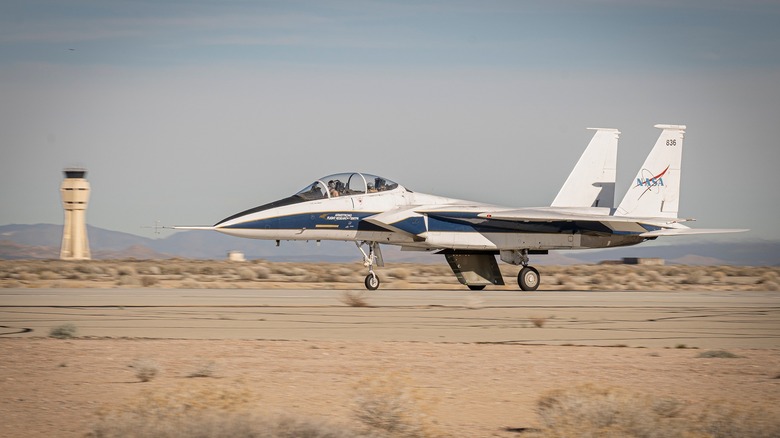
While NASA's primary focus has been on the special Artemis II mission, it has been testing a new wing technology that could save airlines millions of dollars by reducing fuel consumption up to 10%. It works by maintaining smooth airflow, known as laminar flow. Testing started on the ground and has now taken flight – but not on a commercial aircraft. The NASA team mounted a three-foot scale model of a customized wing under an F-15B to test their Crossflow Attenuated Natural Laminar Flow (CATNLF) design.
In early January 2026, the testbed jet taxied around Armstrong Flight Research Center in Edwards, California, reaching speeds of 144 mph. Because the team mounted the test wing vertically, they didn't have to build a costly custom aircraft. In late January 2026, the jet went airborne for a 75-minute flight that reached an altitude of 34,000 feet.
The goal is to maintain laminar airflow and reduce drag on commercial flights. Drag builds when airflow suddenly shifts, causing friction that burns fuel. Most commercial aircraft have large, swept wings that interrupt laminar flow. NASA says scientists have been trying for decades to smooth airflow on swept wings, part of the agency's attempts to improve the performance of aircraft wings.
How this NASA project could save airlines millions
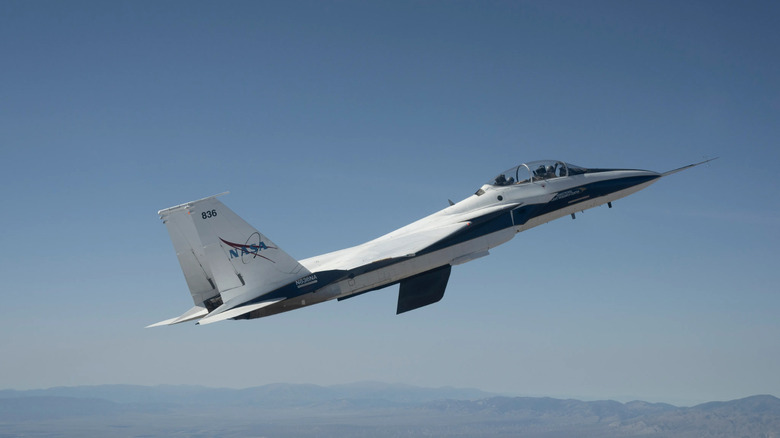
Fuel is the airline industry's highest operating cost, and NASA says that a 10% fuel savings achieved by the CATNLF wing design would save airlines millions of dollars. A typical Boeing 777 flight carrying 365 passengers from New York to London burns 14,500 gallons of fuel, so the design would save about 1,450 gallons per flight. Based on summer 2025's cost of $2.25 per gallon for jet fuel, that's about $3,200 in savings. If you take into account current prices, which topped $5.50a gallon in Europe in April 2026, you're looking at considerably more savings.
Over the course of a standard year, an aircraft flying from New York to London daily would save $1.2 million or up to $2.6 million at current elevated fuel prices. Considering there are more than 1,300 Boeing 777s in operation globally, savings have the potential to reach hundreds of millions of dollars. Airlines could pass those savings to fliers or reinvest in their fleets, as air travel demand could double in the next 25 years.
The design is in its early stages, so you won't see it on an airline flight anytime soon. NASA plans up to 15 test flights to see how the CATNLF design functions in various speeds, altitudes, and conditions. NASA believes the design, if successful, could make its way onto the next generation of commercial aircraft or even supersonic aircraft, which are returning to commercial flights in 2026.