

These 3 Electric Cars Fell 50 Miles Short Of Their Advertised Range In Consumer Reports' Tests
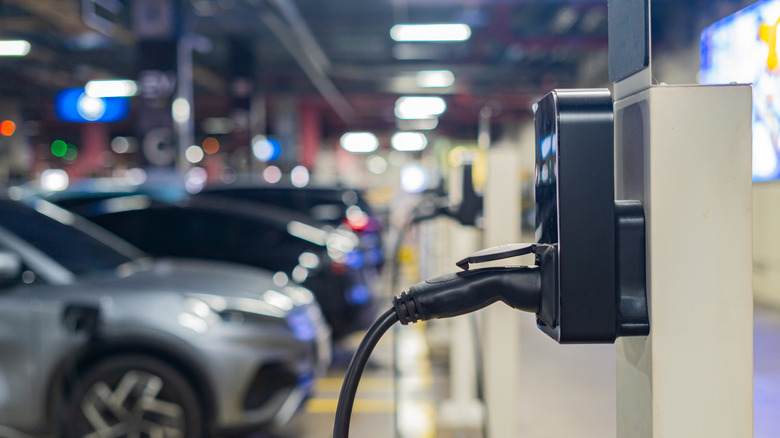
When purchasing an electric vehicle (EV), one decision maker may be the advertised range. That is, how far it can drive before the batteries need to be charged again. While you might think the advertised charging range is true and reliable, it turns out that it might not be. Consumer Reports ran a test of multiple EVs to determine their real-world range, driving them on the highway from a full charge up until the point that the cars stopped moving. While some vehicles exceeded the given ranges, others fell extremely short.
There were three vehicles, in particular, that stopped working at least 50 miles short of their advertised range. The Rivian R1S, a 2025 Dual Max model, lost power 52 miles shy of its expected range. The Ford F-150 Lightning fell 50 miles short, despite being the 2022 Lariat Extended Range model. The third was the Lucid Air 2023 Touring model, which stopped working 52 miles shy of its advertised range. The Lucid Air has also been named as one of the 12 least reliable EVs for 2026.
This data is a bit of a wake-up call in that you might not necessarily get what you think you are when purchasing an electric vehicle. It's worth noting that some EVs exceeded the range, including the Chevrolet Silverado EV, the BMW i4, and the Hyundai Ioniq 5N.
Why is there a difference in the mileage range?
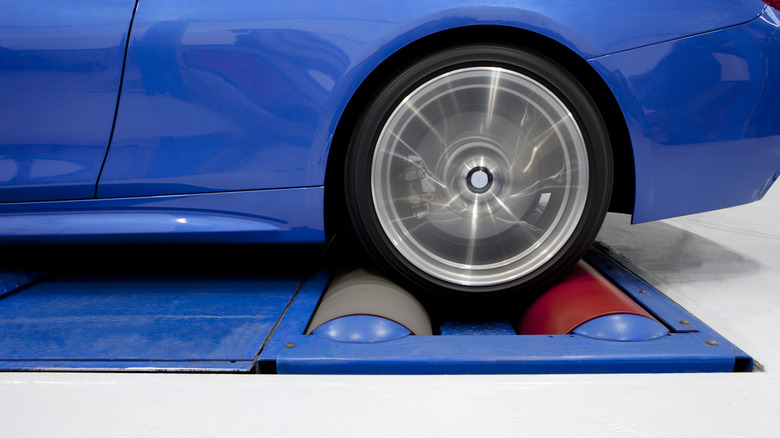
Despite the fact that 3,000 mile-range electric cars may be in the future, we are not there yet. The main reason Consumer Reports found such drastic differences comes down to the way EVs are tested prior to being put out for sale. These cars are tested by the United States Environmental Protection Agency (EPA) in a laboratory setting to determine their range on a dynamometer. They aren't actually driving on any real roads. Other countries use the Worldwide Harmonized Light Vehicle Test Procedure (WLTP) to test EVs in a similar way. Due to this, these cars aren't exposed to wind and weather resistance, changing road surfaces, the use of car electronics that can deplete the battery, and generally enthusiastic driving behavior, which also can impact performance. The same testing method is used for traditional gas cars, but is usually more representative for them as they're not affected by temperature and wind as dramatically as EVs.
Consumer Reports tested cars the company itself purchased and that already had some miles on them. They were tested in the summer to ensure cold weather did not impact range. The cars were then continuously driven on an actual highway with real-world driving conditions to determine what the true range could actually be. The fact that the advertised range of EVs comes from laboratory tests is why actual range can differ so much, whether positively or negatively. The Consumer Reports summary does emphasize that real-world tests are essential to get accurate EV range data. Many drivers have a mix of highway and local road driving, so they may get a few more miles than the Consumer Reports study reveals.
How to avoid running out of charge on trips
Inaccurate charging ranges don't have to stop you from purchasing an EV if you are interested in one. The technology and infrastructure continue to evolve and improve. For example, the SparkCharge electric car charger from Shark Tank was designed as a portable EV charger that can be carried in your trunk to help you out if you're unexpectedly low on battery. Aside from that product, the company also is building out charging station infrastructure across the U.S., Canada, and Mexico.
When planning a long trip where range is essential, there are some things you can do to stay charged. A site and app called A Better Routeplanner will show you road trip routes with EV charging stations, and lets you customize based on your vehicle and charging station preference. Using apps and other similar trip-planning tools can help you ensure you know where charging stations are when you need them.
If you are staying overnight, plan on a hotel with EV chargers. Avoid aggressive or otherwise enthusiastic driving so that you don't strain the battery and deplete it faster. And, as we've seen from Consumer Reports, don't just go off the advertised range for your EV. Look up the real-world range so you can plan your trips accordingly and not get stuck on the side of the road.