

4 Things You Might Not Realize Supercomputers Are Used For
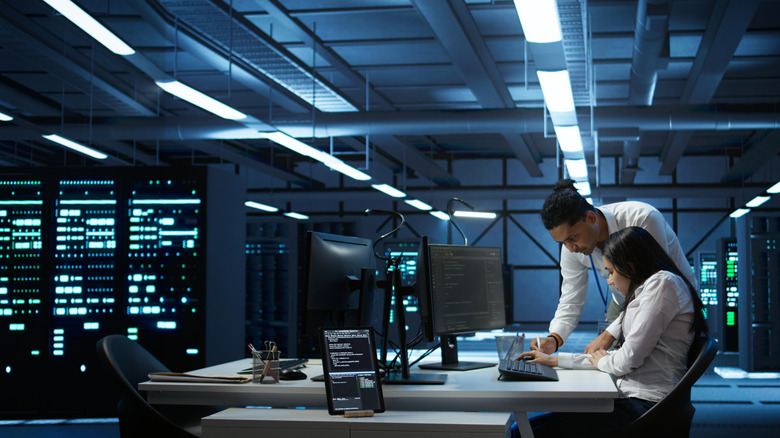
Even if you've never actually seen a supercomputer, odds are that movies and pop culture have given you a good idea of what they do, what they're used for, and maybe even what they look like. The U.S. National Science Foundation explains that "supercomputer" is a general term referring to whatever happens to qualify as the fastest and most powerful class of computers available at any given time. Argonne National Laboratory clarifies that a supercomputer may be made up of large quantities of nodes, which are basically individual computers. Supercomputers perform various functions requiring more data than a typical computer can handle, including weather forecasting, recreating the last moments of the Titanic, and creating models to better understand black holes.
Tasks that involve calculating large quantities of data are ideal for supercomputers. Thus, these devices have ended up playing roles in fields you might not expect. The following are just a few examples of current uses for today's computing behemoths that might surprise you, ranging from gaming to healthcare research.
Supercomputers help researchers in the healthcare community
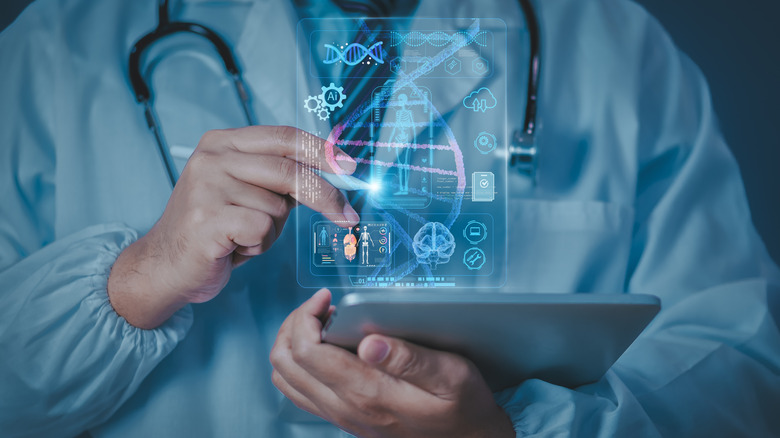
It probably isn't much of a surprise that supercomputing systems offer immense benefits to the medical community, but how researchers use this computing power varies greatly. Supercomputers, for example, were used to study the COVID-19 virus as well as to develop and test vaccines, but researchers have also used supercomputers to better understand opioid addiction.
The U.S. Department of Energy's Oak Ridge National Laboratory (ORNL), specifically, has used the facility's Summit supercomputer to analyze population-scale genomic datasets, and its statistical analysis indicates that some people are more likely than others to become addicted to opioids, suggesting genetic may play a factor. However, ORNL also states that parsing through genetic information to determine which genes contribute to someone's risk of addiction is "a huge combinatorial problem that's too large to calculate."
The Summit supercomputer addresses this problem. Its computing power and algorithmic advances allow it to quickly and effectively identify gene networks that could hold the key to understanding (and perhaps preventing) addiction. Per ORNL, this type of work could also help uncover the roots of other conditions with genetic components, including diabetes and dementia.
If you or anyone you know needs help with addiction issues, help is available. Visit the Substance Abuse and Mental Health Services Administration website or contact SAMHSA's National Helpline at 1-800-662-HELP (4357).
Supercomputers make 'World of Warcraft' possible

"World of Warcraft" is one of the most popular massively multiplayer online role-playing game (MMORPG) titles in history. According to The Gamer, "WoW" attracts more than 1.6 million gamers daily. Ensuring an immersive and consistent gaming experience with so many potentially active users at one time is no small feat.
A 2008 Engadget article further highlights the computing power needed to run "World of Warcraft," indicated by the fact that the company licensed to run the game in Asia, called The9, required more than 10 supercomputer systems to facilitate this online fantasy world. Apparently, along with functions like flight simulation and animation rendering, the company also relied on supercomputers to host a million or more online players at one time.
The Engadget author also mentions an off-the-record conversation with an employee at Blizzard Entertainment, the developer and publisher of "World of Warcraft," regarding the company's computing power. According to this discussion, the company was leveraging the kinds of supercomputing systems that allegedly rivaled those of Google – not even financial and health care organizations used this level of computer power back then.
Supercomputers are even used in diaper design

A diaper may seem like a relatively straightforward (and vital) product. However, according to a report from the Information Technology & Innovation Foundation (ITIF), decision-makers at consumer products companies have recognized that even relatively simple products like these can be improved thanks to high-performance computing (HPC). For instance, the ITIF report indicates that companies have used supercomputing to determine whether a certain type of baby diaper is likely to leak. Supercomputers can evaluate data related to various types of diaper materials to arrive at findings regarding factors ranging from leak-risk to environmental friendliness.
As described in the Berkeley Labs Science Beat series, diaper manufacturers face a unique challenge when developing polymers for their products. A diaper must be constructed in such a way as to effectively absorb and keep a substantial quality of liquid without leaking. However, parents who buy diapers also prefer thin diapers whenever possible. Thus, scientists for diaper manufacturers have to carefully assess materials and proposed designs to meet all applicable standards. Supercomputers can help them do so.
Supercomputers play critical roles in visual effects

The main point to remember when considering potential uses for supercomputers is that these devices are designed to manage tasks that are inherently data heavy, and while some are used for developing medical technologies and managing nuclear stockpiles, others allow digital effects teams to deliver movie magic. This is by no means a new application for supercomputers as they have helped to create fantasy worlds for film franchises like "Lord of the Rings" and "Avatar."
These are two examples of digital-effects movies that require immense computing power work with large volumes of data for tasks such as rendering virtual landscapes and storing footage. Per a BBC News article from 2004, at that time, Weta Digital (now known as Weta FX) was operating the planet's third-largest supercomputer (as measured by the number of processors in the system). And according to Data Center Knowledge, Weta's supercomputers were also used to help James Cameron and his team to transform the world of Pandora from a vision to a (sort of) reality.
As supercomputing technology improves, uses for supercomputers will only become more abundant. Consider the fact that scientists recently used quantum supercomputers to achieve quantum teleportation. Plenty of industries and agencies will find uses for computing technology this powerful. These examples merely prove some of the ways they use the tech may not be as obvious as you'd guess.