

The First 4D Printer Of Its Kind Is Doing More Than Just Making Recyclable Robots
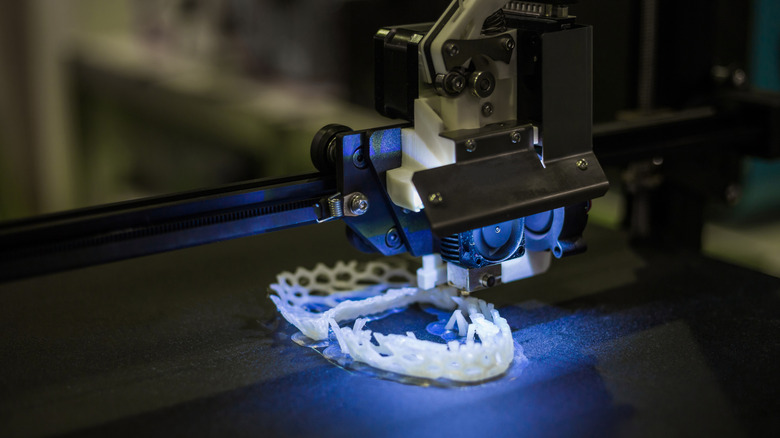
3D printing was once an innovation out of "Star Trek." Now, hobbyists can complete various impressive 3D printing projects in their own homes (as well as some that maybe don't represent the most valuable uses of this technology). However, at the research level, the technology continues to grow and develop, with teams exploring the possibilities of 4D printing. One research team is even experimenting with 4D printing to create autonomous "soft robots" using materials that have typically been waste products.
A key distinction between traditional 3D printing and 4D printing is the addition of a time element. This is the additional dimension that makes it "4D." 3D printing involves printing static objects that typically don't move unless incorporated into machines as parts. 4D printing allows for the creation of objects that can change their shapes, uses, or both in reaction to stimuli. Heat and light are two examples of stimuli that can trigger a 4D printed object to change its shape or function.
This innovation can have applications in fields like robotics. Consider the example of the work being done by a team of Korean researchers. In a paper in Advanced Materials, the researchers detail how they've used a 4D printing method to develop recyclable structures that can autonomously change shape when exposed to heat or light. While this alone is impressive, what's perhaps even more noteworthy is the fact that the team achieved this breakthrough using materials that would typically be no more than industrial waste: sulfur.
Using sulfur plastics to achieve 4D printing
Sulfur plastics derived from sulfur waste can offer a range of benefits. For example, unlike other types of plastics, they're capable of transmitting infrared light. Their ability to trap heavy metals also makes them useful in water purification applications.
Unfortunately, it's historically been challenging to use sulfur plastics with 3D printing technology. Sulfur plastics have complex internal networks that prevent them from easily being used in 3D printing applications involving complex structures. The Korean research team has addressed this barrier by developing a loose internal sulfur polymer network in sulfur plastics, which makes it possible to extrude the material for 3D printing purposes.
This new method allows the team to use 4D printing techniques to create structures that change shape in response to heat or light stimuli. The researchers also found that just eight seconds of applying a special laser to the 4D printed materials triggers an adhesive effect. Such an effect makes it possible to create complex structures with 4D printed materials. The inclusion of magnetic particles can also allow for the creation of so-called soft robots that move in response to magnetic fields, with no outside power sources.
New 4D printing method is rooted in sustainability
Sulfur waste is a common by-product of petroleum refining. As such, any technology that can leverage this waste as a resource would prove valuable from a sustainability perspective. That's why, for some, the main story here is how this work demonstrates greater potential for sulfur waste for use in 4D printing. In addition, objects or structures printed via this method could be melted down so the resulting material can be used in future projects.
It's fine if your biggest takeaway from this news is that someone is experimenting with autonomous 4D structures. It's simply worth understanding how these processes can be sustainable. A breakthrough like this is proof that even industrial waste could serve as a useful resource when innovative thinking is applied. With others exploring how 3D printing could solve the housing crisis or how 3D printing can create an affordable and recyclable form of plastic, it's clear these technologies have the potential to offer real societal value.