

The Design Issue Star Trek's Starship Enterprise Could Never Escape
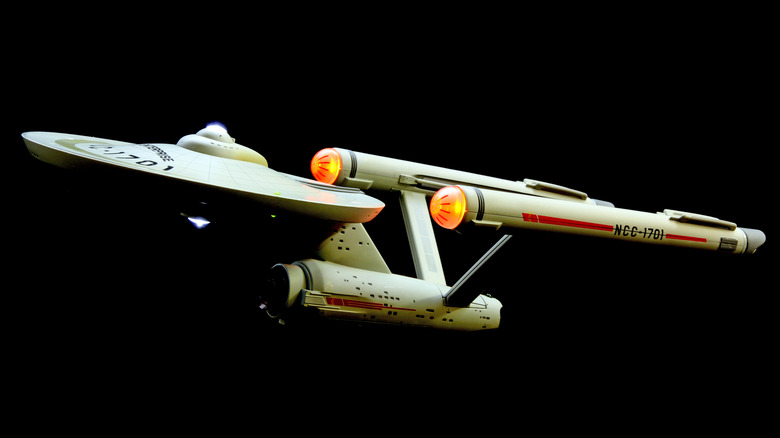
Whether you're a die-hard Trekkie or have merely dabbled in "Star Trek's" Kelvin timeline movies, the Starship Enterprise — in all of its iterations — has made a lasting pop culture impact thanks to an unmistakable design. Since 1966, what amounts to an oversized dinner plate with two broken coat hangers sticking out of it has explored the far reaches of space. There was a time, however, when the Enterprise looked considerably different as its designer tried to veer away from the formulaic spaceship design, only to inevitably get caught in its tractor beam.
The task of getting the Enterprise off its launchpad fell to the show's art director, Walter Matthew "Matt" Jefferies, who had a few rules to follow per Gene Roddenberry, "Star Trek's" creator and sci-fi show extraordinaire. The most important being that the ship not looking like a flying saucer.
In a 2000 interview with Star Trek: The Magazine (via Starship Concept Art), Jefferies recalled the demands of bringing the most beloved vessel in all of Starfleet to life. "He had emphasized that there were to be no fins, no wings, no smoke trails, no flames, no rockets." From there, Jefferies recalled churning out hundreds of designs that Roddenberry would use to cherry-pick his favorite parts. "Gene liked a piece of this and a piece of that and a piece of something else, so I tried to see what I could do with the pieces."
The Enterprise started out with with a ball shape
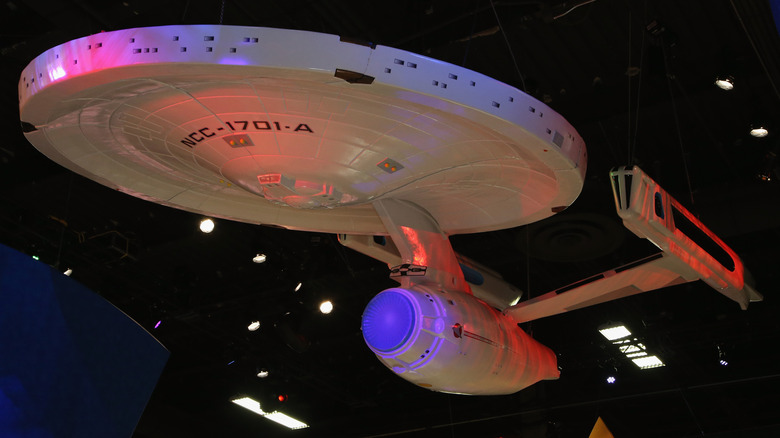
Jefferies would ultimately settle on a design that was almost perfect, though there was no shortage of frustration in the nearly month-long process. One aspect that had a heavy influence on the Enterprise design was propulsion. As Jefferies noted, "...because of the ship's speed, there had to be terrifically powerful engines. They might be dangerous to be around, so maybe we'd better put them out of the way somewhere."
Then there was the issue of the hull for Jefferies to deal with. During a time when shiny metal discs seemed to fill the skies in science fiction, the designer insisted the Enterprise wouldn't be among them — and it wasn't. Sort of. "...for the hull, I didn't really want a saucer because of the term 'flying saucer,' and the best pressure vessel, of course, is a ball, so I started playing with that." Eventually, though, Jefferies gave in to what we ended up with. "..the bulk got in the way, and the ball just didn't work. I flattened it out, and I guess we wound up with a saucer!"
While it's clear that the saucer shape was integrated into the Enterprise's design, everything surrounding it would distinguish it not just from other sci-fi starships of that era, but long after "Star Trek" legends had been sent into space themselves. In its mission to explore strange new worlds, the Enterprise deviated from tradition and found itself light years ahead of others as a result.