

NASA's Orion Spacecraft Has A Problem It Will Need To Solve Before Artemis III
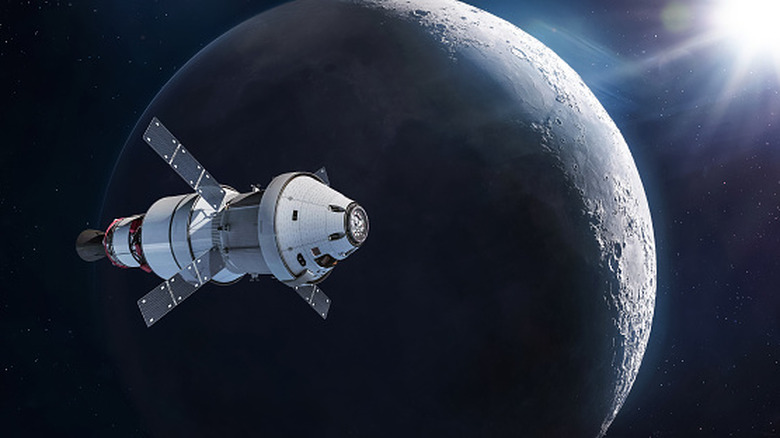
As humanity's first trip to the moon in over 50 years, Artemis II was a special mission that sent four astronauts farther from Earth than anyone had gone previously. This was Artemis's first crewed mission after a 2022 test flight, and future missions intend to send astronauts back to the moon in 2028 and, eventually, to Mars. The 10-day journey captured the world's attention and is widely considered a success, but there are some key problems with the Orion spacecraft.
Orion uses helium pressure to push fuel to the engine as part of its propulsion system, but there's an internal helium leak in the oxygen pressurization system. While it did not impact Artemis II's ability to safely reenter Earth's atmosphere, it needs to be addressed before any future missions launch. Interestingly, NASA was actually aware of the leak before Artemis II's liftoff, but the leak wasn't deemed a big enough issue to delay the mission.
While the propulsion system seems to have functioned normally, this mission only used the larger engine once. It's an issue that NASA has to address, made more difficult by the fact that the module isn't recovered after reentry, meaning it can't study the leaky valves and will have to do a full redesign. Still, addressing the helium leak and other Orion issues is crucial before NASA can launch more complex missions that require the engine's full capabilities — like traveling to Mars.
A helium leak isn't the Orion spacecraft's only problem
The helium leak isn't the only issue, or even the most pressing one, as Orion has a known and potentially dangerous flaw. When the capsule returned from Artemis I, NASA found significant damage to the heat shield, including missing pieces. Still, despite identifying the cause, that same design was used for Artemis II. Given that the heat shield protects the bottom of the spacecraft during reentry, its integrity is a matter of life and death, unlike the helium leak. NASA was confident the astronauts would land safely regardless, and it's studying the heat shield from Artemis II with the intention of developing a new one for Artemis III.
Still, heat shield experts like former astronaut Charlie Camarda (via Bloomberg) say the mission never should have been launched with this known flaw. He compared it to "playing Russian roulette without knowing how many bullets are in the chamber." Additionally, both Artemis I and II faced delays due to hydrogen leaks. NASA has gotten better at fixing these, though they can't determine the exact cause.
Not all of Orion's issues are that pressing, even if they do need to be addressed. There were some toilet-related incidents, the first of which involved it not having enough water to prime the pump. Days later, flight controllers noticed the astronauts' urine had frozen in the tank, which required about a day's worth of maintenance and involved maneuvering the ship in an attempt to thaw the tank and pipes in the sun. Fortunately, NASA has plenty of time to improve space plumbing, as next year's Artemis III will be uncrewed.