

New Breakthrough In Quantum Computers Could Completely Change How Much They Cost
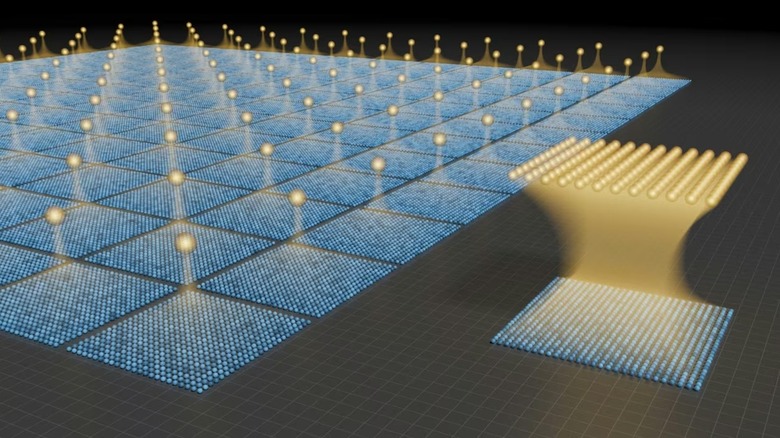
Practical quantum computers, once thought to be decades away, now appear to be much closer than anticipated, thanks to the work of researchers at Caltech and ETH Zurich. Quantum computers are creating huge ripples in the scientific and tech communities largely because of their potential to outperform standard computers in a number of arenas.
Quantum computing could lead to the discovery of new drugs and treatments (through advanced protein folding and analysis of reaction pathways), financial prediction models that could reshape Wall Street, or energy grid optimizations that may help alleviate the global energy crisis. Troublingly, they may also lead to the ability to crack some of the most popular existing encryption methods, which could lead to vulnerabilities in industries like banking and data security.
The breakthrough at Caltech demonstrates that a practical quantum computer built around only 10,000 to 20,000 qubits may be possible, instead of the millions once thought necessary. This means quantum platforms that are both easier to develop and less expensive to manufacture. Simultaneously, advances by researchers at ETH Zurich show how neutral-atom platforms (the kind used in the Caltech research) can prove remarkably error-resistant, one of the other major hurdles preventing practical development of quantum computers.
Why fewer qubits matter
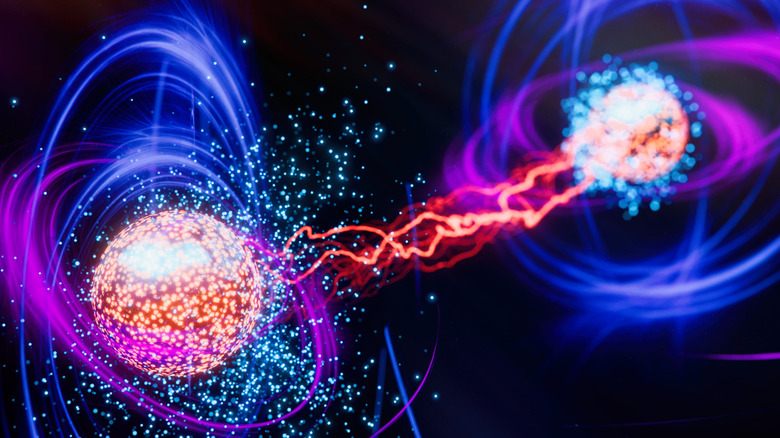
Qubits are the quantum equivalent of bits in traditional computing. Unlike traditional bits, however, which can only exist in one of two states (0 or 1), qubits are capable of existing in both simultaneously. They also have other properties that sound like magic, including what Albert Einstein referred to as "spooky action at a distance": the ability to entangle with another qubit, so that changing the state of one instantly changes the state of the other, even though they may be separated by a vast gulf of distance. This means it's possible to "teleport" information instantly between qubits with no physical connection.
The problem is that qubits are notoriously prone to interference from things like heat and noise. To counteract this issue, researchers group large numbers of qubits together to create a single, more stable "logical" qubit that can perform calculations with fewer errors. Unfortunately, for a workable quantum computer, you'd need something like 1,000 logical qubits, each consisting of around 1,000 physical qubits each, a total of a million or more qubits. That's a massive engineering challenge.
The breakthrough at Caltech and Oratomic (a Caltech associated startup) shows that by using neutral-atom qubits, where information is stored in the internal quantum states of a single, electrically neutral atom trapped in place by "laser tweezers," it's possible to build a logical qubit from as few as five physical qubits, instead of 1,000.
Stabilizing the future with lasers

Meanwhile, halfway across the globe in Switzerland, researchers at ETH Zurich, one of the world's leading universities for science and technology, discovered a way to run highly stable quantum logical operations with qubits made of neutral atoms. One important dimension of quantum processing is the ability to shift qubits between those 0 and 1 states (or both at once) mentioned above. This is done through swap gates, which allows information to be routed through a quantum system by linking qubits and exchanging states between them.
Previous methods for executing swap gates were highly dependent on things like how quickly a laser could be turned on, and how precisely you could control its power level. Tiny variations could introduce significant errors into a quantum system. The team at Zurich was able to mitigate these errors through use of a physical effect called a "geometric phase." Instead of relying on harder to control variables like how quickly an atom is moved or how intense a laser is, this kind of phase depends only on the geometry of their motion, meaning less instability and fewer errors.
These developments are important because they bring Shor's algorithm closer to reality. Shor's algorithm is a method for factoring large integers into their prime components, which could potentially be used to crack widely used cryptographic systems that currently protect oceans of sensitive data. While Caltech's breakthrough remains theoretical at this point, the team has already produced arrays of over 6,000 neutral-atom qubits.