

Your iPhone's Messages App Already Has A Built-In Calculator You Probably Never Used

The iPhone is full of features you might not know about, and with every iOS update, Apple typically adds more functions than we can fully enjoy. However, if you've ever wanted to solve a math problem with a friend on Messages without using a separate calculator app, it's easy to take advantage of this particular iPhone feature. Unlike the scientific calculator, which has been available on iPhone's since the early days however, the built-in Messages calculator was only released by Apple in 2024, alongside new iMessage features in iOs 18.
It helps you quickly solve math problems without having to leave your text conversation. What's even more interesting about this calculator feature is that it's not only good for simple math equations, but also for trigonometric functions of sine, cosine, and tangent. However, if you need help with those tricky algebraic equations, then this hidden iPhone Messages function is not for you.
How to use the Messages built-in calculator feature
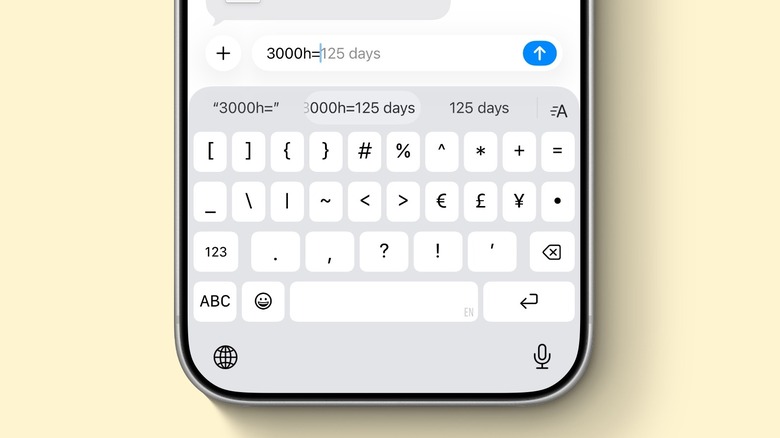
As long as you're running iOS 18 or later (iOS 26.4 is the most current iteration as of April 2026), you can take advantage of the hidden calculator feature on iPhone Messages. On a chat, trying entering an equation like 48 + 27 – 15. Once you type the equal sign, the Prediction Keyboard will give you the answer. You can also use the calculator for fractions, exponents, multiplication, division, and more.
Even if you type something like sin(90), the Messages app will show you the answer after you press the equal sign. It only remains unanswered when you start to use algebra. So if you want to solve 3x + 7 = 25 for x, you're out of luck. However, there's yet another function within this Messages feature, which is the ability to convert values.
While not as rich as say, Morpho Converter, one of the best Apple watch apps, you can input things like 300h= to find out how many days and hours there are in 300 hours. The same goes for converting pounds to kilos, Fahrenheit to Celsius, and feet to centimeters, all while using the most common conversion for the units you're entering.