

AV Receiver Vs. Amplifier: What's The Difference?
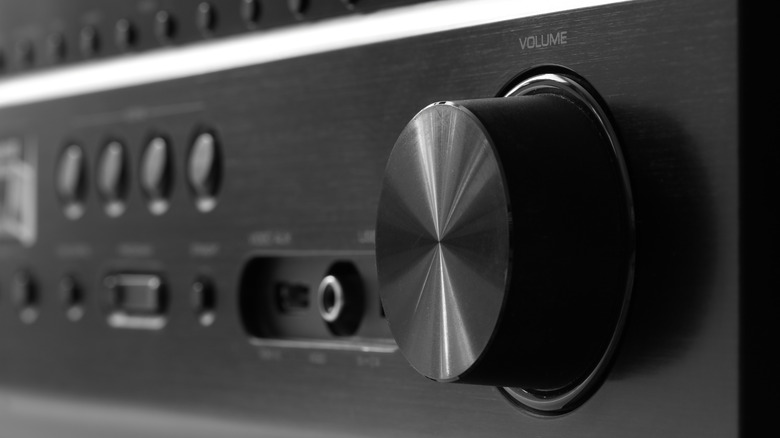
If you're considering your audio-visual setup in any detail, you've almost certainly come across the concept of an amplifier or receiver to handle the sound. But what exactly is the difference between a full-on AV receiver and a more traditional amplifier? While there is some overlap, the differences lie in how the two units handle audio processing and ultimately what each is best suited for.
In the simplest terms, an AV receiver is a unit meant to handle audio in a video-based setup — often featuring surround sound processing, HDMI switching, and more entertainment-center-friendly functionality. While AV receivers do virtually always contain an amplifier as part of their components, they do much more than just drive passive speakers. A more traditional stereo amplifier, on the other hand, seeks to deliver stereo sound to passive speakers in a high-fidelity, typically music-only setup. And while AV receivers can be solid music devices, as we confirmed in our recent roundup of audiophile-favorite receivers, stereo amplifiers are usually better tuned for straight-up audio functions.
AV receivers are all-in-one entertainment machines
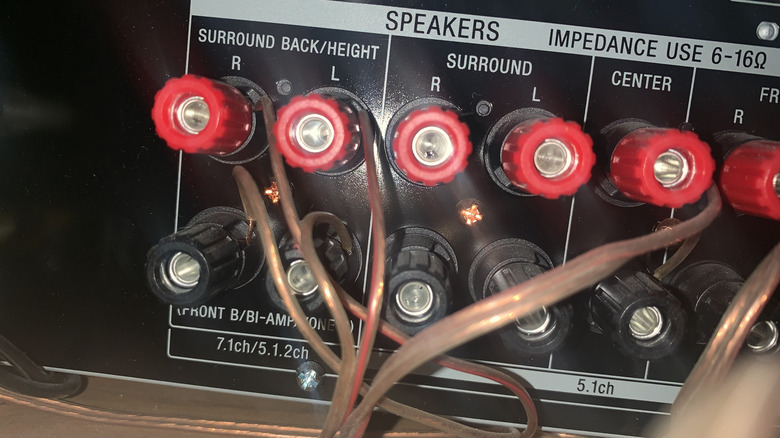
When exploring the world of AV receivers, the name already hints that there's more than audio at play — the V stands for visual after all. So what exactly sets an AV receiver apart, truly? While virtually every AV receiver does offer an audio amplifier capable of driving a certain level of wattage to your entertainment setup's speakers, it's often in support of a surround sound setup. This makes it ideal for driving audio to multiple speakers for a movie room situation, though you might need to experiment a bit to find the optimal setup for your surround speakers.
Then there are the other features inherent in an AV receiver that really make it a different animal than a standard stereo amplifier. First, there's typically a lot of video-friendly audio software processing right in the unit. This software helps to mold the sound to better fit what you're watching, often doing so with presets such as dialog emphasis, sports-centric settings, Dolby Atmos surround, and more. AV receivers also often offer HDMI connections so that you can pass your TV's video signal through and use the receiver itself as the main connection hub. This can be particularly helpful if you know how to set it up to work with your TV's HDMI ARC port.
What a stereo amplifier does well
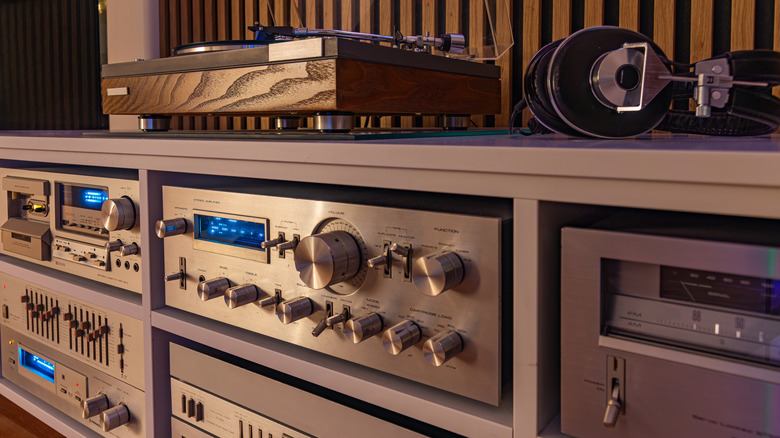
As we already alluded to, both an AV receiver and a stereo amplifier feature some amplification component. What sets a stereo amp apart is its focus on audiophile functionality and fidelity of the audio itself. An amp that's meant to drive stereo speakers often pairs well with a lossless audio or vinyl record setup, providing the right components and headroom to offer rich, warm audio for music-only listening sessions.
Often, an amplifier in a listening space is even paired with a digital-to-analog converter (DAC) that is capable of taking a library of lossless audio files and accurately converting them for analog listening (which is necessary, since actual digital binary is indecipherable by human ears). Many amp units are even combo units that feature a DAC component to ensure they work in concert. You won't find a ton of input/output routing, and typically, there's only support for stereo speakers. Though amplifiers are simple stereo devices, they often do their job really well.