

The Handheld Device That Saved A US Airman Downed In Iran, Explained
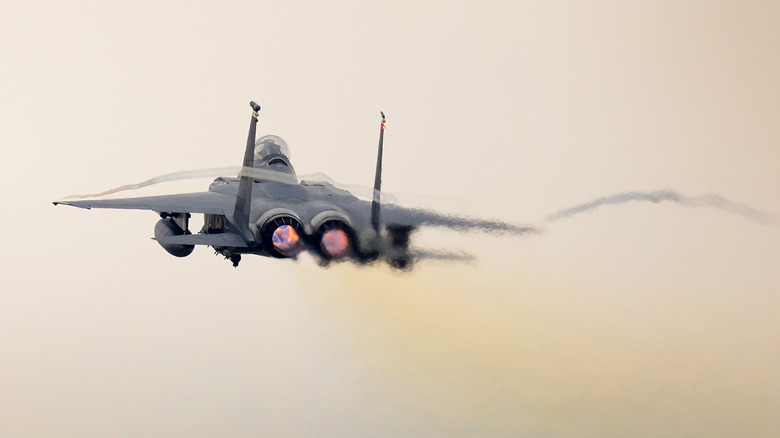
Search and rescue operations are seeing a major strategic shift spurred by a flurry of new technologies, ranging from drones to search and extraction ground robots. When a shoulder-fired missile downed an American F-15 Strike Eagle fighter jet, kicking off one of the largest rescue missions in recent memory, a GPS-enabled radio from the early 2000s may have been the deciding factor.
During the two day rescue mission, over 150 aircraft helped recover the two airman, a pilot and weapons systems operator. According to U.S. officials, the pilot was rescued within hours of the crash on Friday, while his partner, an unidentified colonel, was stranded with little more than a handgun and a communications device. After a furious 50 hours in which the U.S. fired 339 munitions, the colonel was eventually recovered from his hiding place atop a 7,000-foot mountainside, hours into Easter morning.
Following the rescue, President Donald Trump credited mission success to a little-discussed technology, claiming in a news conference, "They have a very sophisticated beeper-type apparatus that is on them at all times. When they go out on these missions, they make sure they have lots of battery space and they're in good shape, and this one worked really well — amazingly, saved his life." Air Force officials confirmed to the media he was referring to the downed colonel's Combat Survivor Evader Locator (CSEL).
How does CSEL work?
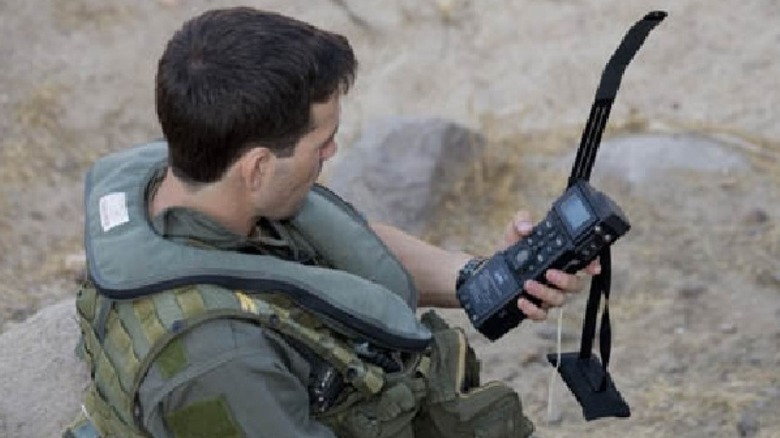
Manufactured by Boeing, CSEL is a handheld locator and emergency contact system for downed airmen that leverages the U.S. military's Global Positioning System (GPS) and radio frequencies to send signals to the U.S.'s Joint Combat Search and Rescue apparatus. To date, it is a pillar of U.S. search and rescue operations. First delivered to the U.S. military in 2009, CSEL replaced the Joint Combat Search and Rescue radio. The multi-function handset resembles a walkie-talkie or portable radio, complete with a small analog screen and a directional pad. CSEL transmits downed troop locations to one of the Air Force's Joint Search and Rescue Centers, units set up to coordinate rescue teams as part of Combat Search and Rescue (CSAR) operations .
The system transmits the location of the lost airman by pinging several military satellite constellations, including the Satellite Communication (SATCOM), Search and Rescue Satellite Aided Tracking (SARSAT), and GPS. These transmissions link isolated troops to the Joint Search and Rescue Center, who then forward communications to the rescue personnel. Its also capable of transmitting radio frequencies directly to rescuers via unsecure line of sight radio frequencies and 23 pre-programmed messages.
For hostile areas where vocal transmissions aren't possible, users can utilize terminal area communications (TAC), giving stranded troops line-of-sight communications. As 1st Lt. Matthew Renner, CSEL test engineer for the Air Force, said in a press release, this means "TAC provides the ability for the pilot flying above and the isolated person, or IP, to text message each other securely." The handset uses what the Air Force dubs terminal area guidance, or TAG. TAG essentially allows pilots and downed airmen to "ping" one another, following which a pilot's inflight systems can calculate the range and bearing of the isolated person's location.
Inside the rescue

CSEL was essential in rescuing the downed colonel. While hiding atop a ridgeline, the officer utilized CSEL to send custom messages to the rescue team. As CBS reported shortly after the rescue, although the officer was forced to go long stretches without making contact, the transponder consistently notified the rescue team about his location. These locations were enabled by an automatic setting in the CSEL's GPS, which periodically emits a signal to American satellite constellations, even when the holder goes dark. Incredibly, the CSEL system was even used by U.S. military to confirm the weapons operator's identity, with rescuers using the transmission system to ask the colonel identifying questions about his family.
Despite CSEL's helpfulness, officials credited a different technology with pinpointing the lost airman's location: a mysterious, top secret long-range spy system called "Ghost Murmur." Reportedly, Ghost Murmur utilizes artificial intelligence to detect the electromagnetic pulses of a human heartbeat. According to an anonymous source interviewed by tabloid The New York Post, which broke the story, "It's like hearing a voice in a stadium, except the stadium is a thousand square miles of desert. In the right conditions, if your heart is beating, we will find you." However, there is skepticism about the tech.
Whether the rescue actually hinged on a Mission Impossible-esque technology or a handheld GPS-enabled radio, remains unclear. Either way, the mission points to an ever-changing search and rescue landscape. Although emerging technologies, ranging from drones to AI-enhanced robotic eyeballs, will undoubtedly revolutionize rescue operations, CSEL remains a major advantage for U.S. military operators.