

If You're Buying A New TV, Don't Fall For These 3 Myths
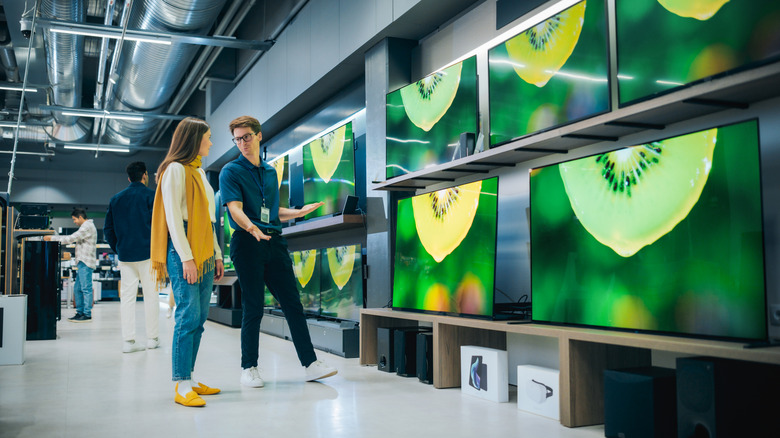
Are you planning on upgrading your TV in the near future? Naturally, you should research models and prioritize options offering key features like 4K resolution and related innovations that are increasingly prevalent in TV technology. It's also wise to familiarize yourself with certain mistakes people often make when buying new TVs. Understanding these common errors will help you avoid making them yourself. Similarly, it's critical to avoid falling for common TV-shopping myths when you're in the market for a new set.
You also need to account for practical factors like your budget. However, you shouldn't assume that the most expensive unit you can afford is always the right one to buy. The idea that spending more is always the safest way to get a quality unit is the foundation of several misconceptions surrounding buying a TV. Being aware of such myths when shopping for your next TV will boost your odds of investing in a set that's worth your hard-earned money.
Myth: You need the newest model available

New doesn't always mean significantly better in the world of TVs. Generally, it's smart to research your options and learn about their specs and features. There certainly may be instances when the newest model represents a substantial improvement over what came before.
That said, it's not uncommon for a new model to boast only minor upgrades compared to the model that came before. Keep this point in mind if you're looking for a quality TV on a somewhat tight budget. By comparing last year's model to this year's equivalent, you might find that the differences between the two aren't substantial enough to justify spending more money on the latest unit. If you can get last year's model at a discount without sacrificing features that are important to you, this might be an option to consider. In addition, if you want to save quite a bit of money, you can research smart TVs under $100 that nevertheless receive positive reviews from customers.
Myth: A larger screen always offers a superior viewing experience
The average size of a TV screen has grown over the years. According to Statista, in 2009, TVs greater than 49 inches accounted for only 7% of global TV sales. In 2019, they accounted for 33% of TVs sold throughout the world. Up until recently, a large TV was a minor luxury. Thus, many consumers are still essentially programmed to assume that the bigger the TV, the better the overall viewing experience.
That's not necessarily the case. A large screen in a small room can make watching TV overwhelming if you're not able to sit a comfortable distance from the unit. For an ideal experience, measure the distance from where you plan on installing your new TV and where you plan on sitting when watching it. Find a TV size-to-distance calculator (you can easily find several online) and use it to determine what size is right for your needs — you might be surprised at how small that turns out to be. Although you can also discuss this topic with a sales associate, be aware that they may be incentivized to steer you in the direction of the most expensive set for your budget. As a consequence, they may suggest a TV that's larger than necessary.
Myth: You need 8K resolution
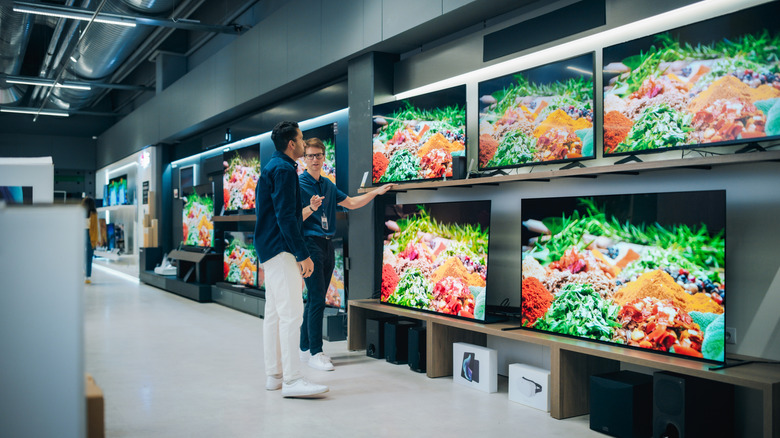
Is 8K resolution technically superior to 4K? Yes, but that doesn't necessarily mean you should lean in the direction of an 8K model, even if you can afford it. The problem right now is that there simply isn't much true 8K content currently available. Content that's been upscaled for 8K won't take full advantage of the technology's full potential, so you'll essentially be spending money on a feature that you'll only actually enjoy on occasion.
All that said, you also need to remember that, beyond the technical details, what makes one TV better (for you) than another often comes down to a matter of taste. Being aware of these myths will help you avoid making mistakes that could result in buying the wrong TV for your goals, budget, and living space. Still, when exploring your options, it's worth taking the time to consider which units make the strongest impression on you. Avoiding common missteps while accounting for your own preferences is key to buying a TV you'll be more than happy with.