

The World War 2 Boeing Aircraft That Inspired The Millennium Falcon's Legendary Cockpit
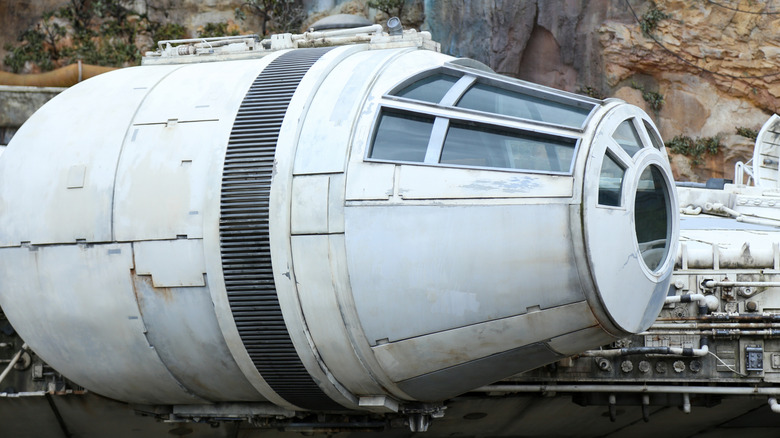
Isn't the Millennium Falcon cool? The legendary "Star Wars" craft, ridden by Han Solo and Chewbacca, has its own long history if you ever decide to broach Wookiepedia. Like most aspects of the original "Star Wars", it's heavily inspired by real life. In the case of the Millennium Falcon, that inspiration comes from the Boeing B-29 Superfortress.
One of the biggest aircraft in the US Army's fleet, the B-29 saw heavy use in World War 2, with 3,970 built between 1943 and 1946. The cost was extraordinary and would go on to surpass costs of The Manhattan Project by some 50%. Thankfully, Boeing's wartime project didn't lead to the creation of a massively contaminated nuclear location in the process. Hugely complex and featuring an arsenal of weapons, the B-29 became America's go-to plane for major operations, including dropping the atomic bomb on Hiroshima, Japan.
It would also go on to inspire an icon of sci-fi movie history, the Millennium Falcon. Though the set for this "Star Wars" ship no longer exists in its original Wales location, there is an exhibition that displays key information about how a dockyard that hadn't been active since 1922 became home to Han Solo's ship.
Han Solo would have been right at home in a B-29
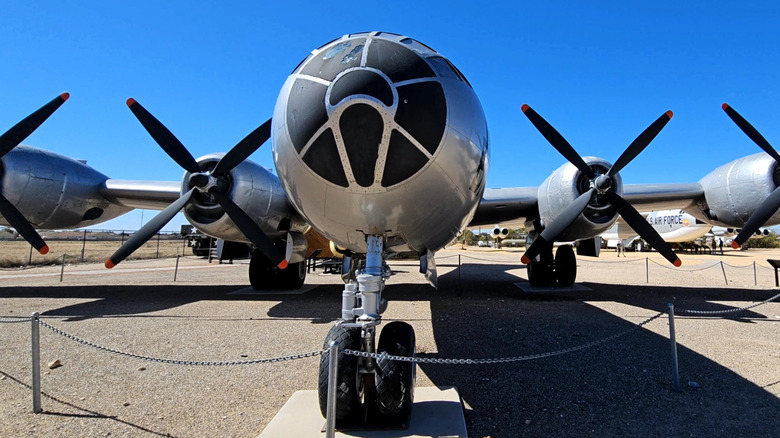
When you take a closer look at the Boeing B-29, you'll find that quite a lot of it matches the Millennium Falcon, just as George Lucas intended. Namely, it's cockpit, with the same rimmed cone that is a direct inspiration. Original concept drawings feature a note about getting closer to the B-52, though this is widely thought to be a typo as that Boeing aircraft had a far different cockpit.
Real aircraft switches and toggles were used for the Falcon's cockpit, and there are also clear similarities with the real B-29 and the small area Luke sat in while firing on TIE Fighters. That large dome-style cockpit was for more than just sightseeing, though. The pilot would be able to look directly at where they were targeting, especially during a bombing run.
An old training video of the B-29's turret system could also have inspired the creators of "Star Wars". It housed an early computer, which calculated variables for where to shoot. The soldier at the turret would then use a tracking apparatus to guide the calculations based on the target. A small wheel could also adjust the reticle, showing an image not too different from what we see on the tracking devices in the "Star Wars" films.
Other inspirations behind the Star Wars universe
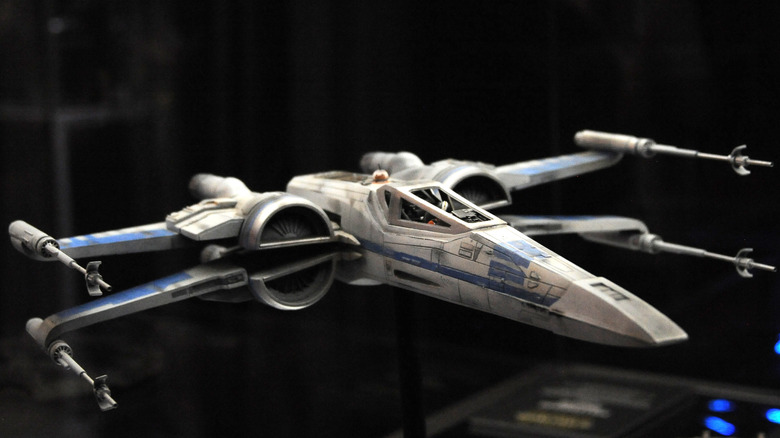
While the Millennium Falcon took its cockpit design from the Boeing B-29 Superfortress, the creator of the iconic "Star Wars" X-Wing was inspired by a dart game in a pub. And inspirations for other "Star Wars" vehicles come from far broader backgrounds than just World War 2. The ship piloted by bounty hunter Boba Fett — who could see action in one of the exciting "Star Wars" shows currently in development — was based on street lamps found in Northern California.
Going the other way around, George Lucas felt that the final designs of the droid lander ships were remarkably similar to the bi-planes used in World War 1, as opposed to the ship anchor and dragonfly that had inspired it originally. It should also be noted that many of the guns found in the original "Star Wars" film from 1977 were based on actual weapons. Princess Leia's pistol pulls its design from the Margolin, a Russian .22 caliber training pistol, and Rebel blasters were built from molds of the Sterling machine gun.