

Why Do Rockets Curve Instead Of Shooting Straight Up At Launch?
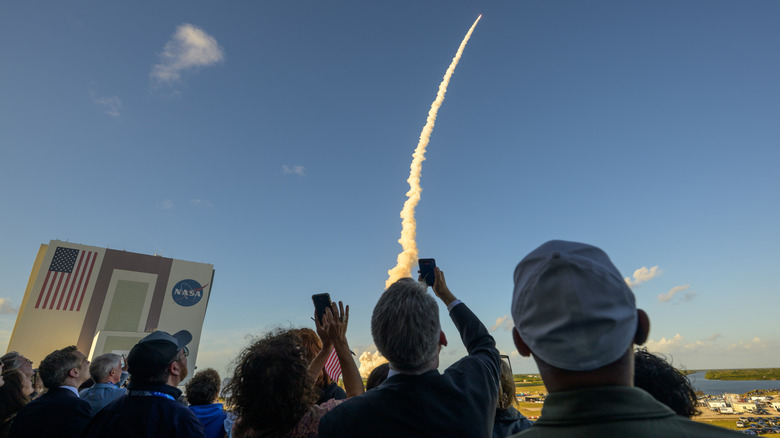
At some point in your life, you've probably watched a rocket launch straight up into the sky. You may have even watched Artemis II's Orion spacecraft quickly reach space, kicking off NASA's most important mission in decades. However, you may have also noticed that, after lift off, the rocket doesn't stay vertical. As the spacecraft gets higher, it begins to curve, even appearing to fly horizontally, parallel to the Earth. That may seem counterproductive for something headed out of the atmosphere and into outer space, but it's actually an essential part of a rocket's journey. And it involves fuel.
Rockets, like other flying machines, are working against gravity. It needs as much thrust as possible for its initial liftoff, which is why they start out vertical. However, that also consumes a massive amount of fuel. Staying that way for too long would burn through its supply and send it plunging back down to Earth. That would be disastrous for both the crew and anyone unfortunate enough to be at the crash site, so rockets need to curve to save fuel, resist gravity, and reach orbit.
Rockets use a gravity turn to reach orbit
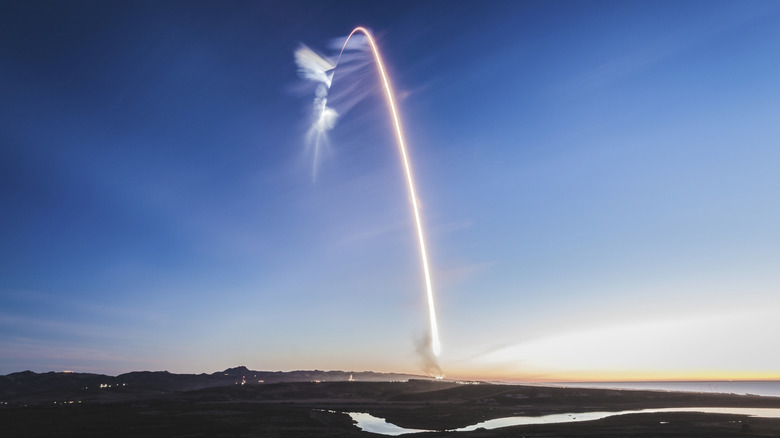
Once they get through the thickest layers of the atmosphere where gravity is at its strongest, rockets curve so they can use it in their favor. This is known as a gravity turn. It's important to remember that the Earth's gravity pulls objects towards its center, not just down. By rotating until the heavier side is facing the ground, rockets are able to increase their acceleration using gravity instead of fuel to reach orbit.
Technically, orbit is when the spacecraft's horizontal acceleration and the pull of gravity balance out, essentially falling without reaching the ground. For many missions, that's the goal. But in the case of Artemis II, which took astronauts to the moon for the first time in over 50 years, Orion needed another maneuver called the translunar injection burn to leave Earth's gravity and reach deep space. From there, the spacecraft later used the moon's gravity to shift its trajectory back towards Earth, allowing the four Artemis II crew members to safely return home with colorful new discoveries.