

A New Quantum Breakthrough Could End Submarine Stealth For Good
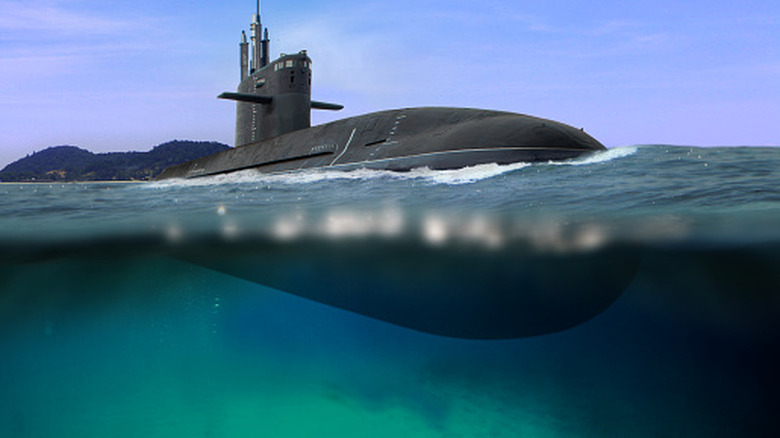
Submarine stealth has always represented the most intuitive form of clandestine traversal. What better way to conceal your movements than to hide under 1,000 feet of ocean water? Traditional countermeasures have relied on acoustics, like active or passive sonar (which is also one of the ways subs navigate) and sonobuoys, or good old-fashioned visual detection, searching the waves for a submarine's distinctive silhouette, scanning for its wake, or even watching for bioluminescence stirred up by a sub's hull.
The limitations of those methods are pretty self-evident. The whole purpose and science behind a submarine is to hide from sight, making visual detection challenging under the best conditions. And acoustic detection can be counteracted by running quietly, or coating a vessel in a material that absorbs sonar.
That's why stealth detection research is pivoting to quantum mechanics. Taking advantage of the unique properties of quantum physics, these new methods are capable of detecting the slightest disturbances in the Earth's gravity or magnetic field, anomalies produced by even the most advanced nuclear submarines. They also open up the possibility of detecting concealed vehicles at a far greater range than sonar or other techniques.
The quantum revolution
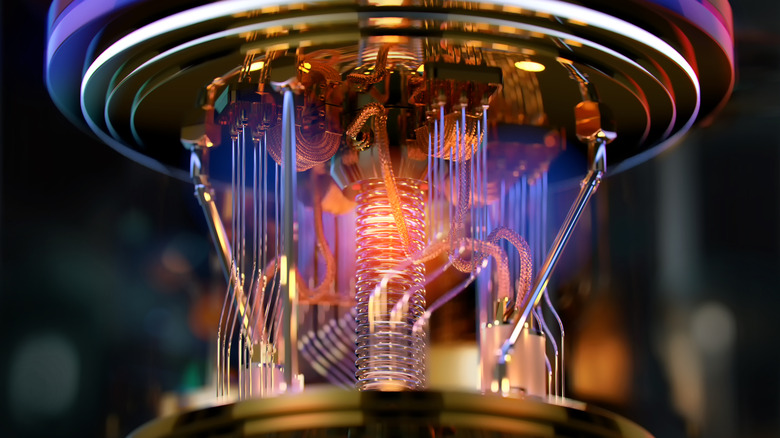
Two of the major tools at the forefront of quantum sensing are quantum magnetometers and Superconducting Quantum Interference Devices (SQUIDs), both designed to detect even faint magnetic anomalies that would indicate the presence of a concealed metal vessel. A magnetometer works using certain quantum states of atoms or defects to sense magnetic fields. The "spins" in particular atoms act as mini-compasses. Magnetic fields influence this spin, creating wobbles, which are then measured with lasers at an incredibly precise level, enabling a quantum magnetometer to detect magnetic fields billions of times weaker than a small fridge magnet.
SQUIDs take a slightly different approach. They're made of tiny loops of supercooled metal wire that's highly conductive, connected by weak links called Josephson junctions. This combination of properties allows electricity to flow through them with very little resistance. When magnetic fields flow through the loops, they interfere with patterns in the electric currents. Keeping the loops in a supercold state allows them to detect even the faintest magnetic "whisper." Quantum gravimeters also rely on extreme cold.
They work by supercooling a cloud of rubidium atoms in a vacuum with lasers, driving them down to near absolute zero. In this sluggish state, the atoms are then pushed upwards (also with lasers), causing their quantum wave to split into two paths. When they fall and recombine, they create interference, like ripples overlapping in a pond. By analyzing those ripples, researchers can find gravity's strength down to millionths of a gal (a measure of acceleration). Discovering small dips in gravity's strength can expose hidden tunnels or other underground masses — or a submarine displacing water as it passes through the ocean depths.
The detection race

While most of these technologies are still in the prototype stage, recent advances have revealed that some nations have a leg up in the detection race, which could define the future of espionage and covert warfare. Chinese researchers have had success with drone-mounted quantum sensors designed to overcome a flaw in traditional magnetic detection methods. In some low-latitude bodies of water, like the South China Sea, these methods are less reliable because of the way the Earth's magnetic field runs parallel to the surface. This creates blind spots where vessels could conceal themselves or evade detection from traditional sensors.
The new system takes advantage of a technology called a Coherent Population Trapping (CPT) atomic magnetometer like the one described above. It also uses clouds of rubidium atoms as its medium, and scans for disturbances in the atoms' energy levels, indicating the strength and direction of a magnetic field. Critically, the Chinese system matches the performance of NATO's Magnetic Anomaly Detection-Extended Role (MAD-XR) system, but at significantly lower cost.
The CPT system can also be effectively deployed using only a single unit, unlike NATO's solution, which requires multiple probes. While submarines are unlikely to be rendered obsolete by these advances, they may force the world's navies to adopt new strategies to avoid detection. Subs may become more compact, add active jammers to baffle the quantum sensors, or even deploy swarms of drones to camouflage their movements.