

WOLED Vs. QD-OLED: Which Display Type Is Best For Your Monitor?
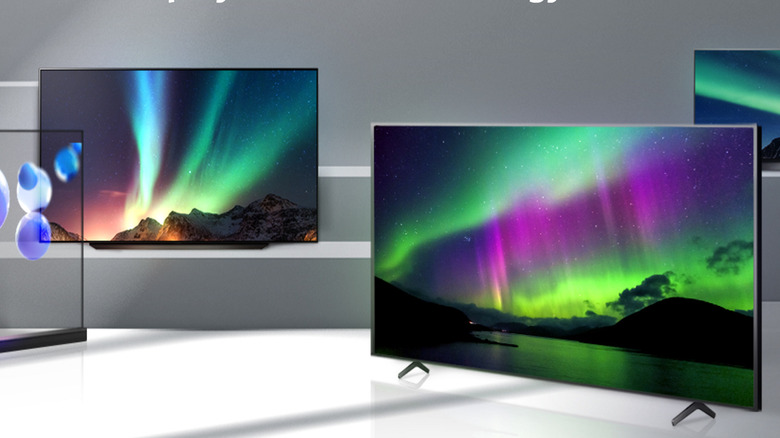
Despite OLED having a handful of disadvantages, OLED monitors have exploded in popularity recently, and it's easy to see why. Delivering some of the most vibrant colors and deepest blacks of any currently available display tech, seeing is truly believing. Once you've had a taste of OLED clarity and fidelity, it's hard to go back to a bland LCD panel. That said, with all the variants and iterations on OLED tech, you'd be forgiven for not knowing the difference between the two dominant panel types, white OLED (WOLED) and quantum dot OLED (QD-OLED).
Both deliver that OLED magic in slightly different ways; ultimately, which is best for your monitor will come down to what you intend to do with it. Neither standard is objectively better for all settings and users — typically, gamers will probably be better off with QD-OLED, particularly in dark rooms, while for productivity, WOLED has a slight edge with its superior ambient light rejection, clearer text, and sustained brightness. For mixed use, a little more clarity is necessary.
WOLED vs. QD-OLED: How they work
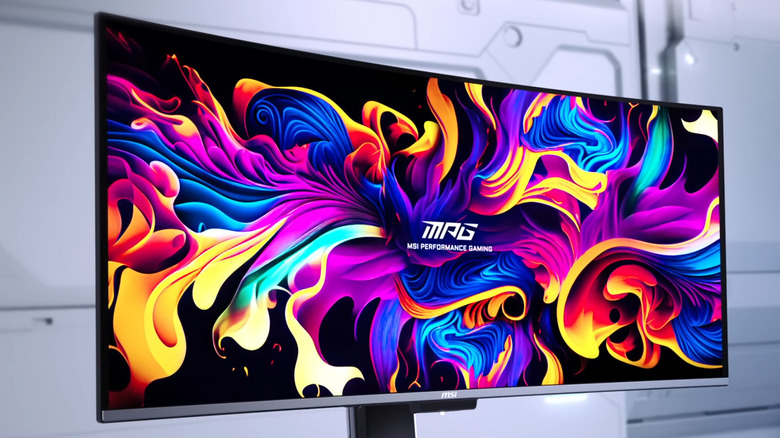
WOLED starts by putting a white OLED emitter behind a panel's red, green, blue, and white subpixels, the subcomponents of each physical pixel that can reproduce nearly any color by adjusting the intensity of each. The white subpixel's job is to boost overall brightness by passing unfiltered light, but the color filters on RGB subpixels slightly dilute saturation. This means WOLED works well in bright rooms because of its ability to produce high-luminance whites and better black levels.
WOLED also shines in bright environments because most WOLED panels make use of a polarizer to handle ambient light (something most QD-OLED panels lack). When ambient light hits the screen, the polarizer filters it out, blocking a lot of it from reflecting back. Newer WOLED panels also often include an anti-reflective coating that's capable of cutting total reflectance by up to 30% and diffusing glare.
By contrast, QD-OLED uses a blue OLED emitter. The light from the emitter excites green and red quantum dots, tiny nanocrystals that emit colored light based on their size, to make pure RGB light with very little waste. This technique produces purer, richer colors than traditional filters, and better color volume, how well a panel can reproduce a broad range of colors at varying levels of brightness. A QD-OLED can show vivid reds in both darker scenes and at high brightness (bright highlights), without colors looking muddy or desaturated.
The best match depends on use case
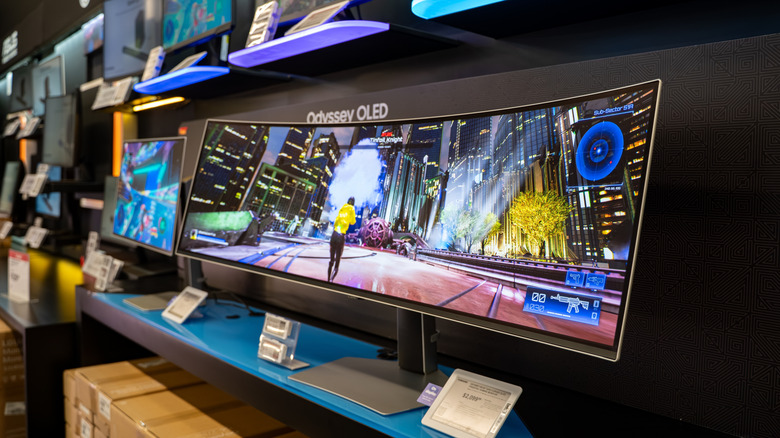
If you're primarily using your monitor in a dark room and don't have to contend with glare, QD-OLED is probably a better fit, with its explosive colors and infinite contrast. QD-OLED panels also tend to look a little smoother when rendering high-motion scenes, like sports or gaming, because of that tidy triangle of blue, red, and green pixels, with no white ones to muddy things. WOLED's addition of a white pixel can result in color fringing, an outline or glow around the edges of some objects, and some stuttering in fast-moving panning shots or frenetic action sequences.
However, if you're mostly using your monitor in a bright office, WOLED is probably a better choice. It's a better technology for handling ambient light and glare, and the blacks on most WOLED screens won't appear grayish unless they're in direct sunlight (while a QD-OLED can shift noticeably in lamp light or under windows). If you're doing a lot of typing, a WOLED will ensure consistent brightness without purple shifts, the phenomenon where a screen looks purplish or magenta when you're viewing it from an angle.
That said, QD-OLED is also a slightly better option for any creative work that's color dependent, due to that brilliant color volume mentioned above. If you tend to use your monitor in a lot of different scenarios and are still torn about which panel technology would be best, consider this quick rule of thumb: QD-OLED is best for immersion, while WOLED is better for versatility.