

Why Supercomputers Use Linux Instead Of Windows Or macOS

Linux will turn 35 this year, with the free and open source operating system launching in 1991. Linus Torvalds created the Linux kernel, and since then, it has been built upon by an army of programmers. In those 35 years, Linux has gone from a niche project to one of the most installed operating systems of all time, partially thanks to the thousands of variations of distributions available. It has also become synonymous with the supercomputer sector of the tech world.
Key to Linux's success in this realm is that it's open source. That means it can be used either commercially or privately for free, however the developer sees fit. With that in mind, having no overhead cost on the core piece of software used to run their servers is immensely appealing to operations building out a supercomputer.
Linux has become even more popular in recent months, with half a million Windows users shifting to it in 2025. While it's been gaining traction for home users, Linux has been the go-to for powering supercomputers across the world for decades. Microsoft even uses Linux to power some of its Azure Cloud services. So why is it that supercomputers tend to stick with something like Linux over Windows or macOS? It all comes down to flexibility, and being flexible is one of the things Linux can do that Windows 11 can't. And, of course, Macs are notorious for being virtually unchangeable (though that's a bit of a myth).
Why do supercomputers use Linux?
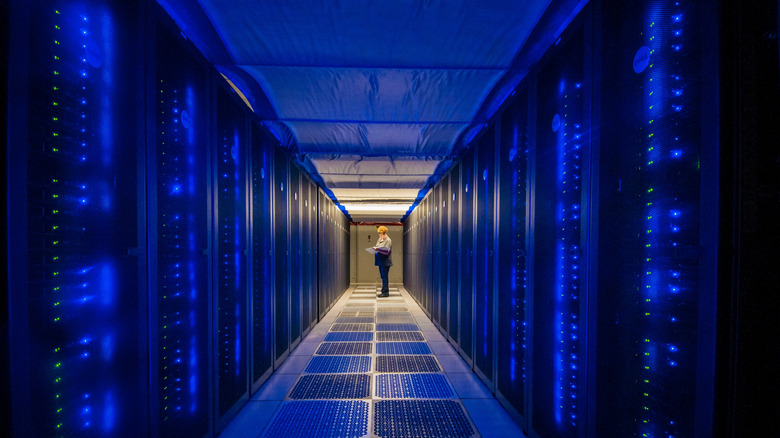
Outside of the open source codebase and being free, Linux is incredibly flexible. It can be scaled to fit almost any project, including embedded systems, giant server farms, and even microcontrollers. With that level of customization at the developer's fingertips, it's only natural to go with what they can shape. This is why, despite Linux being the most-installed operating system on these types of machines, there's still no standard distro to install on a supercomputer. Instead, think of Linux as the baseline, and then operators will customize it to the specifications of the job.
Supercomputers are used for massive calculations, simulations, and other data-intensive tasks. Some are even used to calculate the end of the world. Not only are some versions of Linux far more lightweight than competing operating systems, but they're also significantly better in the areas regular users wouldn't really have to consider. For example, task scheduling tends to be faster and more secure on Linux than on Windows, at least partially due to how the two are developed. Linux has thousands of individuals poking at it every day, trying to find ways to improve the OS or components of it in some capacity, even if it's a microsecond faster, while Microsoft takes a slower approach, or not at all.
Being able to build out a supercomputer to fit the job at hand is of paramount importance over almost everything else. If an OS can't be scaled or pivoted to a new task easily, then it's functionally an albatross around the neck that could bring down the project. Without that level of flexibility and openness, a lot of the world's supercomputers would be a much more rigid, frustrating experience for those who have to use them.