

PlayStation's 5 Weirdest Controller Ideas Ever
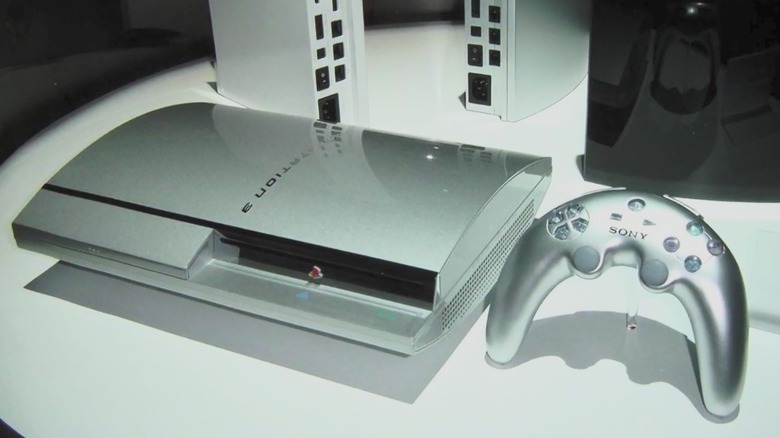
It's no secret that we love the PlayStation 5 DualSense controller. We think it's the best gaming controller currently on the market. The controller is sleek, comfortable, and many developers sneak in additional functionalities, such as sounds that play through the DualSense's speaker. The controller is the culmination of five generations worth of advancement and weird ideas.
Throughout its life, the PlayStation has been home to (or the inspiration for) some strange controller designs. Remember when Capcom partnered with Nubytech to create a novel chainsaw-shaped controller (complete with sound-activating ripcord) to celebrate the release of "Resident Evil 4?" Or when Capcom collaborated with Hori to manufacture a katana-shaped controller to go with "Onimusha 3: Demon Siege?" Fun times. But these are nothing compared to Sony's weirdest controller ideas. The company has manufactured and even toyed around with strange controller concepts that make playing a game with a toy chainsaw sound positively banal.
Here are some of Sony's weirdest controller concepts. For this article we will only cover controllers that were (or would've been) first-party products, so no UltraRacer PS1 or Wu-Tang Shaolin Style controllers here.
PS5 Access Controller
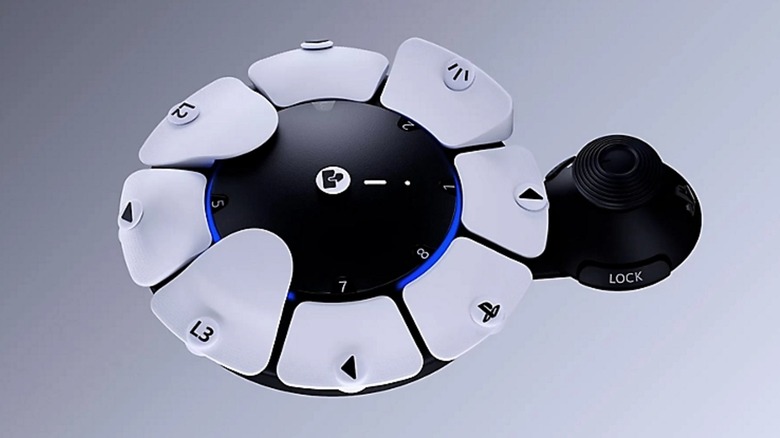
Most of this article will consist of controller concepts that were too weird to make it to production (so far), so let's start out with a strange idea that you can buy right now. Just because something is weird doesn't mean it isn't helpful.
The Access Controller is Sony's proprietary controller designed for people with disabilities. Customizability is the central philosophy behind this device, as every "button" and "trigger" is a paddle you can alter and orient to suit your specific needs. The same is true for the joystick. Although the Access Controller only has one, you can overcome that shortcoming by combining it with other controllers — including another Access or standard DualSense.
Admittedly, the Access Controller looks weird to the average gamer because, to be blunt, we take our full range of finger and arm motion for granted. Sony worked with accessibility consultants to fine tune the Access Controller's functions and shape to work with people who have various disabilities, and judging by videos people have posted using the peripheral, it works as advertised. Sony is hardly the first company to develop features for people with disabilities — Apple added accessibility functions to many of its devices — but the Access Controller is necessary for people with limited hand mobility that still want to play "Horizon: Zero Dawn."
Controller with deformable buttons
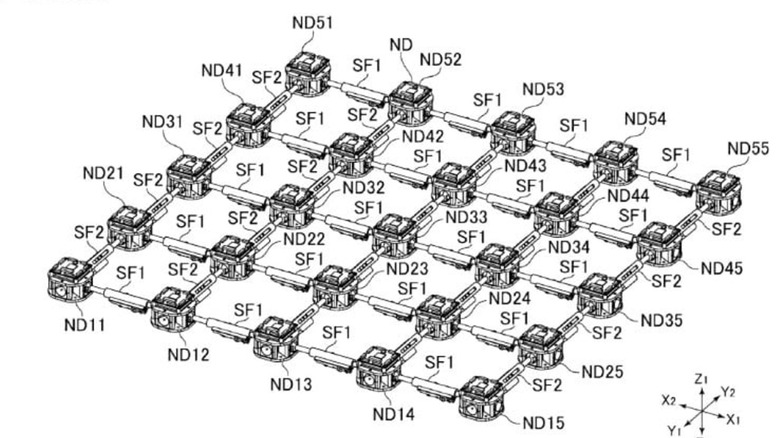
From here on out, this article will discuss controller concepts that either were too weird for release or Sony has yet to finalize. Case in point: One of the company's newest patents tries to turn buttons into components that aren't quite buttons but still are.
Recently, the outlet Cheat Happens uncovered a patent for a series of "deformable buttons" that would be arranged on a "grid-shaped controller." According to the patent, users will be able to twist, push, and pinch (ew) the buttons — for instance, instead of pressing the X button to make a character jump in a game, players would instead pull it. However these components will also push back since the buttons can deliver "force, weight, impact, and vibrations" to provide haptic feedback, and these would all "dynamically simulate sensations" from gameplay.
The patent and its description read like Sony is trying to make the lovechild of a DualSense controller and back massager with a deforming cloth sheath — or a Bop It, depending on how you read the patent. Could the aforementioned buttons only make up a small part of the controller (e.g., the face buttons), or would they be arranged on the grips? Would the controller be nothing but buttons that reform to create the silhouette of a standard controller? The design is so out there that we have trouble grasping the concept.
Fully touchscreen controller
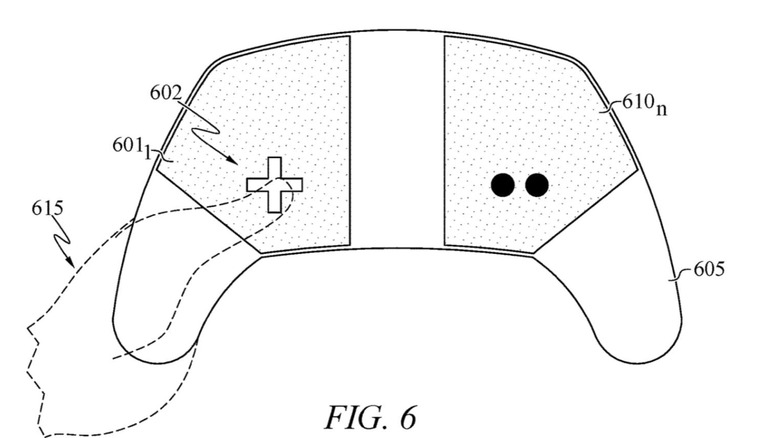
In order to play video games on a tablet or smartphone, you often need to swipe and tap on virtual thumbsticks and buttons onscreen. Accessories like the Backbone Pro let you slot physical controllers into your device, but nine times out of ten, you're limited to onscreen controls that rub against your skin. Once upon a time, Sony thought this was the future of gaming. Or maybe it still does.
In 2023, Sony filed a patent for a controller that's all touchscreen and no physical buttons. Apparently, the idea was players could use the touchscreen to customize the controller layout however they choose. They want to create a left-handed controller where the main face buttons are on the left side? All they have to do is slide the buttons over on the screen. The device would even let players resize buttons, just in case they prefer the layout of the Nintendo GameCube controller.
On paper, the idea has promise, but what makes the controller so weird is why Sony thought it would be a good idea. History has shown that gamers generally prefer physical buttons — it's why a market for devices like the Backbone Pro exists in the first place. Plus, physical controllers are generally more accurate than virtual buttons. Even if Sony makes this controller, it would never be able to compete with a physical device, especially one with Hall Effect or Tunneling Magnetoresistance joysticks. Now if Sony took inspiration from the Turtle Beach Stealth Pivot or Thrustmaster ESwap S Pro controllers, that peripheral could work.
Hybrid Move controller
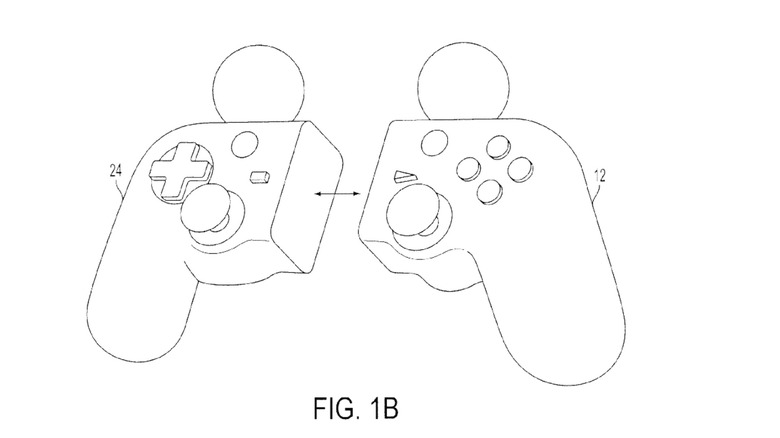
The Nintendo Switch and Switch 2's Joy-Con is a novel controller design. Who ever thought two halves of a controller that could snap together to form a larger controller or the sides of a handheld device could be so fun? Sony did, apparently.
In 2011, Sony patented a controller that could split apart into two separate controllers. The basic idea was that they normally formed a whole Sixaxis controller (the controller Sony designed for the PlayStation 3) but could decouple into two separate PlayStation Move controllers. However, the company didn't quite nail down how to secure the controller halves. Judging by the patent's pictures, Sony was toying with ideas such as a twist-and-lock and a rail system.
Sony's concept (which obviously never came to fruition) was admittedly ambitious, but what was the endgame? Did Sony want to go all in on the PlayStation Move for the PlayStation 4 and wanted to develop a device gamers could use for all titles regardless of control method? Were the balls on the end (a big part of all Move controllers) supposed to be a precursor to the light bars in DualShock 4 and DualSense controllers? And more importantly, why did Sony abandon this idea? We have so many burning questions.
Prototype PS1 Controller
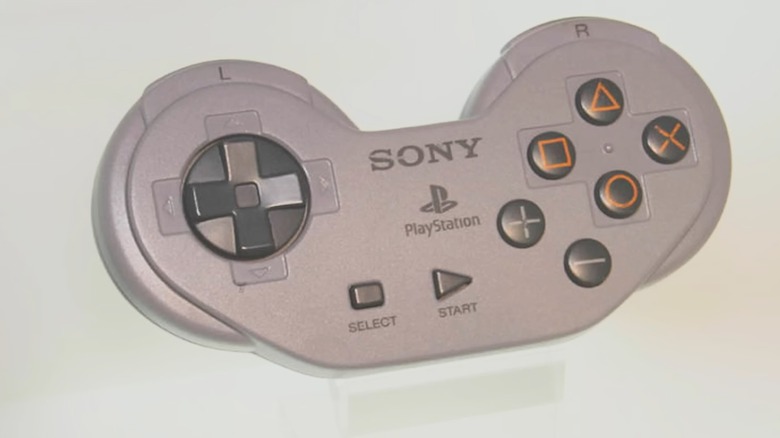
Anyone with even a modicum of video game history knowledge knows the original PlayStation began life as a collaborative console between Sony and Nintendo. This is why the original prototype controller looked like a Super Nintendo controller. But after Nintendo reneged, Sony had to create its own console and peripherals, and since the company had no experience doing that, it came up with many weird designs.
Arguably the most infamous (and strangest) prototype for a proper PlayStation controller was one of if not the first development kit controllers. Like the finalized controller, this one had a d-pad and face buttons — analog sticks weren't added until 1996/1997 — but it lacked the DualShock's iconic gripping prongs. However, the controller had six face buttons (not including Start and Select), and its main gripping surfaces were two circular areas that faced towards the console instead of away from it.
Let's be blunt: This prototype controller looks like it was uncomfortable to hold. It doesn't matter whether a device has prongs or not, as the best ones have d-pads, buttons, and other components that sit above where the palm would rest on the controller's underside. PlayStation's first stab looks more like a backwards Sega Genesis (and by extent Sega Genesis Mini) controller. And what's with the extra two buttons near the main four face ones? At least when third-party controller manufacturers add extra buttons, they're usually placed in areas that don't get a ton of traffic. Had Sony gone with this design, gamers would probably have been turned off, because six face buttons is two too many.