

Aircraft Carrier Power Explained: Why New Ships Need Giant Generators
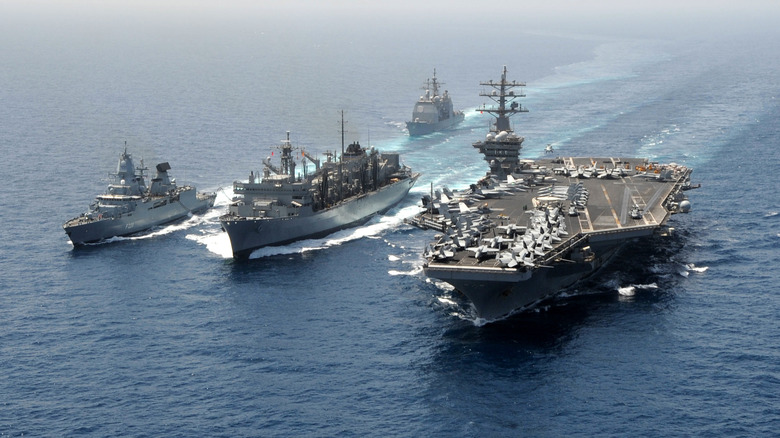
When you're onboard what is essentially a massive floating city, isolated in the middle of the ocean, logistics like resupply can be a massive nightmare. Refueling is also staggeringly expensive. A conventionally powered aircraft carrier like the (now retired) USS Kitty Hawk requires up to 700,000 barrels of oil a year. At the current price of oil, $83.46 per barrel, that's more than $58 million per year, or slightly over $160,000 every day. Conventional fuel also takes up a massive amount of space, and coordinating delivery and refueling with supporting vessels adds further logistical challenges and expense. With all those factors in mind, the appeal of nuclear power becomes pretty obvious.
Nuclear reactors can operate for 20 years or more without ever needing to be refueled (though when necessary, that refueling process is a huge undertaking), and they're also smaller than traditional generators and their required fuel stores. However, new power requirements for increasingly sophisticated systems are demanding more and more power, which means larger reactors. So how do they work, and what's drawing all that power? Let's dive in.
The basics of nuclear power
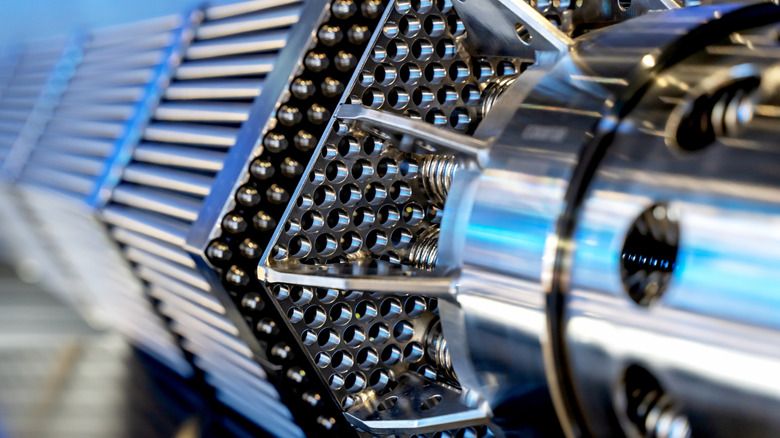
In a sense, nuclear power is actually delightfully steampunk. A nuclear pressurized water reactor (PWR) works by splitting enriched uranium atoms through nuclear fission. Water is kept at high pressure so that it won't boil, even at extreme temperatures. That pressurized water is then fed into the core of the reactor, which superheats it before passing it on to a heat exchanger.
The exchanger allows the water to pass its heat to a secondary loop of non-pressurized water which does boil, generating blasts of steam that drive turbines. Those turbines are attached to systems like the propellers that move the vessel through the water, or to electric generators that transform the kinetic energy into electrical energy to power various systems.
Meanwhile, in the reactor, control rods absorb excess neutrons produced during nuclear fission to regulate output. After the steam has done its job, it's recaptured by condensation and recycled back into the system so it can be reused, creating a continuous cycle. PWRs are popular because they avoid boiling water inside the reactor itself, which can cause instability, and they concentrate all radioactive material safely inside the primary loop, reducing the possibility of leaks or contamination.
Why reactors are so large
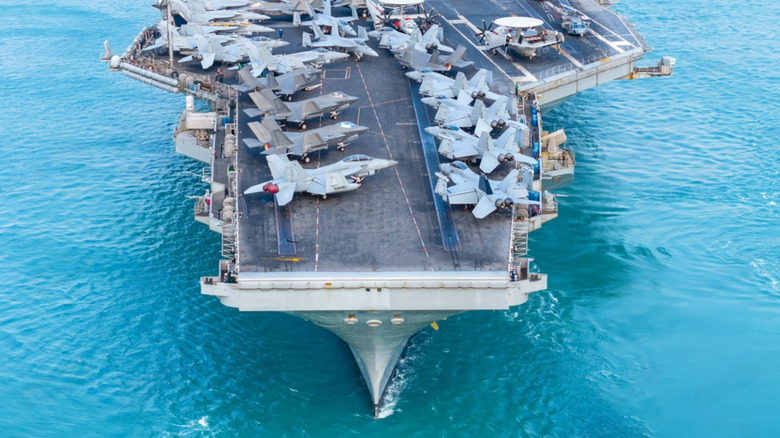
The main reason that modern reactors/generators have to be so huge, and pump out so much energy, is that the demands of a modern carrier are so much steeper than older ships. As you can imagine from a vessel housing between 60 and 90 aircraft and carrying more than 4,000 people, even older carriers required absolutely massive amounts of power. That demand for energy has continued to increase with the incorporation of modern technology and weaponry.
Take the electromagnetic aircraft launch systems (EMALS), for instance. It's the catapult system that allows aircraft like fighter jets to launch from the deck of a carrier despite the short runway. Where old versions used high-pressure steam, EMALS use electromagnetic force generated by a linear electric motor stretched out along the flight deck. EMALS allow for much finer control over aircraft speed and acceleration than their predecessors (meaning less structural stress on aircraft), and eliminate the need for the large mechanical braking systems used in steam systems. However, as you've probably gathered, they also use significantly more power than steam alternatives, up to triple the voltage.
EMALS are just the tip of the iceberg. Modern carriers also need to provide power to highly advanced sensor and radar arrays, weapons elevators, and an advanced arresting system to help "catch" returning aircraft without damaging them. There are also more mundane concerns, like lighting, HVAC, and desalination. In the latest generation Ford-class carriers, energy is also required to power futuristic directed-energy weapons, like prototype solid-state lasers for disabling or destroying hostile drones. It's easy to see why these cutting edge carriers require massive reactors with compartments on the scale of small buildings.