

Star Wars Technology That Actually Exists Today
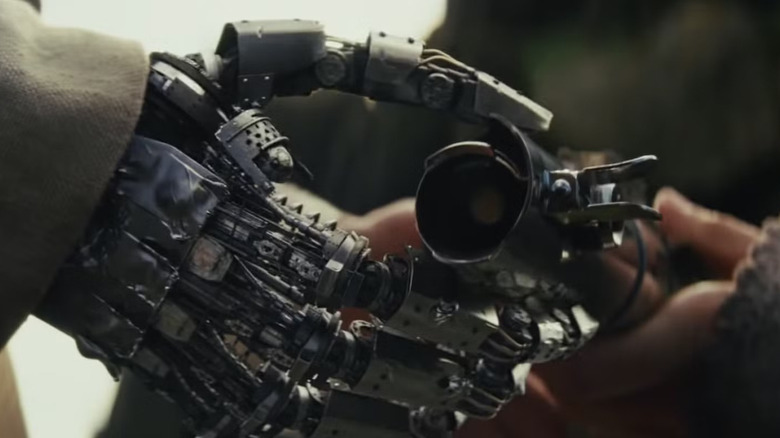
"Star Wars" might not be the most scientifically accurate space-faring franchise around, but some of its technology has made it past the point of fiction. Yes, the stories from a long time ago, in a galaxy far away, might not feature as fleshed-out tech as its competitor "Star Trek," but there are some shockingly familiar concepts. From holograms to land speeders, we're actually almost toe-for-toe on ideas once thought to only exist in science fiction.
Technologically speaking, we're even ahead in some cases. There's quite a bit of debate about whether paper exists within the "Star Wars" universe — there was never a scene where someone from the Empire had to file an incident report after the Death Star blew up, after all. But in the real world, people have made strides to replicate "Star Wars" tech, with the host of YouTube channel Hacksmith going as far as creating a 4,000-degree plasma-based "lightsaber" of his own.
Publicly, no one else has made something quite like this, so we aren't officially including Hacksmith's garage-made lightsaber in our list. But with modern advances in technology rapidly changing every day, it won't be long before the list contains references to an actual X-Wing or plasma blaster.
Our holograms are better than the ones in Star Wars
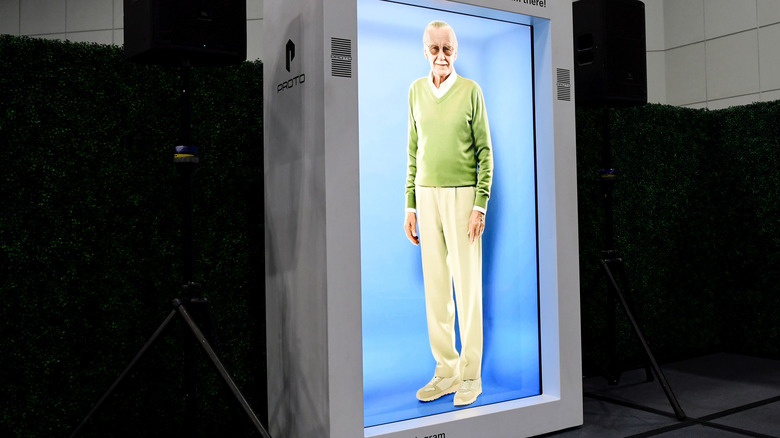
It's funny that "Star Wars" holograms always look like they need a good smack on the side, like how dad used to fix the TV in the 1990s. The once-future tech has been with us for a number of years now, with productions already using it on a regular basis. Holograms showing dead individuals have become something of a gag, but it's still impressive to see how far along the technology has come since a holographic Tupac took the stage in 2012. Last year, technology that would allow us to touch holograms was debuted.
Now, as the tech gets cheaper, we've seen it make its way to our desks as well. Companies like Razer are pitching what amounts to a fancy Amazon Echo, featuring your choice of animated character beamed out of a small device. You won't be asking them for help in your rebellion, but they might be able to tell you the time.
With some stars now aging out of the live stage era of their lives, groups like ABBA are also turning to holograms. Yes, "Star Wars" used them for communication, but we're using them to listen to "Lay All Your Love On Me." Kiss also plans to debut these in 2027. The rock group announced that it would be transitioning to an all-digital band in 2023, later selling its music and face paint designs to the same company producing ABBA's holograms for $300 million in 2024.
No need for mirror tricks, hovercrafts are just speeders

When Luke Skywalker floats across the Tatooine desert with Ben, R2-D2, and C-3PO in the original "Star Wars" film, the crew placed mirrors on the bizarre contraption they'd crafted. On film, it created this excellent special effect that made it look like the actors were actually floating across the wasteland. In reality, hovercrafts have existed in concept since the 18th century, and they finally made a huge splash just before "Star Wars" actually came out.
Dating back to 1716, a Swedish scientist, Emanuel Swedenborg, first mentioned the idea of vehicles hovering. The 20th century is when hovercrafts would get a real start after some trials and tribulations. Much like how Anakin managed to build a protocol droid, Christopher S. Cockerell is known for his first tried-and-true hovercraft, the Saunders-Roe Nautical 1 (SR.N1 or SR-N1), which set sail in 1959.
Cockerell's hovercraft probably wasn't as venerable as its big-screen counterpart, considering its creator is on record as saying that the United Kingdom's response to the SR-N1 was lukewarm. In the Maritime Defence Management Journal, Issue 47, Cockerell states, "The Navy said it was a plane not a boat; the RAF said it was a boat not a plane; and the Army were 'plain not interested.'" Hovercrafts eventually took off properly and started seeing regular use in the same decade as "Star Wars" – the 1970s.
We already have droids and creepy robots
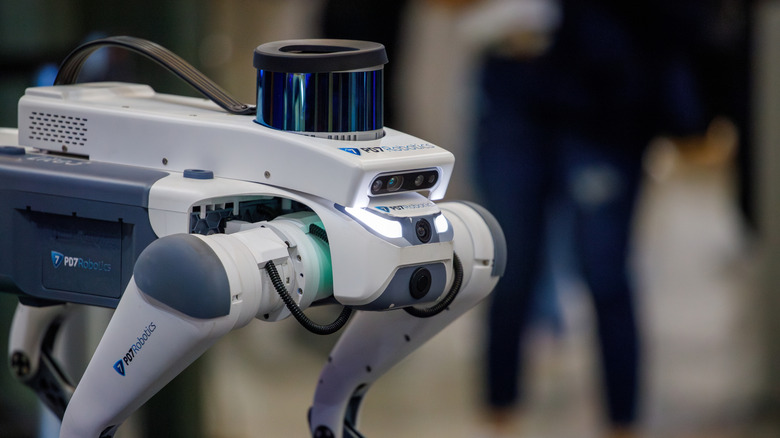
Sometimes ChatGPT and other large language model chatbots come off as a little C-3PO-ish — a supposed all-knowing robot who gets things wrong on the regular is an all-too-real concept these days. For walking and maybe talking robots, we've wound up with companies like Boston Dynamics, or the company literally known as DroidUp, which is creating robots that bring the uncanny valley into your home.
The field of robotics has really been heating up in recent years as the need for capable and movable machines has taken hold. Factories and warehouses have begun to implement some robots on the factory floor already, with these acting less like a protocol droid and more like a brain-dead R2-D2. Meanwhile, companies like Boston Dynamics are seeing their creations, like Spot the robot dog, being deployed alongside troops on the front lines.
We're also seeing Disney take full advantage of the rise of robotics. Aside from "Frozen's" Olaf falling apart in front of kids at Disneyland Paris, it has developed real-life versions of "Star Wars" droids and other characters from its massive list of acquired properties. Disney's "Imagineering" team has also begun integrating forms of artificial intelligence and machine learning, allowing its robots to "explore" the parks.
Father cut off your hand? Bionic limbs have been here a while
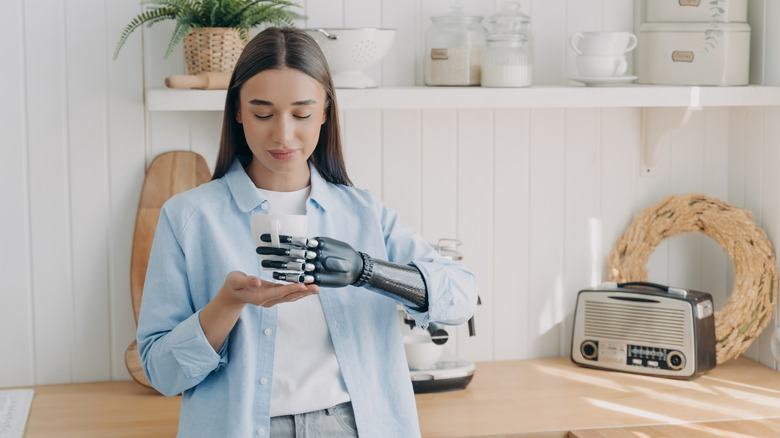
Luke's robotic wrist at the end of "The Empire Strikes Back" may have seemed futuristic in 1980 when the movie hit theaters, but by today's standards, it looks surprisingly realistic. Bionic limbs have come a long way since the first myoelectric prosthesis was created in 1948. Not only are they being integrated with machine learning technology, where they'll "train" on live data to be improved, but they're already out in the field with these high-tech improvements.
Using signals sent from the brain to nearby muscles, bionic limbs can be controlled with enough precision to crack an egg. On top of this, recent breakthroughs in materials science have allowed for more realistic limbs to be created, and advances in 3D printing tech have made prosthetic limbs cheaper, more accessible, and more customizable than ever before.
One of the best examples of this online right now is an Instagram user, ciecie_mommi3type. She's a nurse who has a bionic arm, and she shares videos of her doing regular things around the hospital or at home, including changing her battery mid-shift — fantastic insight into how this technology actually works in the real world. If any of the "Star Wars" movies and shows currently in production want to feature bionic limbs that seem futuristic by today's standards, they'll have their work cut out for them.