

Australia's Floating Solar Array Is Doing A Lot More Than Generating Electricity
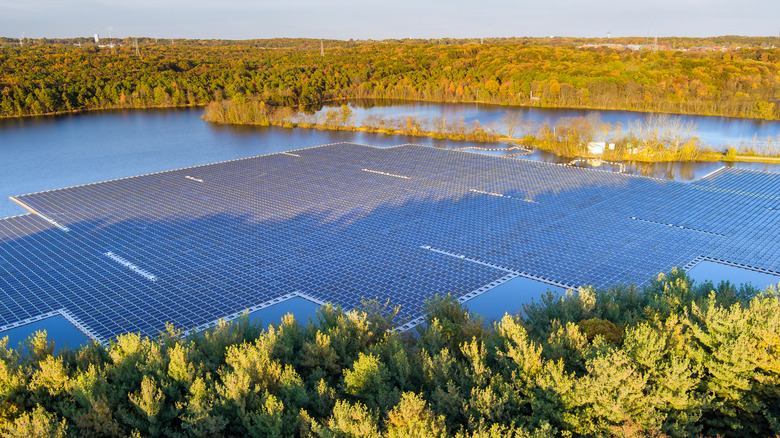
Australia's water supplies are evaporating. According to researchers at Deakin University, the country's water infrastructure loses nearly 370 billion gallons every year due to evaporation, about three times the water in Sydney Harbor. But the land down under has crafted a novel solution to persevering its water supplies, one that has an added bonus of inching the country closer to its zero-emissions goals: floating solar power cells.
Known as floating photovoltaics (FPVs), or floatovoltaics, these massive floating installations of solar panels are cropping up across Australia's dams and water reservoirs. By covering the surface of water reserves, solar panels drastically reduce the rate of evaporation. Critically, it does so without triggering algal blooms that ruin water quality, a common problem with traditional covers that block out too much sunlight. Instead, the installations actually keep water supplies clean while adding renewable energy to the country's power grids.
Of course, solar panels are not a catch all to Australia's energy or water concerns, however, their proliferation across the country exemplifies how municipalities and industrial partners can address climate issues when provided sufficient funding and will power. Furthermore, the solar projects underscore the interconnectedness of global climate concerns and the auxiliary benefits of their solutions. And although floating solar panels may not grab as many headlines as the solar moon-ring project proposed by Japanese firm Shimizu, they may prove an essential piece of the green energy puzzle.
Floating towards solar
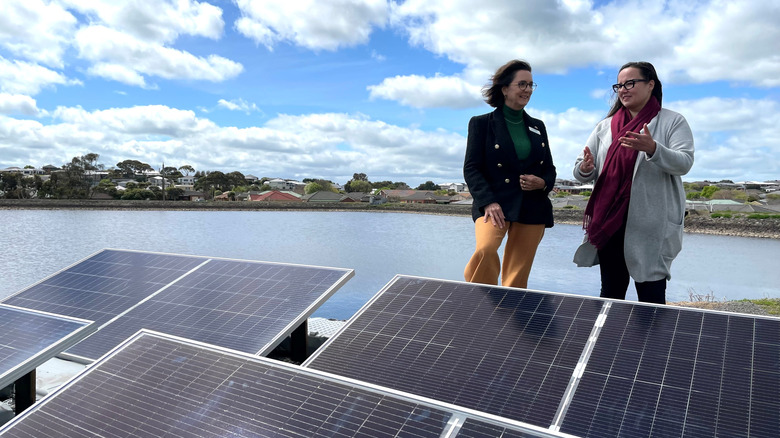
Floating solar farms are becoming increasingly popular as a green energy measure, since floatovoltaics offer several benefits over traditional solar projects. For one thing, the water is a natural coolant, a critical advantage given solar panels' efficiency rates decrease as temperatures rise. Solar arrays that use bifacial panels, which capture sunlight on both sides of the panel, further increase efficiency by using the light reflecting off the water. As such, floatovoltaics can be more efficient than traditional arrays. The water savings from such arrays are more than a knock-on effect. Australian utilities have found that laying solar panels across 70% of a reservoir's surface can cut evaporation rates by over half (via Bloomberg).
This could prove particularly helpful in rural agricultural areas, where canals and irrigation channels often lose massive amounts of water. In California, for example, researchers found that the state's 4,000 miles of aqueducts could conserve roughly 63 billion gallons of water every year by installing solar arrays. The revelations helped spur California's latest energy experiment, Project Nexus, which looks to install solar panels across the state's network of agricultural canals.
Similar projects are underway in Australia, where installing FPV infrastructure in the country's agricultural areas is increasingly becoming a priority. In 2025, for instance, the Australian Renewable Energy Agency invested $8.5 million in a five-year initiative to test the technology's viability in Australia's agricultural settings. The project is part of the Australian government's Future Drought Fund's Resilient Landscapes program, and plans to deploy the floating arrays across the country's farm irrigation infrastructure.
A budding photovoltaic industry
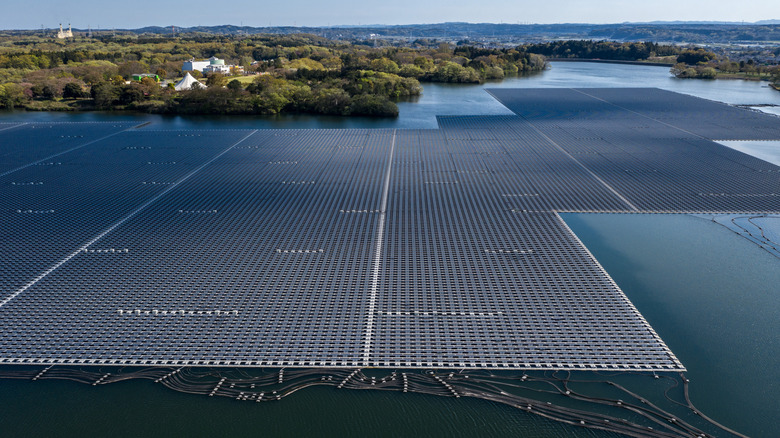
Market researchers expect demand for such installations to climb over the next decade, due in large part to the Australian government's willing support. One example is the floating solar farm in Warrnambool, Victoria. Completed in 2026, the array is the country's largest, consisting of 1,200 bifacial solar panels. Generating more than 600,000 kWh of electricity annually, the energy from the array powers the Warrnambool Water Treatment Plant, and is expected to reduce the utility's greenhouse gas emissions by over 650 tons per year. Similar projects are cropping up around the country. Norwegian photovoltaics company Ocean Sun and Singaporean firm Canopy Power, for instance, have partnered to bring 70-meter solar rings to Australian utilities.
Australia isn't the only country that wants to deploy the technology. In fact, the country's collection of floating solar farms are relatively diminutive compared to other nations long invested in the technology, such as Japan. In 2016, it erected what was then the largest floating plant consisting of 50,000 photovoltaic panels. By 2019, the country's lakes had 73 of the world's 100 largest floating solar plants. Since then, China has risen into a world leader in solar energy, boasting several of the world's largest floating projects, including its 320 MW Dingzhuang solar farm. However, both South Korea and India are developing solar projects that will surpass the Dingzhuang project. France, the Netherlands, Indonesia, Portugal, Taiwan, Norway, Italy, and the U.K. are among the countries investing in floating solar power. In the U.S., the NJR Clean Energy Ventures in Milburn, New Jersey is the continent's largest floatovoltaic project.