

This Sci-Fi Moon Ring Concept Could Send Infinite Clean Energy To Earth
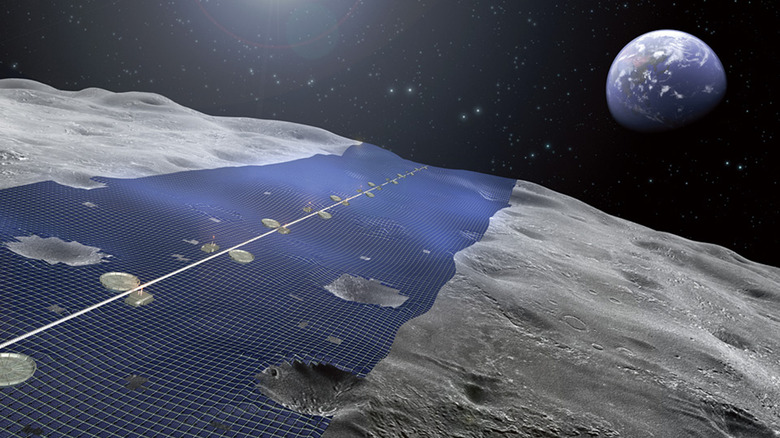
There's literally nowhere on planet Earth where solar energy is abundantly available 24 hours a day, 12 months a year. Even major solar undertakings like California's Project Nexus are hampered by weather conditions and, of course, the inevitability of night. That's a reality which has long frustrated proponents of solar power as an alternative for fossil fuels. But Japanese company Shimizu is promoting a unique concept for providing 24-hour-a-day, high-quality solar power for the whole planet.
The plan, according to the Shimizu's website, is to build a ring of solar cells encircling the moon's equator. The ring would be about 11,000 kilometers long and would range from a few kilometers to 400 kilometers wide. The idea of projecting solar energy from the moon is called, appropriately, the Luna Ring.
Working in continuous sunlight, Shimizu's solar cells would potentially produce 13,000 terawatts. For comparison, the world currently uses 18–20 terawatts of continuous power. That means the lunar ring could radically reduce the need to produce power with fossil and nuclear fuels.
How the lunar ring would work
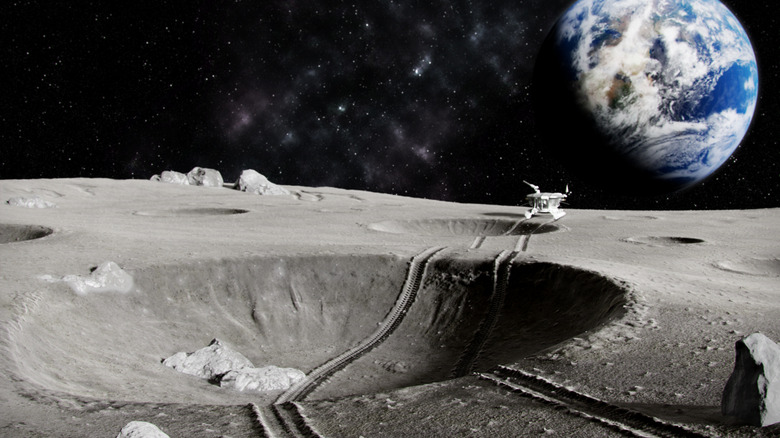
According to the Shimizu website, the Luna Ring concept is still under development. It's a complex project. The first step would require the presence of both humans and robots on the surface of the moon. In fact, lunar robots are under development today with funding from NASA.
The building process would rely on lunar resources like moon soil as well as hydrogen imported from Earth. With these materials, it would become possible to create the materials required to build the solar cells. Fortunately water, a necessary ingredient for the project, is already available on the moon.
Much of the robotic work would be managed from Earth, via remote control. Together, the human/robot construction team would build and deploy an 11,000 kilometer-long ring of solar cells around the lunar equator. Energy generated by the cells would be sent to a lunar antenna via a cable and then converted into microwave laser beams to be transmitted back to Earth. There, rectennas would be used to convert the energy to usable electricity. While power would be generated from the side of the moon that's facing the sun, it would be transmitted from the side which faces the Earth.
How feasible is the lunar ring?
While the idea of a lunar ring has a long way to go it's not impossible to achieve, at least in theory. The biggest obstacle, of course, is cost. Shimizu plans to build the solar cells on-site, but the cost of sending even 1% of the required cells would cost hundreds of millions of dollars. Then there are all the unknown costs, ranging from design and construction of robotic labor to all the steps required to allow human beings to work and live on the lunar surface.
The possibility of generating solar energy from the moon in general is intriguing, and, in a more modest way, is already in the experimental phase. It even spurred NASA to create a $1.5 million challenge which ended in 2024 as part of the Artemis campaign with the goal of designing energy technologies for long-duration moon missions. During the challenge, prototypes were developed for testing in conditions similar to the lunar environment. In the long run, NASA hopes to expand on these prototypes to create tools for transmitting and storing energy in extreme lunar conditions — an important step forward for Artemis and lunar exploration.