

These 5 Common Objects Are Radioactive, According To The US Department Of Energy
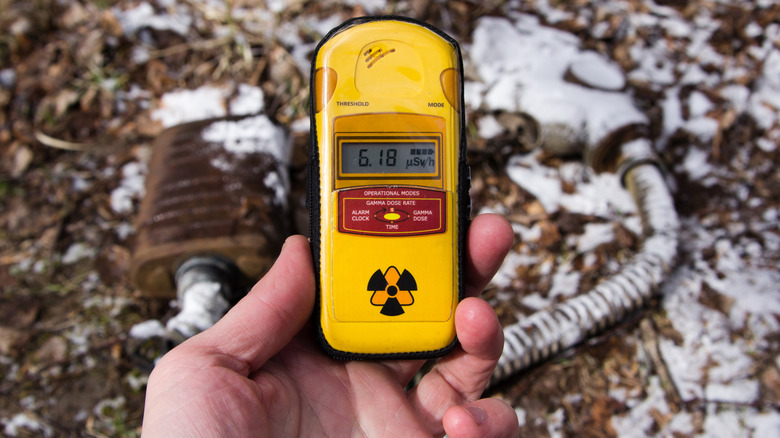
When you're talking about radiation, it's not unreasonable to immediately jump to man-made, weaponized radiation and the horrible effects it can have on human life. However, radiation itself is a completely natural phenomenon brought about by radioactive isotopes, unstable atoms that give off energy as they decay. These radioisotopes can be found in harmless quantities just about everywhere, from gadgets like smoke detectors and exit signs to natural things like gemstones or fruit.
What makes weaponized radiation so dangerous is that it bombards the ground with massive quantities of radioisotopes in a rapid fashion, well past the point that it would induce radiation sickness and damage your body. In the tiny quantities that radioisotopes occur in everyday objects, though, they can't hurt you, and in the case of man-made objects, they wouldn't be able to serve their purposes properly without that teensy bit of radiation. To help assuage concerns, the United States Office of Nuclear Energy maintains a small list of odds and ends where radioisotopes can be found, at least one of which may be right next to you.
Clocks and watches

When you think of radiation and clocks, the first thing that springs to mind is probably the famous atomic clocks used by organizations like the National Institute of Standards and Technology, the gold standard in the complicated pursuit of perfect timekeeping. These clocks measure the passage of time through the resonant frequencies of atoms. Any consumer-grade clock that purports to be "atomic" doesn't actually contain radioactive materials; however, it's just synced to the clock used by the NIST.
While a full clock in your home isn't radioactive, there are some timepieces that may contain radioactive elements, specifically watches. If you've ever had a wristwatch with the ability to glow in the dark, you've got a little bit of radiation on your wrist. That glowing phenomenon is caused by a little glass container, within which is housed a little bit of radioactive tritium gas.
Because the glass is completely sealed, you don't need to worry about being exposed to its radiation, and even if you were, because a watch is so small and the container even smaller, the actual level of radiation you would be exposed to if it broke would be minuscule. The radioactive particles in tritium gas can only travel a couple of millimeters before dissipating, anyway, and it can't penetrate human skin.
Exit signs

Speaking of glowing things, anyone who's ever worked in an office building or lived in an apartment building is likely familiar with the distinctive glow of an exit sign. Even in the event of a power outage, those signs keep on glowing, clearly marking the path to the nearest safe exit in an emergency. You might expect these signs to be powered by batteries, but in fact, that glow comes from the same place as those glowing watches.
A typical exit sign contains a handful of sealed glass tubes containing tritium gas, the sides of which are lined with luminescent phosphor. That tritium gas emits radioactive particles, which cause a mild chemical reaction with the phosphor and make it glow. This is how an exit sign stays lit up even if there's no external power, and that's why every commercial building in the United States needs to have them installed for safety purposes. Again, tritium gas barely moves through the air, can't penetrate human skin, and its actual radiation dosage is minuscule. Even if an exit sign fell right on top of your face, rather than radiation poisoning, the only pressing concern would be your injured nose.
Smoke detectors

Radioisotopes aren't only used to make things glow. Despite the dangers associated with radiation, it's actually thanks to radioactive elements that society has some of the most vital safety equipment in human history. Case in point: the smoke detector, the vital fire and smoke warning system that's been saving lives since the 1960s. Obviously, a smoke detector's job is to detect smoke, but how can a machine do that when it can't smell? Rather than odors, the answer lies in the flow of ions in and around the detector, the disruptive elements of smoke, and the radioactive isotope at the center of it all.
Many consumer-grade smoke detectors contain a small amount of Americium-241, a radioisotope, which is encased in a shielding layer of foil and ceramic. The presence of this radioisotope ionizes ambient air molecules, creating both positively and negatively charged ions that flow between two charged plates in the detector. When smoke passes nearby, the flow of ions within the detector is interrupted, and the alarm is triggered. Thanks to that foil and ceramic shielding, the Americium in the detector poses no radiation threat to you.
Even if it were damaged, the radiation dose is very small and can be stopped by something as thin as a piece of paper. You may be exposed to trace amounts of radiation if you stood right next to a damaged smoke detector every day for years on end, but no more than you would from sitting in front of an old CRT TV.
Gemstones

As previously mentioned, radiation is a completely natural phenomenon, brought about merely by the decay of atoms. Because it's naturally occurring, there are also many natural objects in the world that may contain various amounts of radiation. One good example of this is minerals; uranium, for example, is a naturally occurring mineral that is very rich in radioisotopes. While that's an extreme example, even something as simple as the gems in jewelry can also contain natural radiation, albeit in a much, much smaller dose. Certain kinds of gemstones, particularly very vibrant and colorful ones, are actually the product of radiation exposure.
Gemstones like amethyst, green diamond, and yellow sapphire are produced when minerals are bombarded with radioactive energies, including gamma, neutron, or electron beams. Gem manufacturers will perform this process deliberately to make their gems look more appealing. These manufacturers can just blast a regular, dull gem with a radioactive laser for a while, and it'll turn vibrant and shiny. Don't worry about wearing radioactive stones, though; as required by the United States Nuclear Regulatory Commission, any gems produced in this manner must be set aside for several months to allow the radiation to dissipate, then be submitted to a radiological survey to verify their safety before they can go on sale.
Bananas

It may seem like the best way to keep radiation away from you is to ensure none of it enters your body. However, even some of the foods you eat on a regular basis may contain trace amounts of naturally occurring radioisotopes. For instance, one of the human body's most important minerals, potassium, can contain a particular radioactive offshoot called potassium-40. You know what has a lot of potassium in it? Bananas.
A single banana can contain a very small dose of radiation via its potassium content. Technically, your body would actually absorb more radiation from eating a single banana than it would standing next to a nuclear power plant. However, the actual amount of radiation present in a single banana is positively paltry. A single banana may emit about 0.01 millirems of natural radiation. For reference, it takes 1,000 millirems to make one rem of radiation, and radiation sickness usually starts to manifest around 50 rems. By that math, you would need to consume about 5,000,000 bananas in a single sitting before you even start to develop radiation sickness, and at that point, you'd probably have more important things to worry about.