

NASA Chief Jared Isaacman Is Fighting To Make Pluto A Planet Again - Here's Why
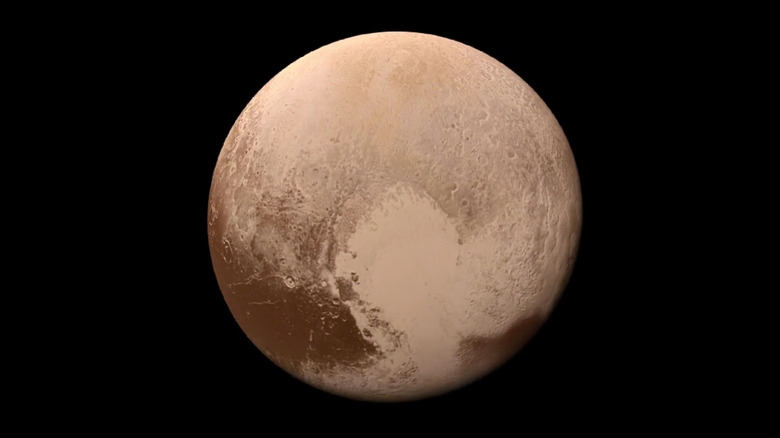
NASA chief Jared Isaacman rekindled a now two-decade-long controversy when he pushed to reinstate Pluto as a planet before the U.S. Senate. Stripped of its planethood in 2006, Pluto's planet status has been a source of consternation both within and outside the scientific community. As it stands, Pluto is considered a "dwarf planet" by the International Astronomical Union, the scientific body in charge of such broad astronomical inquiries and rules. Isaacman, for his part, believes that NASA should disregard the considerations cited by the IAU in its designation.
The Pluto discussion was reignited during the administrator's April 28 testimony before the U.S. Senate Committee on Appropriations, when Republican Senator Jerry Moran asked the administrator's take on the 20-year-old question. Isaacman, a billionaire tech entrepreneur and self-made astronaut who many considered a controversial appointment, answered that he's "very much in the camp of 'make Pluto a planet again." Many scientists have since criticized both the scientific merit and political timing of the comments, noting that Isaacman's statement came during a hearing in which he justified potentially catastrophic budget cuts to NASA and the National Science Foundation.
Since his appointment in December 2025, Isaacman has taken a unique approach to governing the space agency. From stressing private partnerships to announcing nuclear propulsion projects, the tech mogul has pledged to transform the space agency for a new era. Apparently, pushing for Pluto to be renamed a planet has become a priority for the new administrator. In the hearing, he continued, saying, "And I would say, we are doing some papers right now on, I think, a position that we would love to escalate through the scientific community to revisit this discussion and ensure that Clyde Tombaugh gets the credit he received once and rightfully deserves to receive again."
Pluto: dwarf or planet?

The IAU uses a three-pronged approach to determine planets. First, the object must orbit the sun. Second, it must be large enough to condense into a spherical shape. Third, it possesses a gravitational pull strong enough to clear its orbit of space debris. This last criteria is where Pluto falls short. Found in the Kuiper belt, the dwarf planet is one of a litter of celestial bodies considered too small to be a planet. As it stands, the IAU has designated five such bodies in our solar system as dwarf planets, although scientists note that there are at least 100 qualifying bodies.
Critics argue that the IAU's definition of a planet is too narrow. Some note that defining planethood by the other objects in its orbit can create issues. David Grinspoon of Washington D.C's Planetary Science Institute told Nature that "the word 'planet' should be defined by the intrinsic properties of a body, not by its dynamical environment." According to Grinspoon, the line "seems silly" given Earth's hundreds of millions of years with similar small objects as Pluto in its orbit. In illustrating a similar point to The Independent, astronomer Erik Ian Asphaug said "If one day we discover an Earth-mass planet full of inhabitants, orbiting a super-Jupiter, it would not be a planet according to the IAU — how silly is that!"
Other astronomers push back on broadening planetary definitions. For one thing, there are potentially thousands of similarly-sized objects in our solar system, making an expanded planet list complicated. Some have discussed centering a planet's definitions on its geology. One December 2025 study argues that such a definition would expand the solar system's planet count from eight to 150, including Pluto, the asteroid Ceres, and the moons Titan and Europa.
A distracting discussion

Much of the Pluto argument is political, due in large part to its former status as the only planet in our solar system discovered by an American. First sighted by Clyde Tombaugh in 1930 at the Lowell Observatory in Flagstaff, Arizona, the dwarf planet has gained a second life as a totem for nostalgia-bitten activists, a notion Isaacman alluded to in his mentioning of Tombaugh. With hundreds of similar objects in the solar system alone, Pluto's distinguishing characteristic remains its discoverer. Unfortunately for Isaacman, NASA has no control over Pluto's planet designation. And while projects like New Horizons can further develop our understanding of the dwarf planet, its unclear how "papers" the NASA chief referred to can sway the international body's opinion.
More compelling than the merits of Isaacman's "Make Pluto A Planet Again" statement is when it took place: during a Senate Appropriations Committee hearing in which the administrator justified the Trump administration's proposed 23% reduction in NASA's 2027 budget, a decision that would result in cancelling over 50 missions. The irony of arguing to preserve America's status as scientific pioneers while pushing for a 46% cut to NASA's science budget exemplifies an administration that continues to escalate the agency's ambitions while undercutting its budgetary support to achieve them.
Realistically, the fight to include Pluto is largely about semantics. As Kelsi Singer, a scientist on the New Horizons probe that studied the dwarf planet told Nature, the Pluto debate is "more of an unhelpful distraction than anything." Astrophysicist Adam Frank, meanwhile, wrote in Forbes that critics should "celebrate, not cry" about Pluto's fate. Rather than a demotion, Frank argues, Pluto's dwarf planet title was a triumphant announcement that scientists had expanded their understanding of the universe.