

What Is The 83% Rule For Speaker Placement?
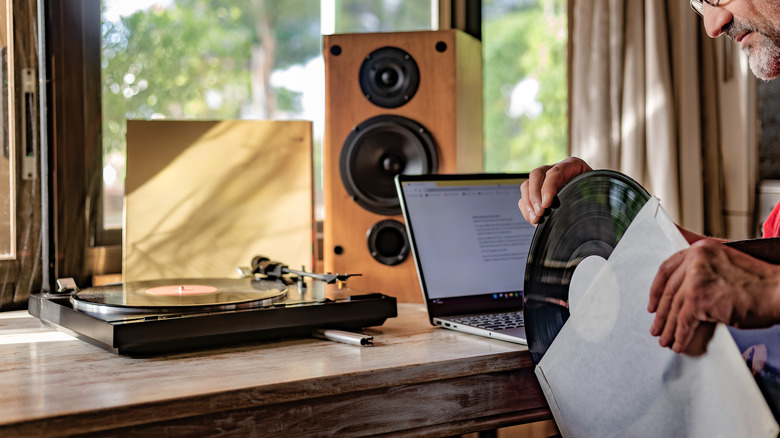
It's not uncommon for audiophiles to get lost in the world of high-end equipment, spending thousands of dollars while never fulfilling their quest for the perfect soundstage. The reality so many audiophiles miss is that regardless of how high-quality your equipment is or how many cool new audio gadgets you've upgraded your music setup with, the basic, physical factors of an audio setup can be as important to cohesive sound as the brand of your speakers. That means making a plan of where you and your speakers are positioned in a room is crucial to getting the most from your audio experience.
According to Jim Smith, an audio expert, consultant, and author, the golden ratio is determined by the distance between your speakers in relation to where you are listening from. Smith, best known for this book (and brand) "Get Better Sound," suggests that the distance between your speakers should be 83% of the distance between you and the midpoint of the plane between those speakers. While not a hard and fast rule, Smith uses that initial 83% measurement as a baseline when doing new installs and then adjusts from there.
How the 83% rule works
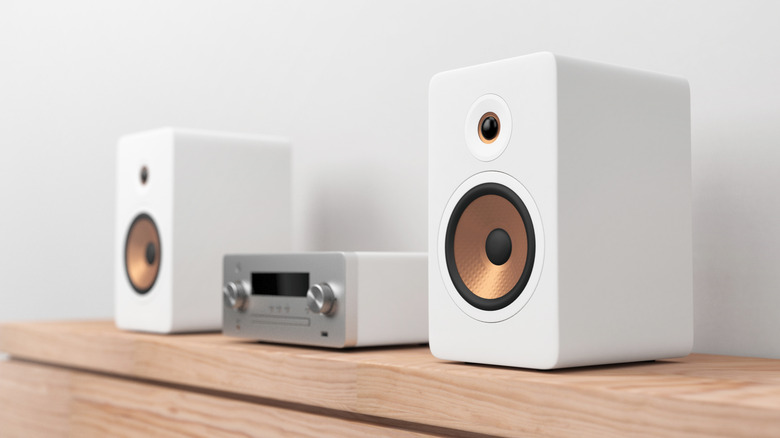
To put it simply, the 83% rule measures two distances in a dual-speaker setup. The first measurement is the distance between your speakers. The second imagines the plane between the speakers as a flat line and measures the distance from the middle of that plane back to where a listener will be seated. The positioning forms a triangle, with the two speakers and the listener as the points of the triangle.
Smith recommends using the listening point as the anchor. With that set, you can begin by finding the optimal position for the two speakers and then make fine adjustments. The reason the rule works is basic acoustics. If the speakers are placed too widely, the stereo image can sound precise but disconnected, and the lower mids may not blend as naturally (Smith describes setups where distances have formed an equilateral triangle, which he says results in a technical sound but boring music presentation). If the speakers are placed too closely together, the presentation can collapse inward and lose width, and presentation is key, even if you're just using Bluetooth speakers in your home gym.
Room setup examples
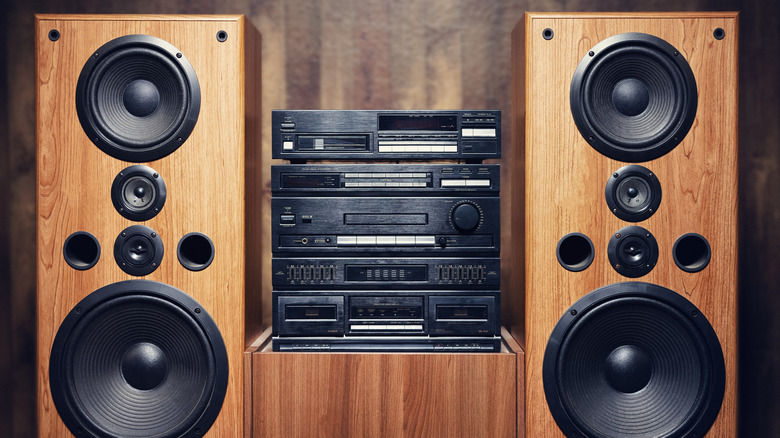
To set up your own space according to the 83% rule, you'll want to start with the equation of X/Y=0.83, where the distance between your speakers is the X value and the listening distance from the midpoint is the Y value. From there, it's just simple math. For example, if your speakers are 10 feet apart (representing X), then you should multiply that number by 0.83 to see that your optimal listening location is about 8.3 feet (Y) away from the midpoint.
Of course, in smaller rooms that this rule isn't possible, it may take more of a manual setup to get the sound just right. Also, be sure to account for toe-in, which is the angle you turn a speaker to face the listener(s). Once you have the spacing and seating roughly in place, you can angle the speakers inward and make small adjustments until vocals snap into focus and the presentation starts to feel musical rather than analytical. And while you're setting up your rear speakers, don't forget to check out the best soundbars you can buy in 2026.