

Is There A Difference Between Ethernet And LAN Cables?
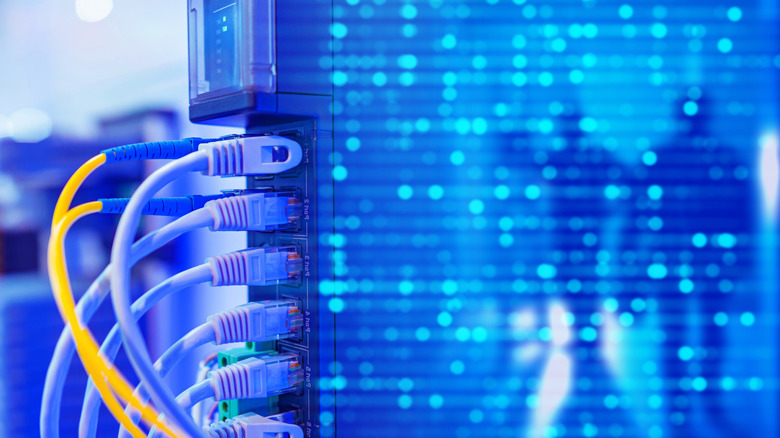
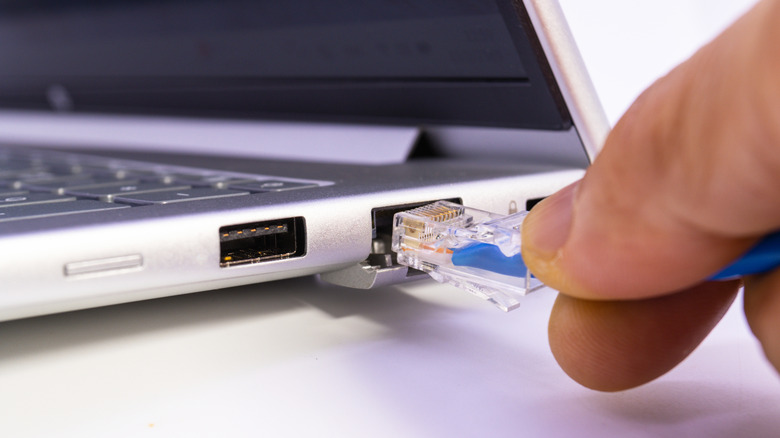
The quick answer is no: Ethernet and LAN cables are not functionally different. Generally, when people say "LAN cable," they are referring to the physical Ethernet cable used to build a Local Area Network (LAN) — essentially, the application that the Ethernet cable gets used with. Yet, confusingly, people use them interchangeably, which can insinuate that they are different. LAN stands for local area network, and the cable portion refers to an Ethernet cable with RJ45 connectors that plug into the NIC's (Network Interface Card's) Ethernet (LAN) ports to link network-dependent devices in a confined physical space or interconnected location.
Technically, an Ethernet cable can be used elsewhere to give Wi-Fi access points that aren't necessarily confined to your home and office. For example, if you have an outdoor-rated Cat6 cable (it should be UV-resistant and shielded), you can use it to strengthen the connection outside for your surveillance camera system. On the technical side, Ethernet cables are primarily defined by IEEE 802.3 standards and their physical RJ-45 connectors for wired, high-speed data transmission. LAN more generally refers to the area in which the network is operating.
Why do people mix up Ethernet with LAN?
Even if the terms are interchangeable, some nuances explain why people might say to use a LAN cable instead of Ethernet, and where these terms came from. Historically, LANs were not always defined by their connecting cables; they were originally defined by the underlying protocol and hardware used to build one, until Ethernet took over. LANs predate the 1990s, even though Ethernet tech was one of the options available in the 1980s. During that time, other competitors could also be used on LANs, such as Token Ring and ARCnet.
Token Ring, for example, operated under a rule requiring a special token, which was usually handled by a Multistation Access Unit (MSAU) to facilitate data flow in a ring. Data could only be sent from the device when it received the token and was enabled by the IEEE 802.5 standard. Since IBM developed this legacy network technology, it still requires specialized IBM-type cabling and specific IBM Data Connectors (Type 1 and Type 2) to work properly.
ARCnet used a similar methodology to Token Ring for enabling LAN communication. It used a flexible star topology with coaxial cabling. It could also be run through Cat5 twisted-pair or fiber-optic cables. But like Token Ring, it was outdone by Ethernet, which was more robust in how much data it could transfer between network-dependent devices, like a good-standing laptop.
Nowadays, Ethernet is widely adopted because standardized ethernet hardware provides a reliable and consistent way to build wired networks. Still, when people refer to an Ethernet cable, they're talking about only one standardized component out of many in a LAN. To clarify their underlying relationship: Ethernet is one standardized protocol family, whereas LAN is the network architecture it supports.