

The Reason American Spacecraft Land In The Ocean – But Russian Ones Don't
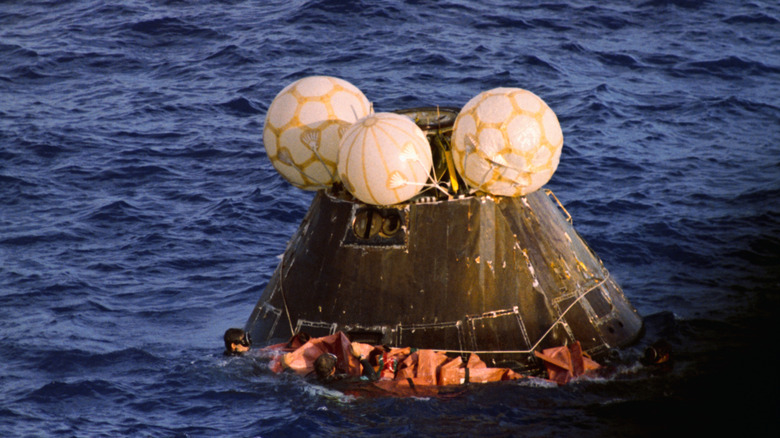
While not as visually striking as a rocket launching and curving as it blasts off into space, the splashdown is an equally important part of American space exploration. However, since the days of the Soviet space program, Russian Soyuz spacecraft have been designed to land in open fields. This difference in how American and Russian space missions end may seem strange or something brought on by a stubborn Cold War-era desire to do things differently, but there's a very simple explanation that has to do with geography.
It may sound obvious, but the United States has more access to the ocean than Russia, which is why NASA launches its rockets on or near the coast and lands them via splashdown. Since 1961, American crewed and uncrewed spacecraft have made it back to Earth using parachutes to slow their descent and the ocean to absorb the impact. From there, NASA and the U.S. military work together to bring the spacecraft and its crew out of the water and back to shore.
Only once has a crewed Russian mission ended in a splashdown: 1976's Soyuz 23. Even then, the water landing was an accident that nearly killed its two crew members, who ended up stuck in a partially frozen lake for around nine hours.
How American and Russian rockets land
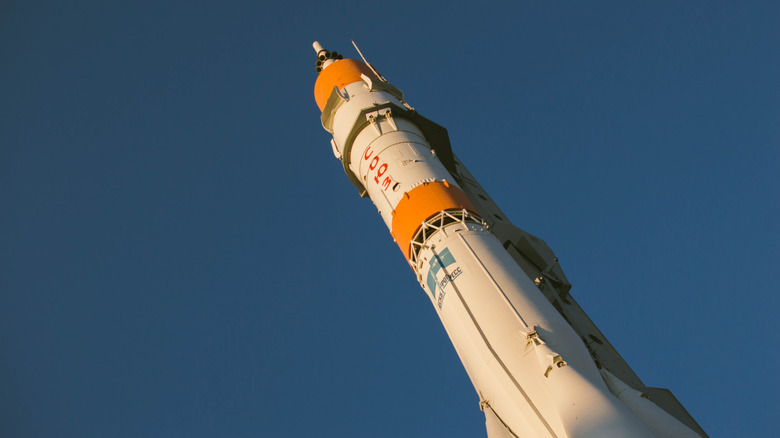
Though Russia has 10,000 more miles of coastline than the U.S., most of that is the Arctic Ocean, where recovering a spacecraft and its crew would be dangerous and difficult. Russia doesn't have these same advantages NASA does, namely access to both the Atlantic and Pacific Oceans and a wide naval presence in international waters, but it does has vast amounts of open, sparsely occupied land. That's why its rockets mostly launch from the Baikonur Cosmodrome, located in land-locked Kazakhstan, and are built to touch down on solid ground.
Given the key role water plays in shock absorption, Soyuz spacecraft need to do more than just deploy parachutes to lower their velocity enough for a safe landing. That is why they have retrorockets that fire just before touchdown, counteracting the descent to slow the craft to under five feet per second — far softer than the 80 feet per second at which American spacecraft hit the water.
While they've been successful over the years, unsurprisingly, Soyuz landings aren't soft. Italian astronaut Paolo Nespoli, who flew on a Soyuz spacecraft during 2011's Expedition 27, likened it to "a head-on collision between a truck and a small car" in which the spacecraft is the small car (via ESA). Compare that to the Artemis II crew, who found a colorful surprise on the moon during their recent mission. They describe their landing with words like "glorious" (via Sky News) and "exhilarating," with Jeremy Hansen telling CBS News that it was like "the best roller coaster ride you've ever been on."