

Can A Nintendo Switch 2 Keep Up With A Steam Deck? Here's How They Compare
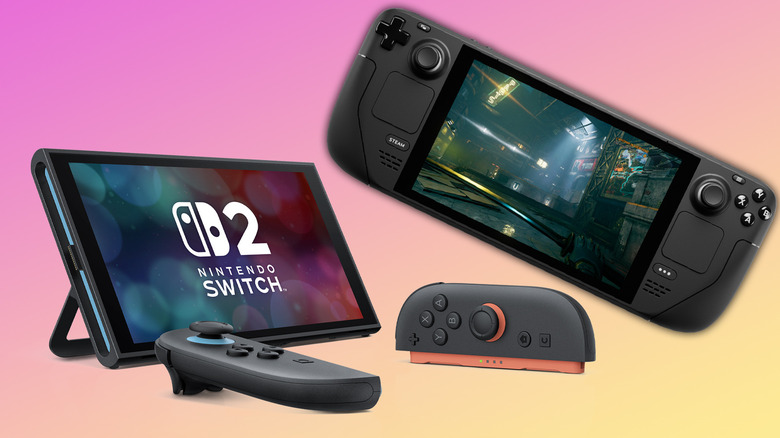
The Nintendo Switch 2 and Valve's Steam Deck are both excellent gaming handhelds with their own merits. Nintendo's second handheld-console hybrid has been lauded for its surprisingly powerful guts, and the Steam Deck continues to receive praise for how its simplified PC gaming has become an excellent way to tackle backlogs.
As of 2026, the parts inside the Steam Deck are around five years old. It utilizes a custom processor-graphics unit combination known as an "APU," or Accelerated Processing Unit. Exclusive to Valve's hardware, the APU is based on AMD's Zen 2 era chips, which were actively produced from Ryzen 3000 to Ryzen 7000. Since it's getting on in age, some more tech-savvy users are trying to find ways to squeeze performance out of the Steam Deck with some nifty (and free) customizations.
By comparison, the Nintendo Switch 2 is also based on older tech, but it packs more powerful software to smooth over gaps. This is thanks to Nintendo choosing to go with Nvidia, bringing DLSS (Deep Learning Super Sampling), the company's upscaling suite, along with it. With a custom Nvidia Tegra T239 as its GPU, the Switch 2 can tackle newer games by leveraging Nvidia's tech.
Steam Deck vs. Switch 2 - it's down to the software
The Switch 2 and Steam Deck are quite comparable as of now, in terms of performance. Some titles will run better on the Steam Deck, but that's because it's essentially a low-powered PC. With expectations in check, it's absolutely still worth getting a Steam Deck in 2026 – if you can find one.
However, the tricks that the Switch 2 has on hand, like DLSS, allow it just a touch more leeway in games than the Steam Deck. DLSS renders the game at a lower resolution and then blows it up to the desired output through algorithms. "Pragmata" for the Switch 2, for instance, runs at 540p, but still outputs a 1080p image docked. When looking at it in handheld mode, pixel-finding experts Digital Foundry estimate that it's running at 360p to maintain its performance.
Another advantage is the dock on Switch 2. The system asks for a voltage and then kicks in an overclocked mode to get even more juice out of the hybrid. This is how the Switch 2 is able to get up to 120Hz at a maximum of 1440p resolution or 4K 60 frames per second (fps). The Steam Deck can output up to 4K60 or 1440p120 on Valve's own dock, but needs third-party docks that can bring a little more to the mix to go beyond that.
Players are finding ways to squeeze more out of the Steam Deck

One way that players are trying to get more performance out of the Steam Deck, which the heavily locked-down Switch 2 can't match, is through modifications. The chip onboard the Steam Deck can use AMD's DLSS competitor, FSR (FidelityFX Super Resolution), which is supported officially up to version three. Modders have managed to backport FSR 4, exclusive to the latest AMD GPUs, after a version leaked. There's also Lossless Scaling, a paid-for program which has brought some much-needed performance boosts at the cost of visuals or latency.
However, it's always worth keeping in mind that the Switch 2 will have ports built specifically for its hardware despite the similar performance metrics. Porting the game over from a PC development environment into a hyper-specific hardware arena, like the Switch 2, will always mean certain elements have to be bespoke for the system. Again, using "Pragmata" as an example, hair isn't strand-based, but a stiffer card-based tech instead.
It should also be noted that Valve and the Steam Deck's "Verified" system is far from perfect. Titles will receive the "Verified" badge only for their performance to be woeful. "Death Stranding 2" required a mod to ease up processor usage and make it playable, despite the badge. On the Switch 2, some ports have been paused, like "Borderlands 4", while "Elden Ring: Tarnished Edition" experienced poor performance.