

3D Printing Research Just Made A Once Impossible 40-Year-Old Concept A Reality
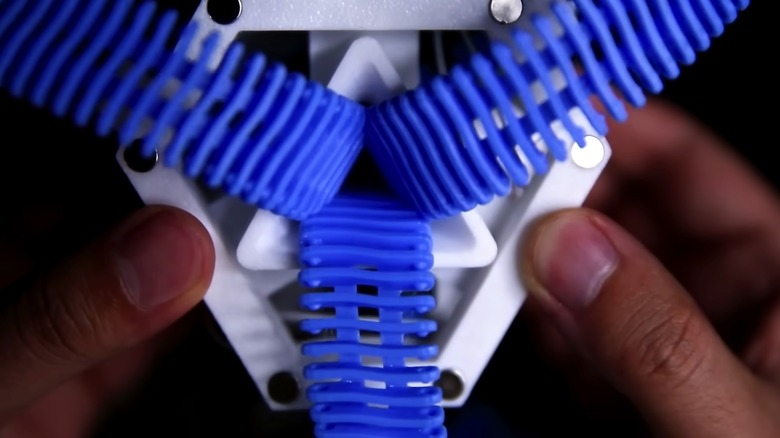
When we think of zippers, we think of a 2D structure that allows users to fasten two parts of a garment. Pulling a slider up and down between two rows of teeth that face each other allows the zipper to close and open smoothly. Applying the same concept to a fastening device that has three sides would result in a 3D zipper that can be used to quickly close or open structures that could benefit from such a mechanism. Such a device is called a "Y-zipper," and it existed only as a concept until recently. Demonstrated and patented over 40 years ago, the original Y-zipper wasn't easy to manufacture. But present-day 3D printing technology allowed the MIT Computer Science and Artificial Intelligence Laboratory (CSAIL) researchers to bring it back to life and turn the Y-zipper concept into a product that could one day be manufactured at scale for specific scenarios.
According to MIT News, William Freeman was an electrical engineer at Polaroid in 1985 when he entered a competition from the Innovative Design Fund. The prize was $10,000 for inventions related to clothing and textiles. The judges rejected Freeman's proposal, but the engineer kept the difficult-to-manufacture prototype and patented the invention. More than 40 years later, Freeman is an MIT professor, and other MIT engineers developed a simpler method to manufacture his three-sided zipper using 3D printing technology.
Jiaji Li, the MIT CSAIL researcher and lead author on the modern Y-zipper version, and his team developed the software that allows 3D printers to create the components of the 3D zipper that can be connected precisely with the help of a 3D slider. The resulting three-sided zipper becomes an object that changes rigidity as the actuator moves.
What can the Y-zipper do?
When not in use, the Y-zipper looks like a squid, according to MIT. Its three arms can be compared to tentacles. They're flexible and loose, as each side provides little stiffness on its own. But when the actuator moves up to close the three-sided zipper, the teeth on the three sides interlock, creating a stiff structure. The software allows the 3D printer to create Y-zippers in different shapes, depending on their purpose.
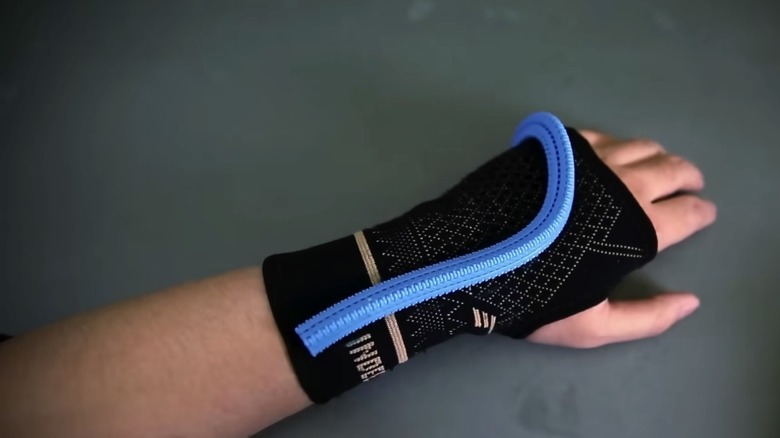
The scientists demonstrated concepts that allow the Y-zipper to form a rigid vertical rod that can be used as a leg in a robot that has to navigate complex terrain. A concept robot featuring four Y-zipper legs was able to reduce its height to pass under obstacles, or increase it to step over rocks on the ground. A different concept proposed a medical device meant to provide support to a broken wrist. In this scenario, one of the three parts of the Y-zipper was 3D printed into a wrist sleeve, allowing it to stay flexible to support wrist movement during the day. At night, the user would connect the other two parts of the Y-zipper with the help of a slider, turning the sleeve into a rigid support that kept the healing wrist protected.
A third concept showed a Y-zipper structure added to a tent. A user needed just 80 seconds to assemble a simple tent instead of the usual six minutes. Adding four motorized actuators to the four Y-zippers could reduce the assembly time to under 60 seconds. Finally, the researchers also showed the potential of using Y-zippers for art installations that require items to change shape or rigidity, as seen in the flower experiment in the video above.
What about durability?
The 2D zippers found on clothes are relatively durable, though they can become damaged over time and need replacing. For 3D printed Y-zippers, durability may be even more important. For example, the flexible Y-zipper legs of a robot that may be used in exploratory or search-and-rescue missions need to be durable enough so the robot can cover large distances reliably. The MIT researchers experimented with two types of plastics used in 3D printing: polylactic acid (PLA) and thermoplastic polyurethane (TPU). The former was better for heavier loads, while the latter was more pliable. They also ran an experiment where an actuator opened and closed continuously to test the durability of the device. After 18,000 cycles, the Y-zipper broke.
These tests suggest that 3D printed plastic Y-zippers may be suitable for specific uses, like adding rigidity to a medical wrist sleeve. But other uses may require more durable materials to prevent the three-sided zippers from malfunctioning and losing their rigidity. The MIT researchers see metal as a potential material for Y-zippers, though it's unclear how a metal model would be designed. 3D printing is the key technology for manufacturing the Y-zipper components, as the software ensures the three zipper components match the geometry and fit down to the millimeter and that the teeth fit precisely when the slider moves.
The perfect fit also depends on a factor the scientists would not be able to control: the environment. The researchers envisioned aerospace use for three-sided zippers, which could be used as tentacles to grab objects near a spacecraft. In such a scenario, debris could be a problem, as it may impact the zipping and unzipping processes.