

How Many Solar Panels Would It Take To Equal One Nuclear Reactor?
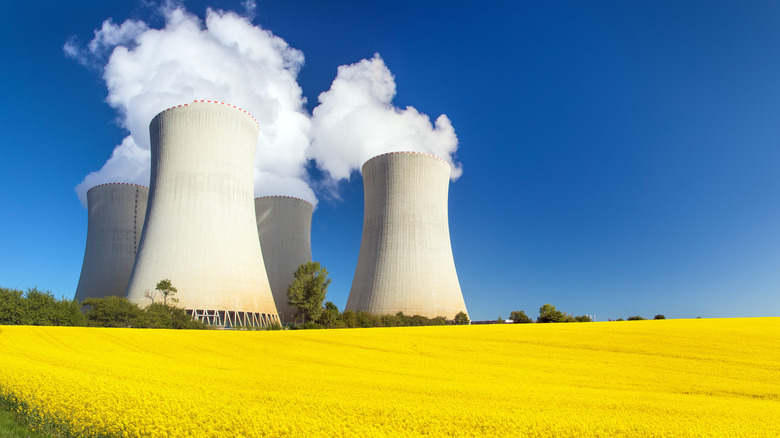
The world is growing more power-hungry all the time, with more and larger devices, appliances, and vehicles hooking into the grid. It's a big part of what makes it difficult to adopt renewable power sources like solar panels on a large scale, especially compared to the monumental power output of a single next-generation nuclear reactor. Both solar panels and nuclear reactors may generate electricity, but it would take over 8.5 million solar panels receiving light around the clock to generate the same kind of output that a nuclear reactor is capable of.
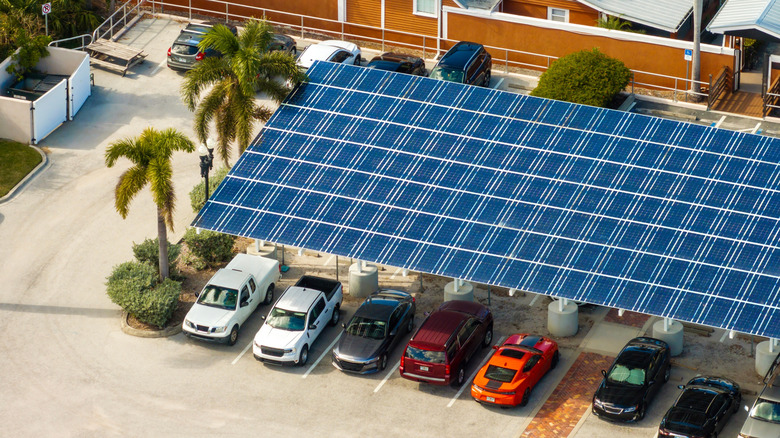
While a nuclear power plant requires a hefty infrastructure investment to get up and running, a solar panel plant, despite being a renewable energy source, isn't exactly free to build. Building the enormous number of panels necessary to match a reactor's output, to say nothing of developing safe ways to store excess power and hook it into local electrical grids, unfortunately means that going fully solar simply isn't feasible yet, at least in the same way that passive nuclear power is. That said, countries and governments have been experimenting with ways to compartmentalize and incentivize solar panel installations, such as placing them over parking lots, which could help make up the difference eventually.
It would take 8.5 million solar panels to equal one reactor
Any kind of large-scale power source is measured by the capacity of the energy it can generate. That capacity isn't just a raw readout of power coming and going, it's what determines how much electrical stress individuals on the grid could place on it before it overloads. Part of what's so attractive about nuclear reactors is that, amongst all power source types, they have one of the highest capacity ratings. The average nuclear reactor boasts around 900 megawatts of power, though larger nuclear plants could output as much as 1,600 megawatts.
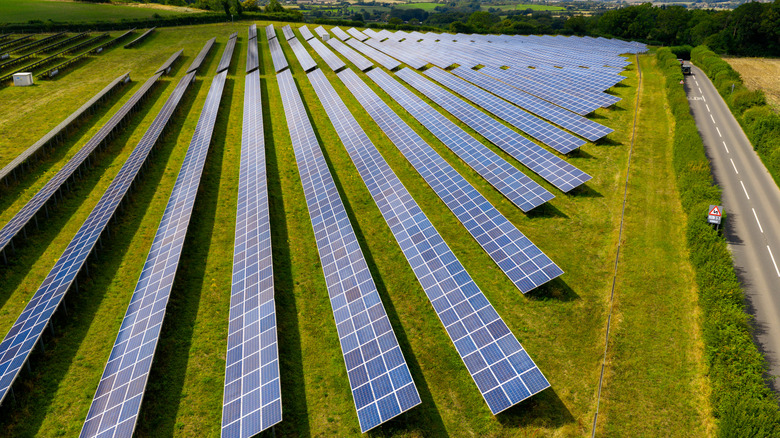
By contrast, a single solar panel typically generates around 400 to 460 watts of power, given optimal sunlight conditions. Assuming constant power generation, for solar panels to generate a comparable degree of energy to a single nuclear reactor, you would need approximately 4 million of them. However, there's an additional factor here: capacity factor, or real-world output compared to the ideal maximum. Nuclear power has a 93% capacity factor, with its output staying mostly stable. Solar panels, on the other hand, only have a capacity factor of 24%, which drops their real-world output from 400 watts to 96 watts. In other words, you would need around 8.7 million solar panels to match the 837 megawatt output (93% of 900) of a nuclear reactor.
Again, this assumes optimal sunlight conditions, and considering how far 8.7 million solar panels would stretch, assuming you'd get that much sunlight consistently seems a bit unlikely. This is also the reason why it takes privately-purchased solar panels so long to cover their own costs.
The hard part is finding space for panels
The obvious problem with trying to adopt solar panels on a large scale is one of space. Nuclear plants aren't exactly small, but even the largest nuclear plant in the U.S. can be contained within a facility measuring around one square mile. By contrast, a dedicated solar plant would need over 14 square miles to match that power output. Only certain parts of the world have the kind of flat, sun-exposed terrain necessary to make that work in the first place, and whether or not it's available in bulk is another matter entirely.
That said, some countries have found clever ways to increase the presence of solar panels, if not get them up to nuclear-comparable numbers. France, for example, passed a law back in 2023 mandating that car parking lots measuring over 1,500 square meters (~16,145 square feet) must be at least 50% covered in solar panels. It's a smart way to make use of the heat island effect that often plagues parking lots, and while it would take a lot of parking lots to match a nuclear reactor, it's a good start that most developed countries could also make use of.