

Why It Takes So Long To Build New Air Force One Planes
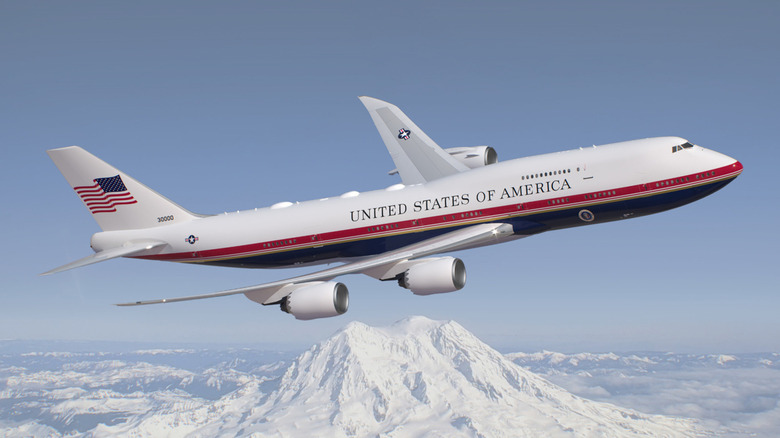
Air Force One is an aircraft of legend, known for its high-profile arrivals all over the world during state visits, and the highly secretive technology it uses to protect the president of the United States. The pair of highly modified Boeing 747-200 series aircraft — known as VC-25As — have been flying since 1990. Considering the complex array of communications and self-defense systems it requires, replacing it with a modern iteration is an enormous undertaking.
Boeing was awarded a $3.9 billion contract in 2018 to replace the aging fleet of aircraft, and committed to delivering the type by 2024. That delivery target has since slipped twice, and is now slated for service entry no earlier than 2029. U.S. president Donald Trump, who has stated that he intends to fly aboard the new aircraft before the end of his current term, has already expressed his displeasure at the delay.
The two Boeing 747-800s that were initially ordered by Russian airline Transaero were purchased in 2019 after the airline went bankrupt before the jets could be delivered. The first Trump administration picked up the aircraft at a reduced cost after Trump alleged that the Air Force One replacement program's costs were spiraling. The two aircraft are now at a Boeing facility in San Antonio, Texas, where the modifications are under way.
The mission-critical upgrades
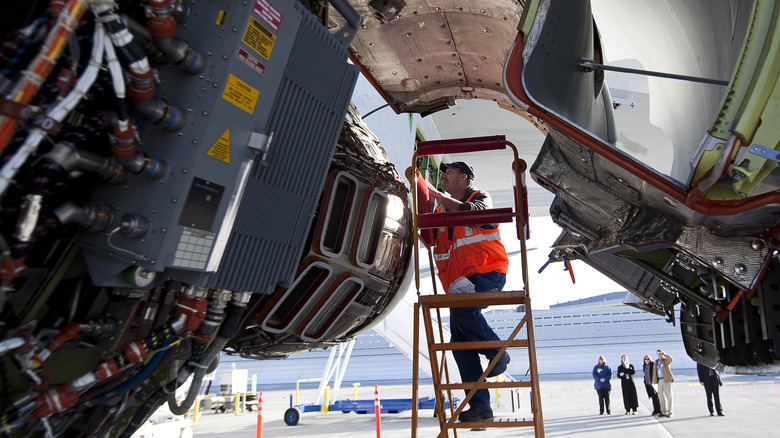
Why would it take so long to replace the current fleet of Air Force One jets; especially considering that the new models — designated as VC-25Bs — are based on already-built aircraft? The answer to this question lies in the sheer complexity of the upgrades required to make the aircraft fit to transport the U.S. president safely and securely. The pair of VC-25Bs are expected to be able to fly the president over great distances, offer a highly secure communications system, and feature mechanisms designed to protect itself from surface-to-air missiles and similar threats.
The communications system on the new Air Force One planes have to be a modern version the system that was built into the famed 747 "doomsday plane". The system should offer highly secure communications that will not only enable the aircraft to act as a central command-and-control post, but also provide a highly secure means of ordering a nuclear strike should the need arise. It must be able to withstand any attempts to intercept communications or hack into onboard systems through a series of integrated digital networks used by the Air Force. With cyber warfare advancing as quickly as it is, this becomes a paramount requirement.
In addition to the communications aspect, one of the most time-consuming enhancements that the aircraft requires is a shell-hardening process. This process enables the aircraft to withstand an electromagnetic pulse, like one caused by a nuclear blast that may occur in the aircraft's vicinity.
The Qatari 747
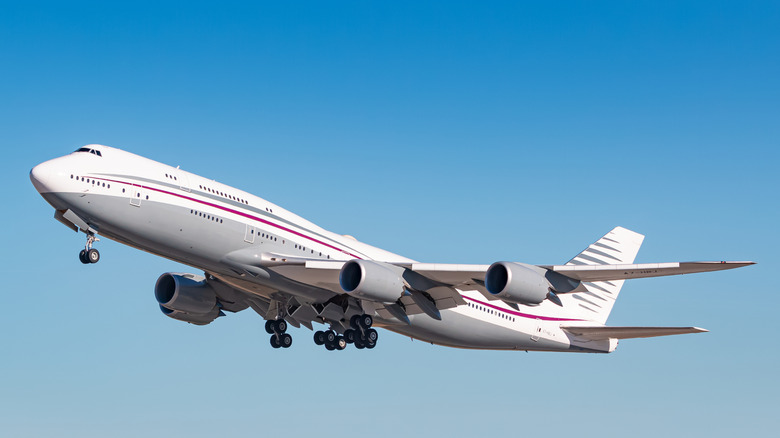
In early 2025, it was widely reported that the Qatari government had offered one of its own Boeing 747-800s to the U.S. as a gift. This aircraft became the subject of a "bridge" program designed to offer an interim upgrade to the Air Force One fleet, given the delays that Boeing had been experiencing. The bridging program aimed to deliver this interim aircraft much sooner than the two VC-25Bs already under conversion with Boeing.
The addition of this third aircraft raised questions about how feasible it would be to deliver an aircraft that had all the necessary modifications required by an Air Force One platform, and how it could possibly be delivered in such a short space of time. The U.S. Air Force enlisted the expertise of a company called L3Harris, who also happens to supply the engines for NASA's SLS rocket. The Melbourne, Florida-based company is known to have a strong portfolio of expertise in the modification of communications and self-defense systems onboard executive aircraft.
Details still remain scarce as to how the modifications could be done up to standard in such a short span of time, but it's likely that the Air Force had to agree to some form of middle-ground between the bridge aircraft and the full spec VC-25Bs. The Qatari aircraft has already been heavily modified with a luxury interior, and it is likely that less work would be required to get the aircraft up to the required spec to transport the U.S president.