

G.I. Joe's '80s Relaunch Involved A Special Arrangement With The National Guard
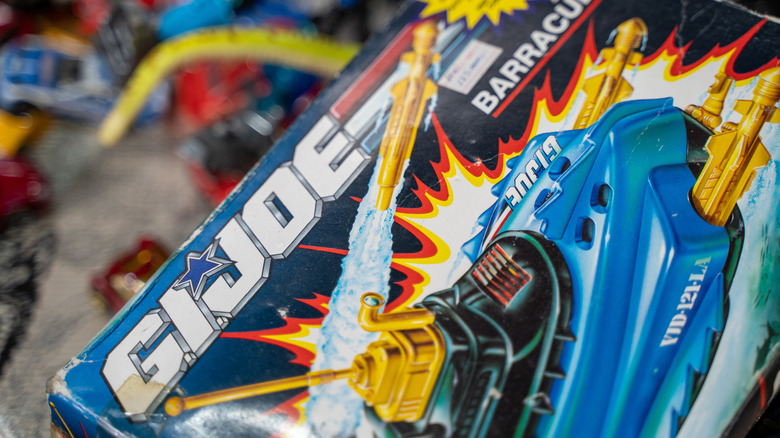
Look back far enough into the history of Hasbro's G.I. Joe toys, and odds are they'll eventually become almost unrecognizable, at least if you came up during the '80s era of the iconic action figures, when the toy line was anchored by Marvel's eponymous comic book and the television series. Back in the 1960s, when the toy line was first introduced, there was very little of the character, color, and imagination that later came to define the series (and a far cry from the wild novelty recently seen at the 2026 Toy Fair or the recent crop of sophisticated fidget toys on Amazon).
The figures launched in the '60s were much more traditional U.S. soldiers, recalling the infantrymen of World War II. The brand underwent a number of transformations through the years, but its most significant was the relaunch in the early '80s. A new line of much smaller toys (3.75-inch figures replacing the 12-inch and 8-inch versions available in the '60s and '70s) appeared alongside the Marvel comic, later accompanied by a five-part TV movie.
While the relaunched toys were wildly different from the '60s original, representing individual characters locked in an epic conflict with an evil organization called Cobra, they did hearken back to the originals in one important way: an agreement with the Rhode Island National Guard to create realistic vehicles and uniforms.
A history of cooperation with the U.S. military
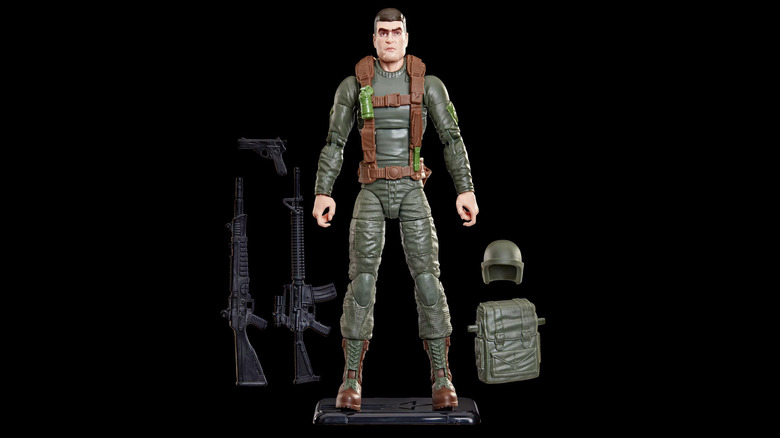
The original toy line was developed as a product to appeal to boys, in answer to the popularity of girls' dolls, an evolution of the rigid plastic and lead soldier figures that predated it. Positioned originally as a "Movable Fighting Man," the original G.I. Joe was the first action figure ever developed, and its poseability opened play opportunities that rigid figures missed.
When Don Levine, who headed the G.I. Joe development team in the '60s, and Hasbro president Merrill Hassenfield first developed the toy line, they reached out to the National Guard to ensure verisimilitude. According to a report on the U.S. Army's website, the two reached out to an old friend, National Guard Major General Leonard Holland, who offered up a selection of authentic military equipment as research for the toy line. According to Bill Ratner, when the time came to relaunch the line in the 80s, Hasbro took the same tack.
The U.S. military was suffering greatly in terms of public perception because of the travails of the war in Vietnam, Ratner told The Hollywood Reporter, and Hasbro capitalized. The company "made a deal with the Rhode Island National Guard in order to get perfectly accurate attack vehicles and uniforms," Ratner said. "When Hasbro approached the director of the National Guard in Rhode Island, they said yes, and it was a quid pro quo. It was, 'You're doing a military show. We want the military to look good.'"
A successful collaboration
The G.I. Joe toy line has sold hundreds of millions of figures across its history, and has been described as the world's most successful boys' toy. Despite not launching until the summer of 1964, the line racked up an impressive 16 million units sold in its first year alone. Within two years, Joe accounted for almost 66% of Hasbro's total profits.
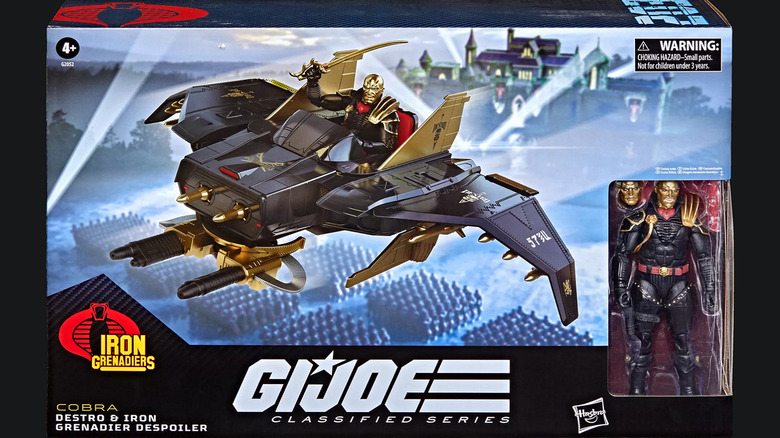
The toys have since spawned countless spin-offs beyond the 1982 comic and original television series, and now span media, including video games and feature films. A trio of live-action films released in 2009, 2013, and 2021 have grossed more than $700 million worldwide at the box office, and the toys remain one of the most recognizable brands in the world. Despite toy makers' fears that kids are increasingly turning to high-tech toys, the enduring popularity of classics like G.I. Joe is showcased by the success of recent inclusions like the G.I. Joe Classified Series.
Launched in 2020, it's since expanded into multiple waves, premium exclusives, and retail partnerships. The HasLab H.I.S.S. Tank crowdfunding campaign, which offered a $299.99 version of the iconic Cobra vehicle, reached its funding goal of 8,000 backers in just half a day, eventually more than doubling that number.