

5 Major Tech Brands You Might Not Realize Are Owned By Chinese Companies
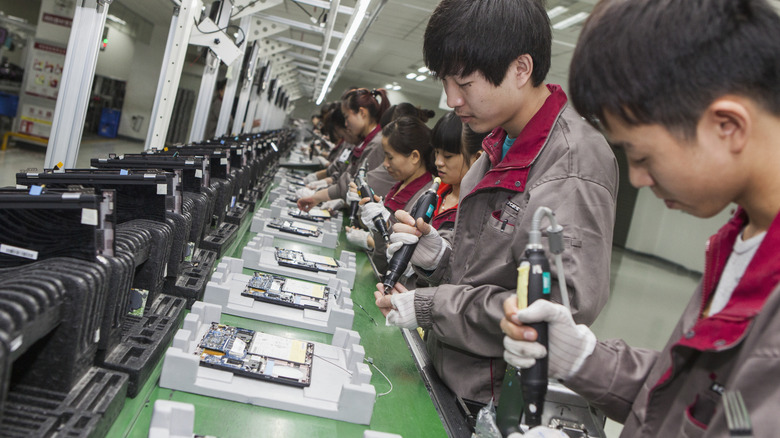
Businesses worldwide have evolved significantly since the 2000s, and that's especially true of technology companies. However, China has been rapidly outpacing the United States — whose manufacturing output has seen significant decline since the mid-20th century — in manufacturing capacity and in the pricing of consumer technology. Nowadays, Chinese companies like TCL make high-quality products at prices that Western brands often struggle to compete with.
As AI data centers cause various consumer tech prices to skyrocket, there is some hope that China-based companies may be able to meet continued consumer demand at affordable prices, therefore contributing to the global market's future stability. This is backed by a senior Samsung advisor, Kye-hyun Kyung, who, during a speech at the National Academy of Engineering of Korea Forum, claimed that Chinese business investments in chip production could help pull the globe out of the pricing crisis in tech by the second half of 2027 (via Wccttech).
The most recent dent in the armor of the Western technology industry has been made by China's electric vehicle industry, where brands like BYD have proven to be cheaper and better alternatives to American brands like Tesla. Of course, Chinese business interests are broader than the EV sphere, so we'll be taking a look at some corporate entities that are now owned — or that have always been owned — by Chinese stakeholders.
Lenovo
With offices around the world and a notable presence in the West, it's not exactly common knowledge that Lenovo is a Chinese company. Originally called Legend, the company opened its first location in Beijing back in 1984. The company has been vital in spreading computers across China, having been one of the first companies to develop "Chinese character cards" that allowed PCs to process the Chinese language without taking up too many resources. It produced its first computer in 1990, which it had also dubbed "Legend." Now, in its fifth decade of existence, Lenovo is showing off complex concept products that are designed to be powered by AI.
In 2003, the company known as Legend would become Lenovo. In 2005, it snapped up IBM's entire PC division, which included the long-standing computer model known as the ThinkPad. That purchase would prove to be one of the most pivotal business decisions in the company's history; by 2013, Lenovo had secured its place as the top PC provider in the world. As of 2025, it maintained this enviable position in the global market, beating out HP, Dell, and even Apple in PC vendor shipments. In 2014, Lenovo also acquired IBM's x86 server business, which further bolstered its enterprise initiatives.
Lenovo has also acquired other companies from around the world — including Motorola Mobility — to strengthen its existing foothold in the tech market. To this end, in 2026, it also purchased the firmware business of Phoenix Technologies to bring development under its roof.
Motorola
Motorola is well known for its 2000s-era flip phones and, more recently, for its popular foldable Razr smartphones. However, the company was once a manufacturing powerhouse that provided microprocessors to major industry players like Apple, Atari, and Commodore. In 2011, the company was split off into Motorola Solutions and the now-Chinese-owned Motorola Mobility. The latter division was bought by Google in 2012 for $12.5 billion, but it was later sold to Lenovo in 2014 for $2.91 billion, which therefore put it under Chinese ownership. Motorola Solutions, which remains American-owned, renders security and IoT services for several applications, including oil and gas, water and wastewater, and even early warning systems.
Despite being something of a power brand in the past, Motorola has lost much of its former relevance and industry standing. Its 2010s phones failed to make much of an impact in the global market, with Apple and Samsung dominating the landscape at the time. However, things began to change in the 2020s. Its lower-cost foldable smartphones, as well as its range of budget smartphones, have made them popular in countries like Brazil, where it holds roughly 30% of the smartphone market share.
Even though it's now a Lenovo company, Motorola is still based in the U.S. That said, much like most other phone manufacturers, its phones are built and shipped out of China. In fact, Lenovo backed the Motorola brand so much that the company ended up phasing out other phone branding in favor of Motorola.
GE Appliances
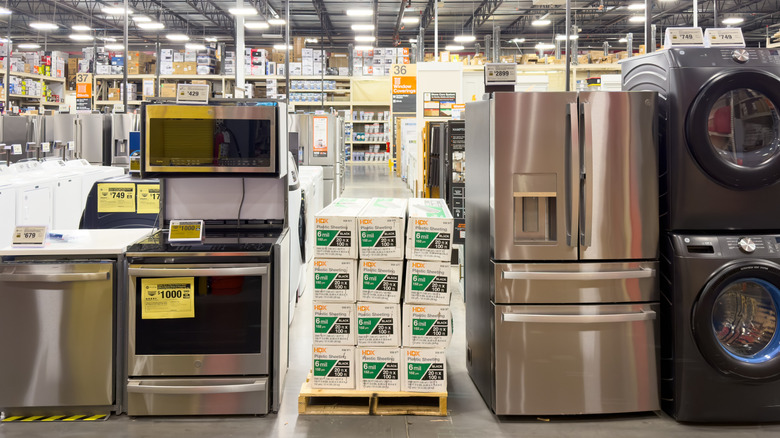
Once one of America's largest and most valuable companies, General Electric products used to be found in U.S. households everywhere. Radios, televisions, and kitchen appliances were the name of the game for the company, but at this point, GE has something of a confusing history. Now split into three companies — GE Aerospace, GE Vernova, and GE HealthCare — GE doesn't even own its famed appliance division anymore. The company sold it to a Chinese conglomerate, Haier, for $5.4 billion back in 2016. Now, Haier has fully leaned into the appliance side of the tech industry. It's largely focused on products meant for home use, with recent launches including the Opal brand, which produces nugget ice makers.
Despite being Chinese, however, Haier has framed GE Appliances as being a wholly American company. The company's site features vaguely jingoistic offers for military service workers and other American government employees, embedded videos that seek to showcase how "American" the manufacturing is, and a landing page with UI elements that echo features of the American flag. However, the company also operates in India, Mexico, Puerto Rico, South Korea, and — of course — China.
Per Financial Times, Haier reported record-high profits and earnings of 302.35 billion in Chinese Yuan in 2025, which equates to over $44 billion in U.S. dollars. Haier also reported that GE Appliances has managed to secure its "no. 1 market position for the fourth consecutive year" in the North American market.
TCL
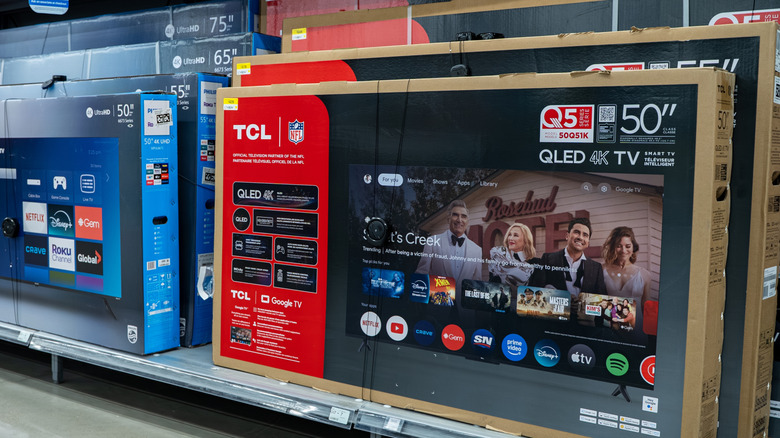
If you've wandered into a Walmart, a Best Buy, or any other store that sells TVs, you're likely to have noticed the TCL brand at some point. Although the major Chinese company merged with Sony's Bravia brand of TVs, it was already a heavyweight in the mid-range to budget TV verticals. Founded in 1981, the company has made some serious moves in the TV department in the last few years.
Since 2003, TCL has acquired companies — or entered major deals — across the globe to produce TVs. In that same year, TCL managed to triple its TV exports. In 2008, TCL became involved with making Samsung's LCD TVs; from then to 2013, the company had managed to become China's leading LCD manufacturer, as well as the third-ranking LCD manufacturer globally. It then partnered with Roku, which would ultimately serve as the brain powering the software ecosystem that would help TCL make its move into smart TV manufacturing.
TCL even acquired some of Samsung's assets in China, including fabrication and LCD module plants. TCL also operates the mobile brand Alcatel, which made BlackBerry-brand phones between 2016 and 2020. Its other business ventures include selling air conditioning units in the U.S.
Hisense
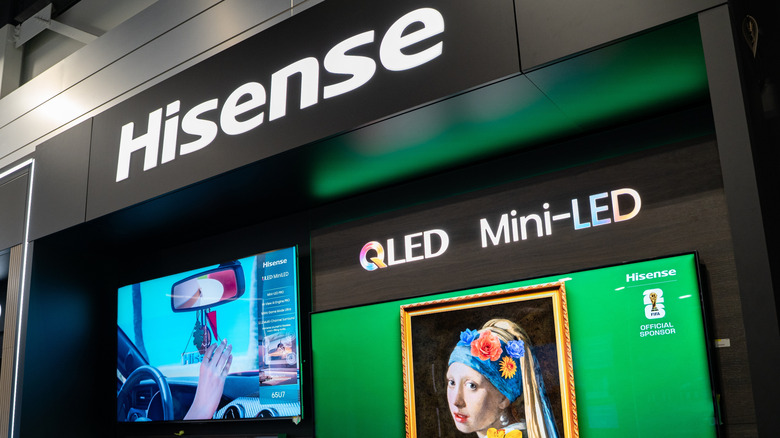
Hisense is another TV company whose devices you're likely to spot lined up alongside other mid-range TVs. The company has been around since 1969, but until 1993, it was known as Qingdao No. 2 Radio Factory. As with TCL, it also produces a range of products in different categories. However, TVs are its largest business; accordingly, Hisense has landed itself in fourth place worldwide for television manufacturing.
As of 2024, Hisense owns the second most installed TV operating system in the world, Vidaa, which is surpassed in popularity only by the South Korean Tizen OS, which was created by Samsung. Vidaa is also used in Toshiba-brand smart TVs, as well as TVs from other brands. In 2020, Hisense became the first company to produce an 8K TV that featured 10-bit color support and HDR, which effectively positioned China as a record breaker and innovator in the TV manufacturing space. Prior to that, Hisense developed a transparent 3D TV back in 2013, but the device was never released.
Much like most Chinese companies do, Hisense maintains operations worldwide, including a South African location intended to produce TVs and appliances. It also owns and operates an 80-hectare facility in China, Hisense Information Industrial Park, which has been running since 2001. In 2022, it also opened a site in Nuevo Leon, Mexico, which took an initial investment of $260 million.