

Which Aircraft Carrier Catapult Is More Effective: Steam Or Electric?
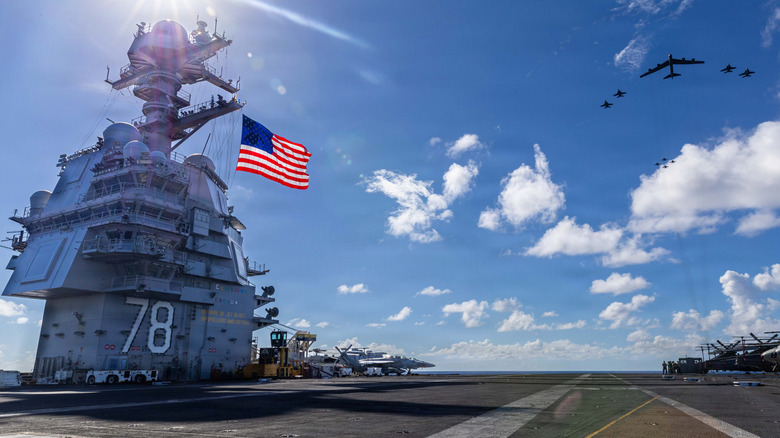
A debate is brewing in the world of aircraft carriers as navies race to build the world's premier force-projection instrument. China launched the Fujian, the third aircraft carrier in a fleet it hopes to grow to nine within a decade. For the United States — which operates the world's largest, most advanced aircraft carrier group — the question largely centers around making the floating airfields more effective. Critical to this discussion is the type of catapults used to launch aircraft from the carrier's bow. American carriers depend on two forms of catapult: steam and electromagnetic. Although electric catapults are more effective on paper — offering more speed, efficiency, and control than their steam counterparts — reliability issues paint a more complicated picture.
Deployed by the U.S. and British navies since the 1950s, steam catapults use compressed air to launch planes down the runway. In recent years, the United States has begun to replace the technology with its Electromagnetic Aircraft Launch System, or EMALS, which uses the kinetic energy generated by electromagnetic force fields to shoot aircraft down the carrier. The U.S. deployed the technology on its latest supercarrier, the USS Gerald R. Ford. China, meanwhile, began deploying the technology on the Fujian in 2025.
Electromagnetic systems offer several advantages over their steam forebears, including faster relaunches, adjustable control systems, and smoother rides. However, they've also proven unreliable, and required operators of the USS Gerald R. Ford to rely on off-ship support staff to address technical issues. In fact, the system isn't expected to meet reliability targets until after 2030. As such, the Trump administration has pushed back against the technology, calling for a return to steam. The decision, if enacted, could have major implications for the United States' naval advantage.
Catapulting into a new era

Electromagnetic catapults offer several advantages over traditional steam-powered systems. First, the system can launch heavier aircraft more quickly. Using linear induction motors to generate a magnetic field, they can launch a 100,000-pound plane at 150 mph. Critically, the launch process takes a matter of seconds, and requires just 300 feet of track. By comparison, typical steam catapults can only achieve such feats with a 60,000-pound aircraft.
Moreover, electromagnetic catapults allow carriers to have more control over their launch systems. Using a feedback control system, EMALS can adjust its force based on the weight of the aircraft, allowing for a greater variety of aircraft. Steam catapults, meanwhile, use the same pressure for every launch, making it difficult to launch both large aircraft and lighter unmanned aerial drones without major recalibration. This increased precision places less pressure on the aircraft, reducing wear on the Ford's expensive cargo.
Another major benefit of the electromagnetic launch system is its elevation of a carrier's launch rates. Using the aircraft carrier's nuclear reactors, EMALS takes only 45 seconds to recharge. This quick recharge time means Gerald R. Ford is capable of launching droves of aircraft in a single sortie. EMALS represents a major capabilities boost in terms of launch and recovery. Originally, naval planners predicted that the new carrier class would produce a 30% higher sortie rate than their Nimitz predecessors. However, while the Pentagon has stated that the sortie rate has increased, the 30% figure has yet to be confirmed. In theory, EMALS should also provide several logistical advantages, as it requires less space, water, and man power to operate.
An uncertain future
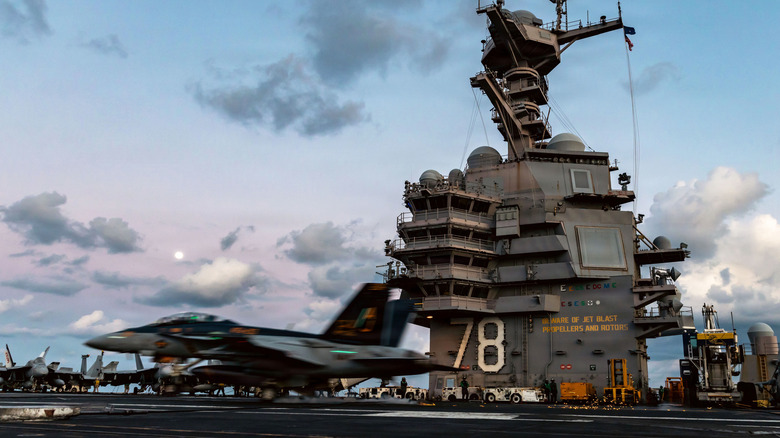
Despite these advantages, the USS Ford's electromagnetic catapults have been plagued with issues since its sea trials in 2017. Both hardware and software failures have become a trend with the Ford's EMALS systems, some of which have prevented the carrier from launching aircraft for extended periods, requiring off-ship technical support staff to restart operations. According to the Pentagon's February 2025 report, "despite engineering upgrades to hardware and software, reliability has not appreciably changed from prior years."
These challenges caused President Trump to publicly float replacing the new electromagnetic system with steam catapults. During a speech on board the USS George Washington in October 2025, the President said he was "going to sign an executive order" demanding electromagnetic catapults be scrapped. Such moves aren't without precedent. The U.S. Navy ditched the Gerald R. Ford's much maligned Dual Band Radar for future Ford-class carriers. As such, the USS John F. Kennedy supercarrier will use the Enterprise Air Surveillance Radar system. However, replacing EMALS would be a more complex and costly decision. The Pentagon has yet to initiate a move back to steam.
Despite the United States' troubled EMALS program, China' became the second navy to adopt electromagnetic catapults, underscoring the technology's potential capability gains. A major feature of the Fujian, the electromagnetic catapult is a major jump in Beijing's force projection capabilities. Experts predict that the People's Liberation Army Navy's next carrier will likely use four electromagnetic catapults, matching that of the USS Gerald R. Ford. The capabilities leap by the United States' greatest naval rival highlights the potential consequences of the Navy's flailing EMALS program. To preserve its strategic advantage, the U.S. will need to ensure its electromagnetic push doesn't lose its steam.