

NASA's Mars Helicopter Actually Breaks The Sound Barrier
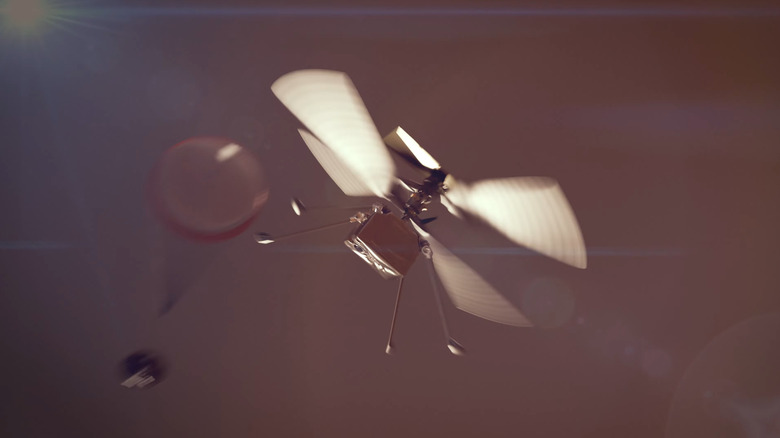
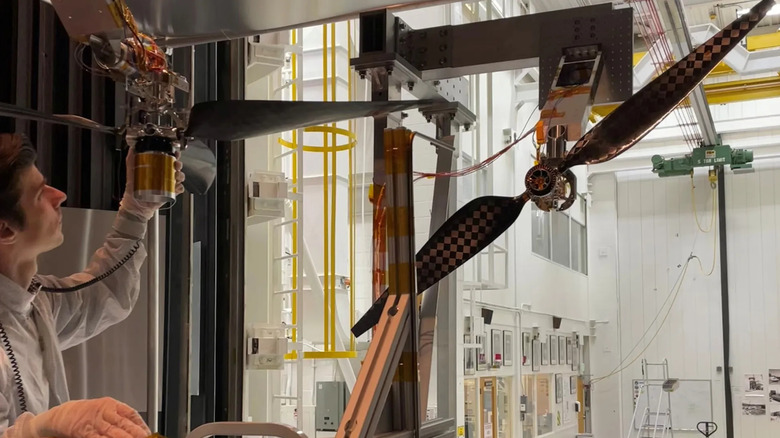
NASA recently pushed the rotor blades of its next-generation Mars helicopter to Mach 1.08 at its famed Jet Propulsion Laboratory (JPL) near Pasadena, California. JPL is testing a high-performance version of the original Ingenuity helicopter that flew 72 flights between April 2021 and January 2024. Here on Earth, it's unheard of for a helicopter's rotor blades to break the sound barrier. However, because of what the next version of this helicopter will be required to do, supersonic rotor blades fit the brief perfectly.
As previously reported by BGR, the next-generation Mars helicopter will feature a flight control system called "Autonomy," which has AI-based systems that can be called upon if the helicopter runs into trouble, and recovers itself to a safe landing spot. In a March 2026 news release, NASA detailed its initiatives towards achieving the National Space Policy, and previewed the mission featuring the next Mars helicopter that will fly before the end of 2028. Three Ingenuity-class helicopters will form part of the Skyfall payload, to be delivered to Mars on a mission packed with innovation.
The mechanism used to deploy the helicopters will be just as ingenious as most of JPL's historic Mars missions. It addresses one of the most time-consuming problems previously faced when it comes to getting exploration vehicles from Mars' orbit to the surface. Previously, teams at JPL had designed bouncing vehicles that were surrounded by huge air bags to protect them as they were dropped from a descending parachute, bouncing several times before coming to a stop. The delivery of NASA's last two rovers — Curiosity and Perseverance — was even more impressive, featuring the sky crane maneuver that used a thruster platform to lower the heavy rovers down to the surface with ropes, before translating away from the landing site for a hard landing at a safe distance. JPL's newest landing technique will see the helicopters simply take off while the payload is still in the air.
Supersonic rotor blades for Mars
Why would it be necessary to push the rotors to go that fast? The Martian atmosphere is 1% as dense as the air back on Earth, which means that the rotor blades on a helicopter have a lot less air molecules to use for lift, and more power is needed to get it to fly at all. While the Ingenuity helicopter was able to fly on Mars quite well, it lacked the ability to carry any significant loads.
According to a NASA simulation, three helicopters will enter the Martian atmosphere attached to a parent vehicle. When arriving close to the surface, they will simply fly away from the descent platform and land on the Martian surface. The helicopters will perform advanced terrain mapping to identify future potential landing sites for manned Mars missions, and carry more specialized surface scanning hardware for longer distance exploration over the surface of the planet. All of this means that the helicopters will need to lift more weight, and the helicopter's supersonic rotor blades will help deliver that capability.
Pushing the rotor blades to this speed has an element of risk due to the unpredictable behavior of any blade or wing when moving at supersonic speeds. The original Ingenuity helicopter never exceeded 2,700 rpm, which ensured that the rotors remained in the Mach 0.7 range, with a speed buffer that means that not even an unexpected gust of wind on Mars could push airflow over the blades past Mach 1 while flying. The recent test at JPL was all about making sure that the blades could go fast enough without risking structural failure that could end a Mars helicopter's mission early. Teams at JPL had to achieve a rotor speed of at least 540 mph to break the sound barrier in a simulated Mars environment (slightly lower than the speed required on Earth).
Going nuclear to get the helicopters to Mars
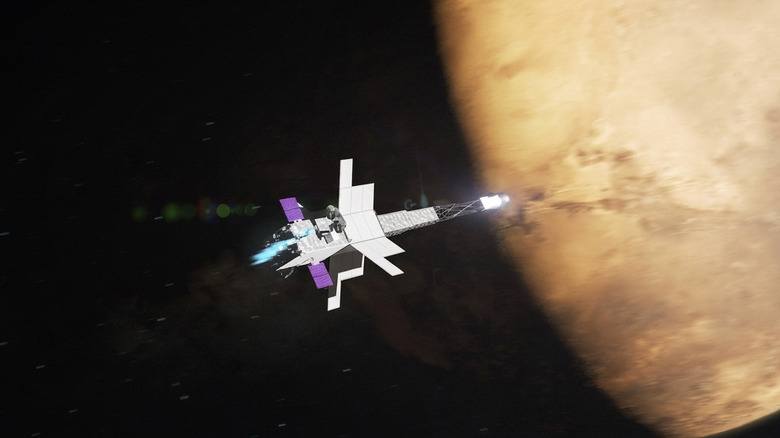
The Skyfall mission will become the first ever interplanetary mission to feature nuclear electric power, and will be an extraordinary step forward in deep space exploration. Most spacecraft rely on solar power to continue functioning in deep space. However, none of these have ever been able to reach beyond Jupiter, where solar arrays become ineffective and fuel capacity becomes an issue.
This mission is the first in a line of applications planned by NASA, and is intended to break down existing barriers to flight safety and activate a supply chain that will support this technology in the future. What makes this so groundbreaking is that it will enable humans to explore the outer reaches of our solar system. A spacecraft's effective range can, in this instance, only be limited by hardware failures and usable lifespan.
The mission is also set to lay the foundations for the construction of a permanent NASA moon base, where a nuclear fission power source called Lunar Reactor-1 (LR-1) will ensure continuous power supply. This power helps even when the base is in a lunar night time that lasts for 14 days, where solar panels are ineffective. The U.S. is on an accelerated path towards establishing a continuous human presence on the Moon, and this technology will be key to enabling astronauts to operate on the surface with reliable power sources for years to come.