

Why Your Smart TV Doesn't Have DisplayPorts (And Probably Never Will)
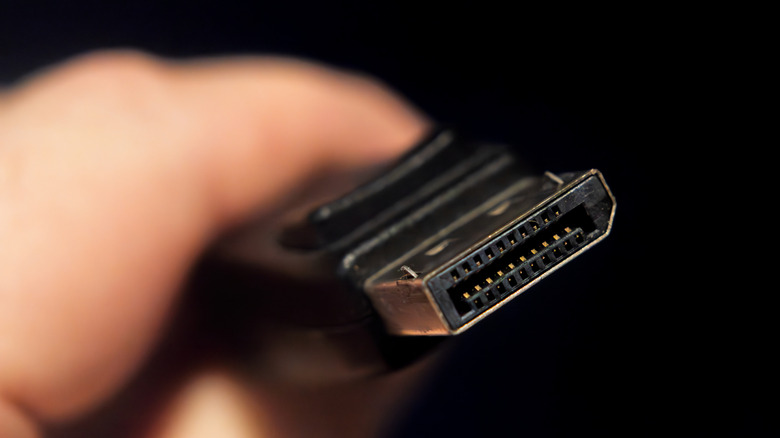
Just as VGA connectors reigned supreme in both gaming and general consumer markets for nearly two decades, HDMI is the undisputed champion for video connections. Though it will likely remain the norm in the foreseeable future, it's not quite the most capable digital interface. In fact, the latest iteration of DisplayPort blows the commonly used HDMI 2.1 out of the water.
So, why don't smart TVs offer a DisplayPort instead? DisplayPort 2.1 supports 80 Gbps of bandwidth, while HDMI 2.1 offers only 48 Gbps. This means less compression and higher refresh rates for DisplayPort 2.1. However, HDMI 2.1 is still sufficient for most consumers. It delivers uncompressed audio at 4K resolution with a 120 Hz refresh rate, which is more than solid. You can daisy-chain extra devices with DisplayPort, sure, but since the majority of smart TV enthusiasts may not care about this feature, what would be the point?
The biggest reason for the lack of DisplayPort inputs on TVs, though, is the extra cost. Smart TV manufacturers are required to pay systems-on-a-chip (SOC)/licensing fees to implement the HDMI standard, so adding an extra input would significantly drive up manufacturing costs. Even the best smart TVs use HDMI, so DisplayPort inclusion doesn't offer any economic incentive.
DisplayPort is ideal for large monitors and PC gaming
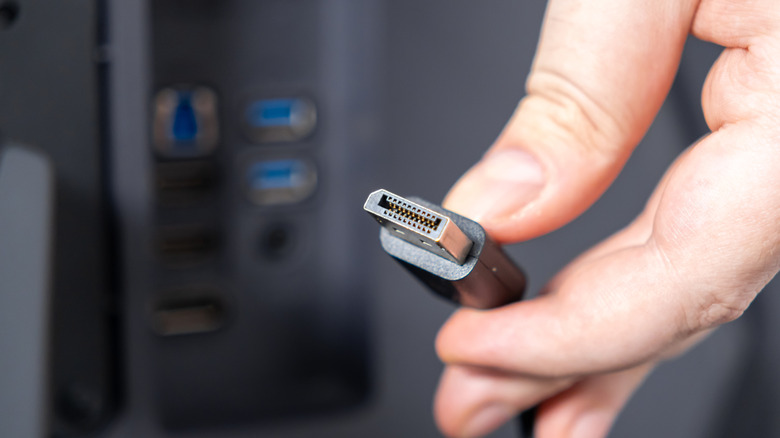
DisplayPort is routinely found in PCs. With a superior bandwidth of 80 Gbps, the newest iteration — 2.1 — has the ability to support a maximum refresh rate of 267 Hz at 4K. Naturally, since modern graphics cards and higher-end monitors implement the standard, it's bona fide the perfect choice for gamers and PC users. It may also be a more future-proof benchmark for games for a simple reason: DisplayPort 2.1 can deliver 4K video at 240 Hz, handle 8K resolutions at 120 Hz, and go as high as 16K with a refresh rate of 60 Hz. This, of course, matters more to demanding users playing on large monitors and aiming for high FPS, so if you have the option, it's much better to ditch the HDMI in favor of DisplayPort for quality's sake.
On the other hand, HDMI is good enough for the latest generation of consoles and most home theater systems. HDMI 2.1 is far from outdated and is capable of driving current 4K TVs while also providing 8K support. Considering that 4K TVs are so prevalent in the current decade, HDMI's limitations are practically negligible for the majority. Even when 8K becomes the dominant resolution, HDMI 2.1 will likely remain the preferred input.
Implementing DisplayPort into smart TVs would be too expensive
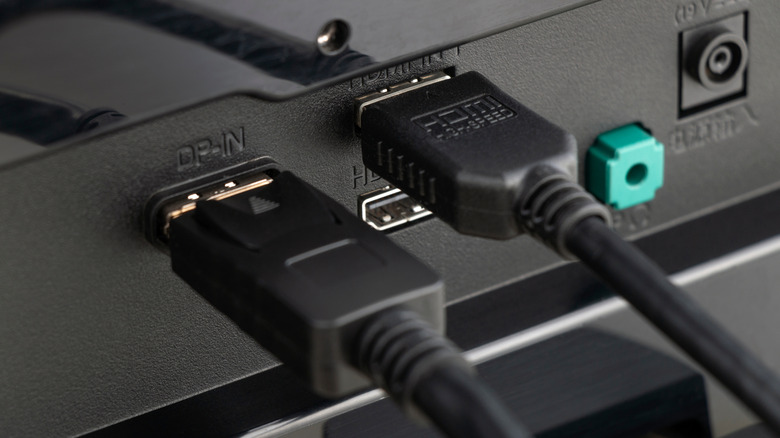
On a wider scale, it's unlikely that smart TVs ever implement DisplayPort. For most consumers, DisplayPort would be a superfluous feature. Take, for example, PS5 and Xbox Series S, and check how high-intensity modern games perform. "Alan Wake 2," for instance, delivers 60 FPS in performance mode with a 1440p resolution. In quality mode (ideal for 4K displays), the game renders at native 1270p and outputs 4K using FSR 2 upscaling tech.
What's the point of using DisplayPort for consoles? Since you're very unlikely to squeeze anything more than 60 FPS, the superior refresh rate wouldn't be something you'd really benefit from. Although there are probably some gamers who would want to hook up their PC to their large TV, those who can afford a flagship NVIDIA card like the RTX 5090 likely already have solid monitors to work with.
En masse, implementing a whole new input would be too expensive for numerous manufacturers who generally want to serve the broadest market possible. It's unreasonable to expect that today's TVs will cater to niche groups with a DisplayPort capability, though Hisense, for instance, presented one model that supports both HDMI and its less popular counterpart. It's an interesting idea, but it remains to be seen if others will follow suit. Since the new HDMI 2.2, which supports 16K screens, is more likely to take off, you shouldn't bank on DisplayPort becoming a mainstay in the smart TV space.