

This Nuclear Battery Can Outlive Civilization Without A Single Recharge
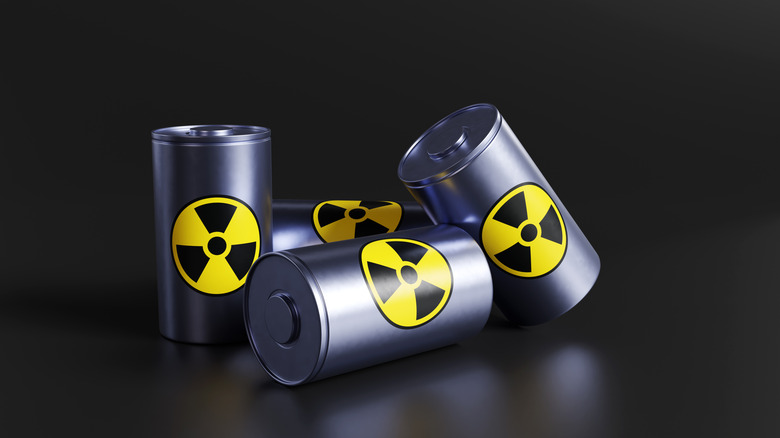
Scientists from the U.K. Atomic Energy Authority (UKAEA) and the University of Bristol have created a diamond battery that can operate for over 5,000 years. The battery, which is composed of carbon-14, has the potential to power hard-to-maintain devices. These batteries are known as betavoltaic batteries, which means they convert the decaying power of the carbon-14 isotope into electricity. According to a press video shared in 2016 by the University of Bristol, this allows the batteries to continually generate an electrical current.
Carbon-14 is a well known isotope, which is used in radiocarbon dating to help determine the age of organic materials. However, when turned into a diamond form and then placed inside of another diamond layer, the scientists say the isotope becomes a long-lasting battery that can be used within the harshest of environments. That means they could be used in both space and on Earth, in places where normal lithium batteries might not be safe to operate, like in nuclear-powered spacecraft.
Turning waste into power
The way betavoltaic batteries work is by turning the decaying power of radioactive isotopes into an electrical current. This is possible because the isotopes emit beta particles as they decay. These particles then collide with the semiconducting material placed in the battery — the diamond layer in this battery design — and it knocks some of the electrons free. The freed electrons are then responsible for creating the electric current in diamond batteries.
Nuclear waste can last a long time, which makes long-term storage expensive. And while we have found ways to speed up nuclear decay, finding new uses for the waste is a great way to help cut storage costs and push fresh developments. In this particular case, the University of Bristol and UKAEA heated the used graphite blocks taken from nuclear facilities in the U.K. This allowed the scientists to collect the carbon-14 on the surface of the blocks in gas form, removing it from them entirely. Not only did this help reduce the radioactivity of the blocks, but it also allowed the researchers and engineers behind the advancement to then process the carbon-14 and convert it to diamonds.
However, the diamonds are still radioactive because they are made entirely of carbon-14. This means they need to then be placed inside another layer of diamond to help absorb and contain the radiation. In addition to acting as a containment system, the outer layer of diamond also works to increase the efficiency of the electrical current generation to nearly 100%.
A perfectly safe solution that can outlast civilization
"Carbon-14 was chosen as a source material because it emits a short-range radiation, which is quickly absorbed by any solid material," Dr. Neil Fox from the School of Chemistry noted in a press release. Normally, this would mean that carbon-14 was dangerous to ingest or even touch. However, none of that short-range radiation can escape when the carbon-14 is placed within a diamond. This means that the amount of radiation detected on the outside of the battery is less than what a solitary banana gives off, making these batteries exceptionally safe to use in a variety of different ways.
Because carbon-14 has a half-life of 5,730 years, the batteries can power whatever they are placed within without ever needing to be recharged. That, combined with their lower power output compared to normal batteries, could make them a perfect alternative for powering devices that don't need a ton of power, but that are hard to replace or recharge without extensive surgery or maintenance.