

How Many Original iPods Would It Take To Equal The Storage Of The iPhone 17?
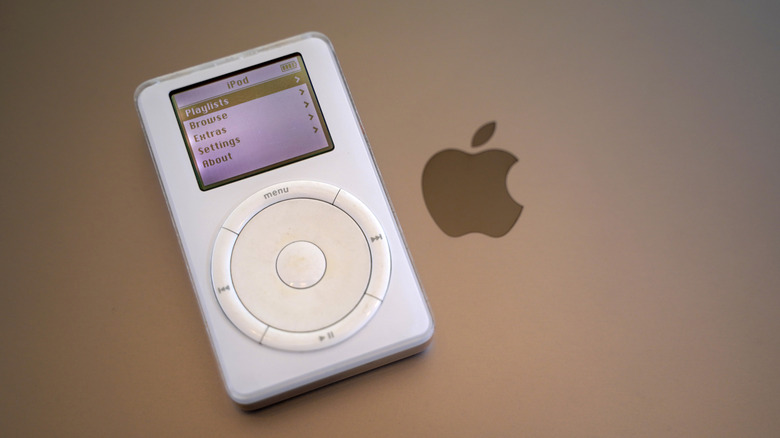
People who want to disconnect from smartphones, and young users who may not be allowed to use iPhones and Android devices in school, are making old-school iPods popular again. Apple isn't manufacturing new models, but used iPods in good condition are selling on marketplaces like eBay despite their limitations. The original iPod can't connect to streaming services, and you need to transfer tracks to the music player for offline listening.
Older users may be aware of Apple's "1,000 songs in your pocket" tagline that the company used for the original iPod in 2001, a way to show how generous that 5 GB capacity was compared to alternative MP3 players, but younger iPod owners may worry that's not enough for all their favorite music today, when the base iPhone 17 model comes with 256 GB of storage. If you were wondering how many original iPods you'd need to match the cheapest iPhone 17, the math is really simple. You'd need 51.2 iPods to get 256 GB of storage space for music.
Apple also launched a 10 GB iPod in the spring of 2002, advertising it as a music player that allowed users to store 2,000 songs. You'd need 25.6 units to reach the iPhone 17's 256 GB storage capacity. The iPhone 17 also comes in a 512 GB version, while iPhone 17 Pro models go up to 1 TB and 2 TB in storage capacity, depending on the model.
In the years that followed the original iPod's release, Apple launched other iPod models featuring various storage capacities. The first-generation iPod shuffle came in a 512 MB variant. At the other end of the spectrum is the 160 GB iPod classic, launched in 2007, and the 7th-generation iPod touch (2019) that came in a 256 GB option.
Was 5 GB enough?
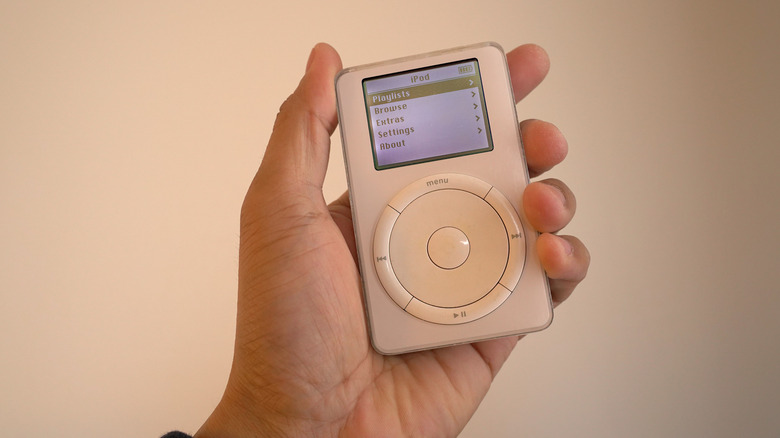
Most base-model smartphones sold in 2026 feature 128 GB or 256 GB of storage space. Apple's entry-level MacBook Neo laptop comes in 256 GB and 512 GB versions. Comparatively, 5 GB doesn't seem sufficient for a mobile device, even one limited to music playback. But 25 years ago, the original iPod's 5 GB storage was seen as state of the art. It wasn't just about the 1,000 songs in your pocket. The music player featured a mechanical hard disk that allowed owners to use it as a portable storage device for documents, photos, and videos. The 10 GB model that followed supported contact storage, allowing users to carry with them up to 1,000 names and addresses. Also, Apple said at the time that the FireWire port allowed the device to transfer the full 1,000 songs in 10 minutes, which was 30 times faster than regular USB-based MP3 players.
A traditional flash player sold around 2001 could feature 32 MB or 64 MB of storage space, which is 156 times or 78 times smaller than the original iPod's 5 GB capacity, respectively, and thousands of times smaller than the 256 GB of storage in the base iPhone 17. An iBook laptop that Apple sold in 2001 came with 10 GB of standard storage, which could be upgraded to 20 GB. The iMac desktop launched in July 2001 featured up to 60 GB of storage. Among smartphones available around the original iPod's launch, a Nokia 9210 Communicator offered 16 MB of built-in memory, 2 MB of which were available to the user. The device supported 16 MB memory cards.
Can the original iPod still hold 1,000 songs?
While iPods are seeing renewed interest among some buyers, Apple's 1,000-song claim won't necessarily hold up for a device that features 5 GB of storage unless the user still has songs encoded at 128 Kbps. That was the song quality Apple used to calculate iPod storage capacity. A 4-minute 128 Kbps AAC music track would need about 4 MB of storage space. That's how Apple reached the "1,000 songs in your pocket" estimate for the iPod.
Fast-forward to 2026, and the base storage for a mobile device like the iPhone 17 isn't the only thing that has changed. Apple encodes songs in 256 Kbps AAC, which is double the rate of the 2001-era songs. A 4-minute song would need about 8 MB of capacity, which means that a 5 GB original iPod may offer users enough storage for over 500 songs. That's still a good amount of music to have available to play offline. Then again, Apple Music subscribers who own the base iPhone 17 can download more than 500 tracks on the handset to listen to music even when an internet connection isn't available.
Finally, to put things in perspective, the 256 GB iPhone 17 costs $799, while the 5 GB original iPod was priced at $399. However, considering their rarity, first-gen iPods are being offered for as much as $599 on eBay at the time of this writing.