

This World Record Breaking Laser Wirelessly Powered A Robot For 24 Hours
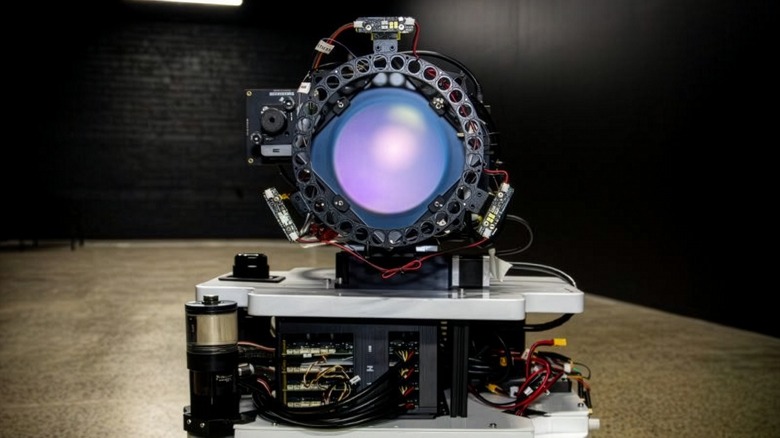
Australian startup Aquila just said it broke two world records while powering a moving warehouse robot for 24 hours straight, using nothing but a laser as its power source. The company shared on its LinkedIn page that it set two world records: the most power ever beamed by a laser (4 kWh) and the longest sustained delivery of laser-based power (24 hours). The power-generating technology demonstrated by this test uses a laser fixed to a tracking platform that fires it at a target's receiver in real-time. The concept of providing power wirelessly through the use of laser beams isn't entirely new.
It shares its foundations with solar-cell technology, which was pioneered as far back as 1839 by Alexandre-Edmond Becquerel. The feasibility of using lasers instead of sunlight to generate electricity was demonstrated by Mitsubishi Heavy Industries in 2025, when it fired a focused laser beam with an optical power of 1 kilowatt at photovoltaic cells, generating 152 watts of power. The Aquila model builds on the success of the Mitsubishi test, generating around 167 watts of power continuously over a 24-hour period. What makes this concept different is the ability to keep the laser focused on a receiver moving constantly, which will unlock more opportunities in the future.
The perpetual drone
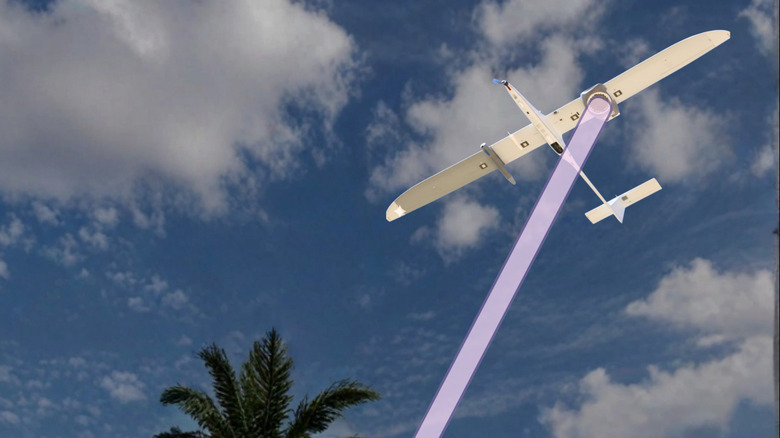
Laser-based power relay is set to rapidly evolve in the near future, with two U.S. Department of Defense programs featuring the technology. The PTROL-UAS program, partially funded by U.S. Central Command (CENTCOM), is focusing its efforts to advance laser power delivery to unmanned aerial vehicles (UAVs). It aims to achieve near-perpetual flight times over various distances, as confirmed by PowerLight Technologies in December 2025. The concept uses high-precision optical tracking to keep a laser beam focused on a UAV's receiver to relay power, and is set to work over distances of up to 5,000 feet.
DARPA recently set a distance record in one of its own tests under the POWER program, sending 800 watts of power over 5.3 miles away. While this was achieved over a shorter distance compared to the concept being developed by PowerLight, it was a real-world demonstration that proved the technology is progressing in terms of distance capabilities and power output. DARPA sees the technology being put to use in places where power delivery is challenging, including battlefields and disaster zones. The United States is not alone in its efforts to develop wireless power relay technology for military applications, either, as China is known to be investigating ways of transporting power wirelessly to UAVs, using microwave technology.
NASA plans to use laser power delivery at its Moon base
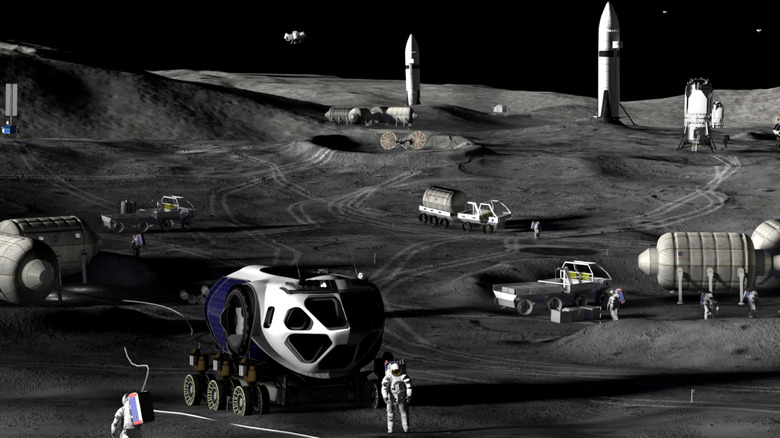
While NASA forges ahead with plans to return to the Moon to build a $20 billion Moon base, power generation will be a key hurdle in the base's design. A 2021 NASA paper (link will download a PDF to your device) detailed plans on how to deploy this technology to solve the problem, especially when round-the-clock power is required. Solar panels would only be effective in direct sunlight and wouldn't work during lunar nighttime. To get around this issue, NASA has studied using hundreds of Earth-based laser telescopes, phasing the lasers together and directing them at photovoltaic cells to generate about five kilowatts of power.
NASA has also expressed a desire to use radioisotopes to generate heat and power for its Moon base, though the concept of delivering power by laser still has significant potential. While primary generators would provide centralized power, distributed work and exploration sites at the Moon base would also require electricity. If radioisotope-based power could be integrated with laser-based power transportation as demonstrated above, it could eliminate the need for transporting heavy batteries and legacy power-extension mechanisms to the Moon, which could save precious weight on rockets.