

The World Record For Fastest Drone Was Just Broken Thanks To Carbon Fiber
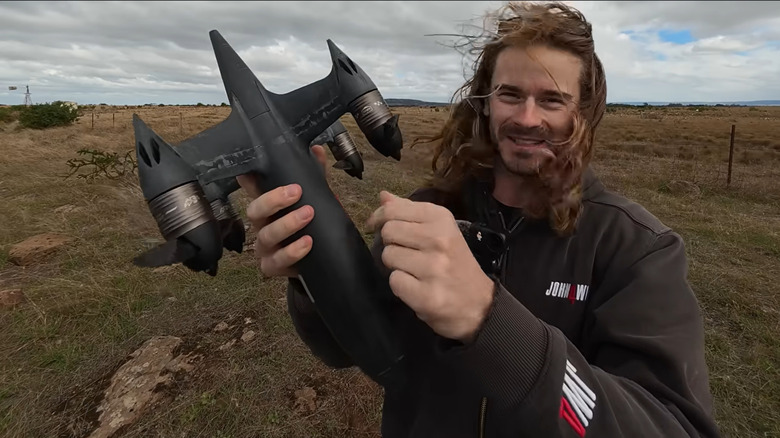
Drone technologies are changing at an unprecedented rate. As leaps in artificial intelligence and robotics transform military and industrial strategies, drones have emerged as a driving force of rapidly evolving military and industrial landscapes. But despite roughly $30 billion being poured into drone development worldwide, innovations in the space continue to emanate from unlikely places. Nowhere is there a better example than the group of YouTubers who just set the unofficial record for the fastest drone ever made.
The quadcopter, dubbed Blackbird by its engineering team, bested the previous record by almost 50 mph, reaching an astounding 453 mph during their standout run. The developers, Australian duo Aidan Kelly and Ben Biggs, who run the YouTube channel Drone Pro Hub, added custom-made carbon fiber rotors sporting an ingenious serrated edge to break through aerodynamic limits. Adding high-pitch blades was another innovation that paved their way up the drone speed leaderboard. Although not an official Guinness World Record, given Biggs and Kelly's test run lacked an official observer, the video evidence of the duo's feat is impressive.
The team has cemented itself at the forefront of the drone development game. How quickly their sawtooth rotor design makes its way into military — especially with its Amazon-style marketplaces for military drones — commercial, and amateur drone builds will be a storyline to watch. Given the lightspeed advancement of drone technologies, it won't be shocking to see developers mimicking the duo's designs.
A record breaking drone
According to Drone Pro Hub, they pulled off their incredible accomplishment without the use of specialized equipment. Partnering with some friends of the program, they designed their carbon fiber propellers to feature an extremely high pitch and a sawtooth leading edge. Although the duo is keeping the exact pitch a secret, their video explains how the serrated edges create more efficiency by forcing the air to flow directly over the blades. Previous propeller edges created drag by funneling air to the side, counter to the flightpath. The drawback of such a system is that it necessitates noticeably more power when at lower speeds, placing extra strain on the batteries at takeoff.
The record-breaking run was the duo's second time using the enhanced Blackbird drone, with the first resulting in a wrecked prototype due to a lost video signal. At its peak, this first run eclipsed the 630 km/h (391 mph), more than double the speed of an Apache helicopter. Unfortunately, the team had come just short of the Guinness World Record. Making a second go at the record, the team combatted winds that ranged from 21 to 37 mph.
They held several runs with their latest Blackbird to calculate a verifiable average. Their first downwind test shattered previous records, hitting an incredible 730 kph (453 mph). On their second attempt, the Blackbird sped upwind, peaking at 640 km/h (397 mph). The average of 685 km/h (426 mph) was a new record, although slightly below the team's initial goal of 700 km/h.
What's next for Drone Pro Hub?
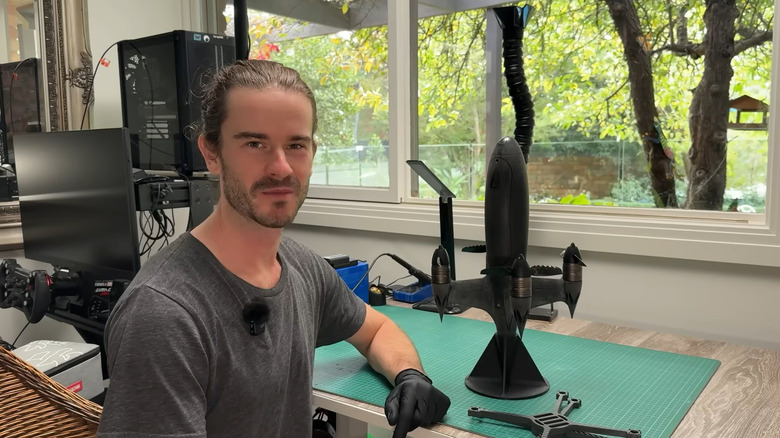
The duo claims the Blackbird became the first electric vehicle to cross the 700 km/h mark. To generate this record-breaking speed, the Blackbird sustained 400 amps for 10 seconds, placing an incredible strain on its electrical system that left the Blackbird's batteries hot and smoking. A hard landing on the final run created further damage, though it didn't appear to be fatal.
Aidan said in a video, Drone Pro Hub is "coming for that Guinness record next run." As it stands, the fastest official ground speed by a battery-powered remote controlled quadcopter is 657.59 km/h (408.60 mph). The record is held by South African father-son duo Mike and Luke Bell, who achieved the record during an official run outside of Cape Town. The accomplishment bested Ben and Aidan's previous December 2025 record of 626 km/h (388 mph). Luckily for their fans, Kelly and Biggs came back with a vengeance.
Pro Drone Hub plans on releasing the blueprints through their website for anyone looking to build their own Blackbird. Enthusiasts can sign up to join Pro Drone Hub's Blackbird waitlist for the opportunity to purchase the blueprints. The blueprints are "designed to work on most FDM printers," and while they're proponents of Bambu Lab's industry-leading printers, the blueprints should work on any of the many 3D printing alternatives. The Blackbird's carbon fiber materials might certainly be harder to come by, but the team's PCB Way suppliers are listed in their video's description.