

Researchers Say LED Lighting Might Actually Be Hurting You

LED lights have become increasingly common, offering better energy efficiency and lasting significantly longer than incandescent and fluorescent bulbs. They are the reason why car headlights have changed and are also used in smart bulbs, though they use more electricity than regular ones. However, a study published in Scientific Reports suggests that LED lighting may have negative health impacts. In their report, Dr. Edward M. Barrett and Dr. Glen Jeffery, both of University College London (UCL), found evidence that LED light bulbs "[undermine] human visual performance" when they aren't supplemented by another light source.
To study how LED lighting impacts the body, the researchers used color contrast tests on employees in a UCL building before and after introducing incandescent lights to supplement the LED. They found that visual performance "significantly improved" after incandescent light exposure, speculating that it's the result of improved mitochondrial function.
Mitochondria — the powerhouses of the cell — are known to be light sensitive and increase energy production (in the form of ATP) when exposed to longer wavelengths of around 660–1,000 nanometers. They are responsible for creating 90% of the energy the human body needs, and damaged mitochondria have been linked to cancer, genetic disorders, and more. Given the important role mitochondria play, Barrett and Jeffery conclude that LED lights and their impact on our cells could "represent an important issue in public health."
LED lights come with major pros and cons
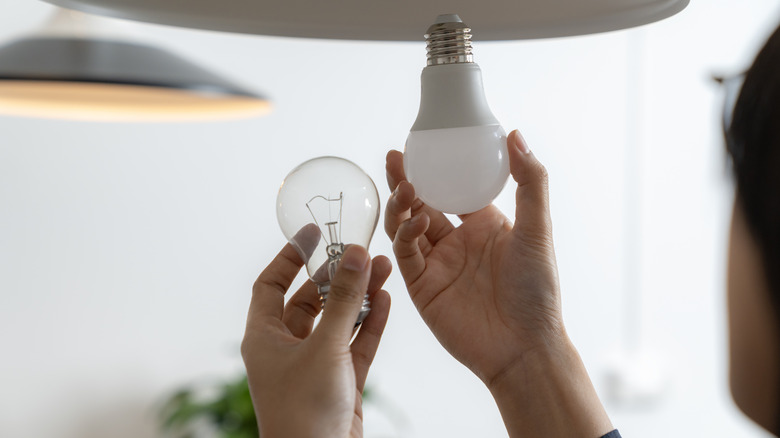
LED lights do have some significant benefits. According to the U.S. Department of Energy, they use 75% less energy, and individual lights last 25 times as long as incandescent ones. LED bulbs also don't overheat like incandescents or contain mercury like fluorescents, which make them seem safer than other bulbs.
Unfortunately, the very thing that makes LED lights more efficient is the same reason scientists believe it's harming us. Because humans evolved under solar light, which reaches Earth with wavelengths of 300–2,500 nanometers, our bodies are accustomed to that spectrum. Our eyes can only see 380–780 nanometers, which we perceive as different colors, but that doesn't mean we aren't impacted by longer wavelengths. However, LED lights are limited to the human visual spectrum, emitting between 350–650 nanometers.
Limiting wavelengths means LED bulbs aren't using excess energy on what we can't see. While that's great for reducing our ever-growing power needs, it means our bodies aren't getting the longer wavelengths that our cells need to function properly. Considering how much time most of us spend inside, indoor lighting quality is crucial for our health. Even though energy efficiency is important, we can't forget about public health as we chase breakthroughs in LED tech.