

What Is The Best Subwoofer Size For Your Home Audio System?
When it comes to subwoofers, bigger is not always better. The ideal setup isn't just about more bass; it's about finding the right balance for your space and listening preferences (and, to some extent, the proximity of your neighbors). In simple terms, larger drivers can move more air, which translates to more visceral low frequencies, but that extra muscle can easily swamp a small living room or a compact speaker setup. Even some of the best subwoofers for audiophiles may not be a good fit for a studio apartment, unless you're attempting to simulate an earthquake.
An 8‑ or 10‑inch sub will usually integrate well with small bookshelf or satellite speakers and is often enough for apartments or bedrooms where wall‑shaking bass is more of a problem than a feature. A 12‑inch model, by contrast, is typically the sweet spot for medium‑sized rooms, offering a good blend of depth, impact, and musicality that pairs well with larger bookshelf or floor-standing speakers. If you're looking for cool tech to power a large home-theater setup or fill an entire house with rumbling bass, a 15- or 18-inch sub (or multiples) may be the only solution. Before getting into specific sizes, it helps to think about how your room, speakers, and content shape what good bass actually means for your setup.
Matching size to space
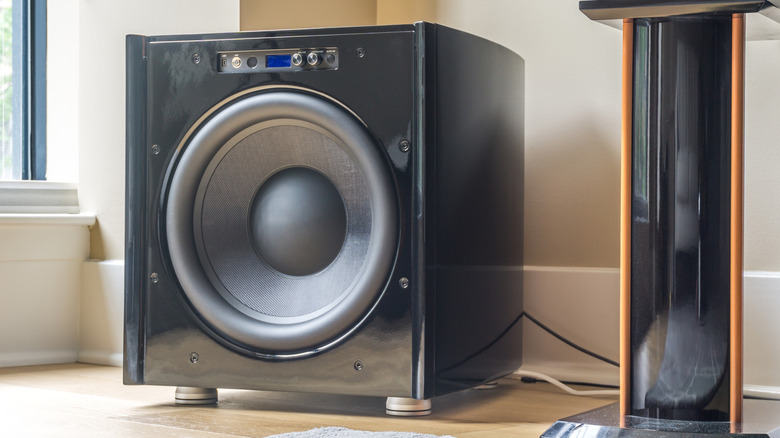
Picking the right size for a subwoofer starts with a fairly simple calculation of volume. Larger rooms can accommodate more bass, and need more to support the same level of perceived bass than smaller spaces. A good rule of thumb is that smaller or mid‑sized rooms can be filled nicely with an 8‑ or 10‑inch sub, while large, open spaces call for 12‑inch or larger units to deliver satisfying low‑end extension. A 12‑inch driver is a strong all‑rounder for typical rooms in the 150–230 square foot range, where it can reach deeper frequencies without becoming unwieldy.
There's also the vital matter of matching your speakers to an appropriate woofer. The last thing you want is to find the perfect sub for your space only to discover that it completely drowns out the treble of your speakers at even the lowest setting. If you are running tiny satellite speakers or small bookshelf speakers that roll off early in the bass, a more modest 8‑ or 10‑inch sub tends to blend more naturally, because its capabilities are closer to the rest of the system.
On the opposite end of the spectrum, if your front stage consists of big floor-standing speakers and a large center channel, a 12‑inch or larger model is practically a necessity. Otherwise, the sub can feel like the weak link that collapses before your mains do. Matching the sub's performance to your existing speakers helps avoid that disjointed effect where the low end either disappears or overwhelms everything else.
Content is key
The other major consideration when choosing a subwoofer is the type of content you tend to primarily enjoy on your sound system. If you're mostly screening comedies or dramas, or just casually streaming light fare on a modest system, you'll probably be fine eschewing a massive driver. On the other hand, if you're a bass-obsessive who watches tons of action flicks, sci-fi, or disaster movies at high volume, you might need a 15- or 18-inch monster to properly thunder. This is also true for music lovers who prioritize a deep, physical low end.
The best strategy overall is to select the smallest sub that can comfortably meet your output and extension needs, given your room and speakers, and then really drill down on proper speaker placement, room correction, and EQ rather than blindly upsizing the driver. In many cases, you may also be better off investing in a high quality pair of smaller, 10- or 12-inch drivers than one massive, oversized unit that never gets to properly stretch its legs.