

RAM Is Reportedly Back In Production — But It Still Won't Be Enough
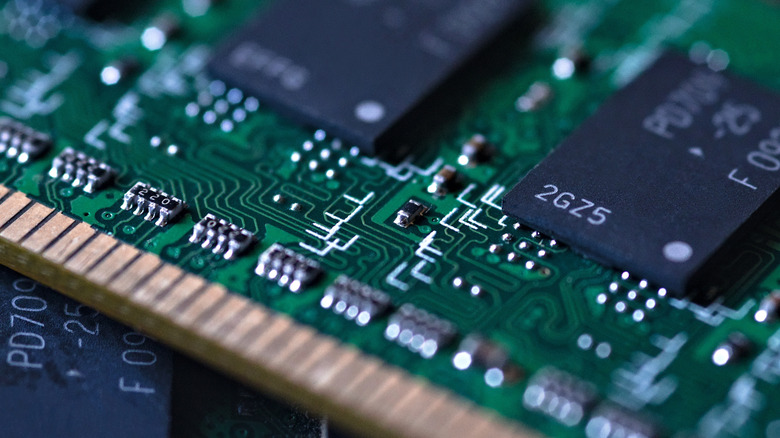
The AI bubble has done more harm than good for the average user. Companies snapped up all the RAM chips they could to run their data centers, which resulted in shortages that made the prices of everyday gadgets skyrocket. Manufacturers are finally making moves to address concerns, but just because components will become affordable again doesn't mean they will be fast.
During the ongoing Computex 2026 expo, outlets such as Tom's Hardware learned that many computer hardware companies are retrofitting production lines to produce DDR4 memory and compatible motherboards. This move is in direct response to increased demand for more affordable components. According to Tom's Hardware, an anonymous motherboard manufacturer stated it would ramp up DDR4 production due to "a double-digit increase in sales over the last quarter," while another cited a "collapse" of motherboard sales.
Even though companies are promising to produce DDR4 RAM again, don't expect to see the chips on store shelves at your local Micro Center anytime soon. While these manufacturers have the capabilities to make DDR4 RAM, they retrofitted these production lines to start producing other products a long time ago. Reallocating company resources to churn out DDR4 will take a while; one company told Tom's Hardware that it probably won't be able to ramp up production until the latter half of 2026. Don't be surprised if stores can't stock enough RAM until 2027 at the earliest.
Less of a solution, more of a staving off of the inevitable
In the spirit of fairness, increasing DDR4 production is a smart move for many reasons. The last generation of RAM is easier to produce and package than DDR5, so manufacturers can pass the savings on to customers. However, several issues stand in between these plans and a future where more people can build a budget gaming PC for under $1,000.
Arguably the biggest hurdle the resurrected DDR4 manufacturing lines must pass will be the supply of silicon wafers. Both DDR4 and DDR5 chips require these wafers, so if companies dedicated to DDR5 keep snapping up the wafers to satisfy the RAM needs of data centers, we will be left with plenty of new DDR4-compatible motherboards, but not enough DDR4 chips to populate them. Then there's the issue of future-proofing. Companies moved on from DDR4 to DDR5 because the latter is just superior. DDR5 provides significantly more memory bandwidth; the chips require less electricity and are more power efficient, and DDR5 can fit more GB in each module. While DDR4 is cheaper, you need more chips to match the capabilities of one DDR5 chip. Even if you had the money, would your computer have enough module slots?
According to Tom's Hardware, virtually all of the outlet's sources agreed on one thing: Even with resurrected DDR4 manufacturing, PC users will have to suffer through a DRAM and NAND drought until 2028 at the earliest. You should worry less about whether DDR4 RAM is still worth purchasing and more about whether you can get your hands on any RAM at all, DDR4 or otherwise.