

4 Huge Monitors That Might Be Too Extreme For You
Massive and extreme screens have always been showstoppers at various expos, like CES. See-through screens, 3D TVs, rollable screens. They're all waiting to seep onto shelves once the costs have been figured out. However, when it comes to making "extreme" monitors, you'll find some truly bizarre oddities.
Monitors have a little more of a requirement-based system than a TV. With TVs, these are devices that will sit meters away from the viewer, and often don't rock the boat outside of size, currently. Monitors, however, need to be usable and comfortable to look at when on a desk, inches away from your face. So what happens when Samsung or BenQ decides that 48 or 55-inch screens should be the new norm?
Well, that's how you end up with the Samsung Odyssey Ark, or reaching further back, how you wind up with a 43-inch projection-based screen in 2008. These monitors all sound like great ideas on paper, but not one of them will be great if you lose your mouse on the screen or your PC simply doesn't have the juice to meet them at the recommended resolution.
BenQ EX480UZ - 48-inches
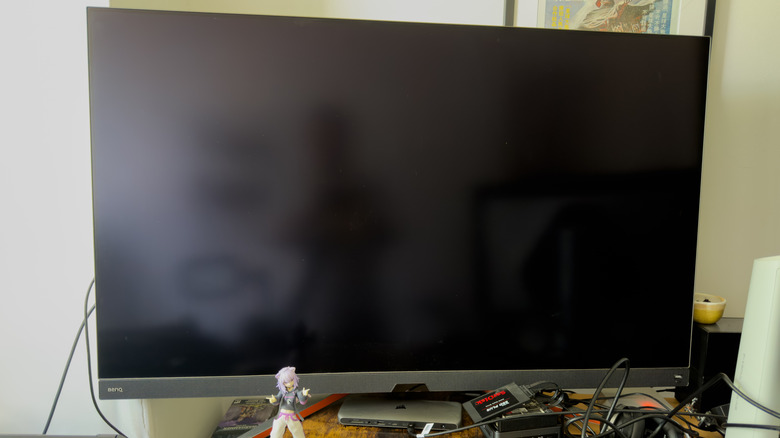
Standing at 48 inches, the BenQ Mobiuz EX480UZ is actually one of BenQ's first forays into the OLED world. It's also one of the biggest monitors that the company has produced, intended for a desk. Made for gaming, this is one monitor that's best used at a huge distance, rather than craning your neck around just to find the mouse.
Launched in 2023, the BenQ Mobiuz EX480UZ sports a 120Hz refresh rate, a 4K resolution, and yes, a 48-inch screen. It's truly impressive, but it's far too big for regular work, and you really do need to sit further back to take it all in. Using this for productivity can be a major hassle, unless you decide to blow up the user interface past the 200% mark just to track the mouse properly. For gaming, there's now just cheaper, more available, and importantly, monitors that provide a better image.
This monitor is "extreme" because you really do need your head screwed on a little incorrectly to think this is going to be properly usable at short distances. For quite some time, the unit in our possession functioned as a "dumb TV", as it has no onboard software outside of the usual settings fare, avoiding some awful Smart TV OS's. Here, it's less extreme, more useful, but as soon as it lands on a desk to be used as a PC monitor, it falls apart.
Samsung Odyssey Ark - 55-inches
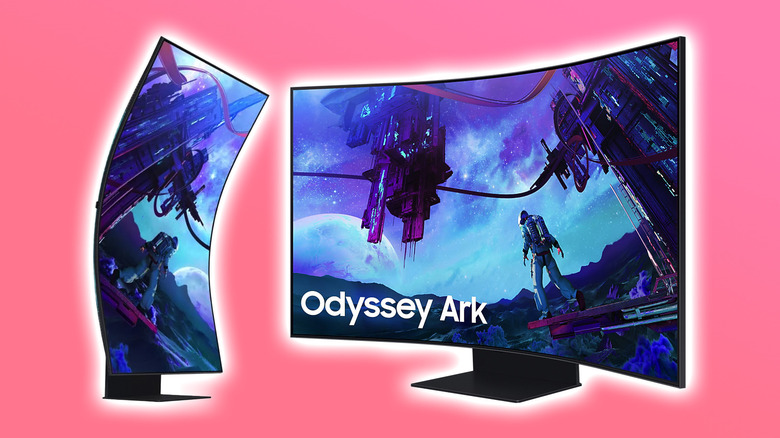
Part gimmick, part massive gaming monitor. The 55-inch Samsung Odyssey Ark gained a lot of attention when it was announced and launched due to its rotating design. Samsung even intended for it to be used while vertical, with a split-screen mode that would section the panel into three sections for various uses. The monitor was divisive when it launched in 2022, with middling scores from some outlets and glowing praise from others. Then it received a second-generation refresh in 2024.
However, according to reviews, even the second generation's multiview mode still doesn't function the way an end user would want, with some apps struggling to work in the format. It can't provide sound for all four inputs, as it can only play one at a time. At a huge price of $2,699.99, the 4K and 165Hz monitor might be an impressive gimmick, but it is outclassed by smaller, more focused monitors in terms of performance.
55 inches in your face is also not exactly the most pleasant experience. As with the BenQ Mobiuz 48-inch, the Samsung Ark provides just too much real estate to be used comfortably in an office or PC gaming environment. If you shrink all of this down via the multiview, it becomes a little more usable, but ultimately, do you even need this extravagance, or just a regular monitor?
Samsung Odyssey Neo G9 - 57-inches
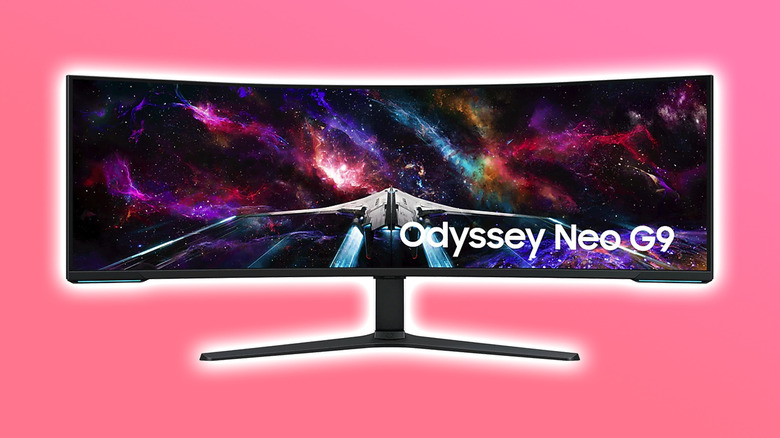
At 57 inches and a resolution of 7680x2160, the Samsung Odyssey Neo G9 is perhaps one of the largest ultrawide monitors on the market today. Its massive scale is effectively like having two 32-inch displays next to each other, and Samsung claims that it's the "first" dual ultra-HD monitor. Launched in 2023, it will swallow your desk whole with its gargantuan size.
Online, some users actually recommend Microsoft's PowerTools or other third-party applications on other operating systems to make managing the desktop far easier. With such screen real estate, it can make the Neo G9 a productivity machine, but you will need to manhandle it via software. For those on Windows 11, it might even be worth turning on the taskbar's hiding feature, so that you get the most out of it without one of the longest taskbars in history taking up unnecessary space.
This is for the real power users out there. While it might be aimed at gaming, the picture-in-picture options let you have those two 32-inch displays at 4K for two separate devices. It won't have the same problems as the Samsung Ark or BenQ Mobiuz, where those are just too big when up close, but do you really need all that monitor real estate? Can your PC even handle the maximum resolution? These are the questions you need to ask if you've got a couple of grand burning a hole in your pocket.
Ostendo CRVD 43 - 43-inches
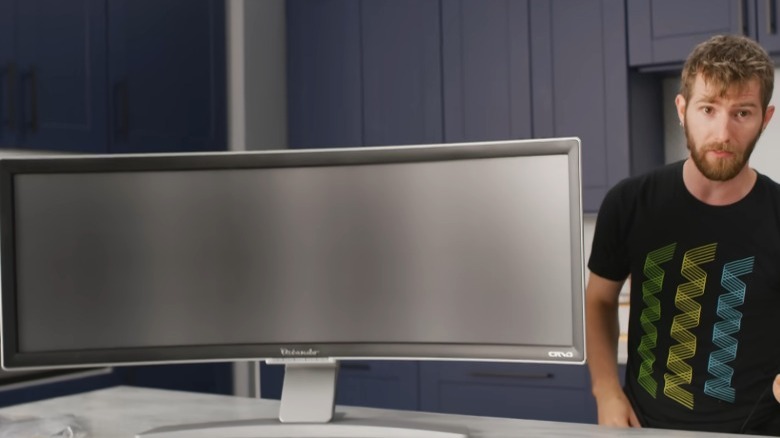
A throwback, and an incredibly niche one at that. Information is thin on the ground about the Ostendo CRVD 43 and its lifespan, with the monitor being more of a sideshow attraction than a highly sought-after item. Launched in 2010, after a couple of years of appearing at CES '08 under Alienware and Macworld '09 with NEC, before finally landing at Ostendo. It came with a maximum resolution of 2880x900, and a behemoth price of $6,499. Ostendo even pitched combining three of these together for a 180-degree vision cone.
It is actually four LED-lit screens connected together into one giant display. It used Digital Light Processing (DLP), so it functioned closer to four projectors. Owing to the way that DLP functions, with a ton of tiny mirrors providing low input lag, it had a response time of 0.02ms. Due to this design, it meant that the monitor weighed 45.5 lbs (20.7kg) without the stand, and another 7lbs (3.2kg) with it on.
A historical artifact now, the monitor gained some more attention in 2020, thanks to tech content creator Linus Sebastian showing it off on his Linus Tech Tips YouTube channel. Linus mentions in the video that it emits a loud fan noise to keep the parts cool, and those who had access to it said that it would break all the time. Ostendo quietly discontinued the CRVD 43, with no real mention as to when it disappeared.
Methodology

For this article, we took a look at some historical information, including reviews and news about the monitors included on this list. Based on initial reactions and the subsequent reviews, this was the basis of our decisions. Outside of that, the author has had hands-on or other experiences with these monitors in the past and has utilized their prior knowledge on the subject to come to the conclusions.
The BenQ Mobiuz EX480UZ is the only monitor we have direct access to for this article. However, the Samsung Ark and Neo G9 have both been used at previous press events. Of course, the CRVD monitor from Ostendo is ultimately out of our reach, and this relied on second-hand or third-hand information from creators or users around the web. Official, first-hand information on the Ostendo CRVD monitor was gathered from the Internet Archive, as the company doesn't exist in the same capacity as it did nearly 20 years ago.