

New Solar Breakthrough Could Be A Game Changer For Fresh Water And Lithium
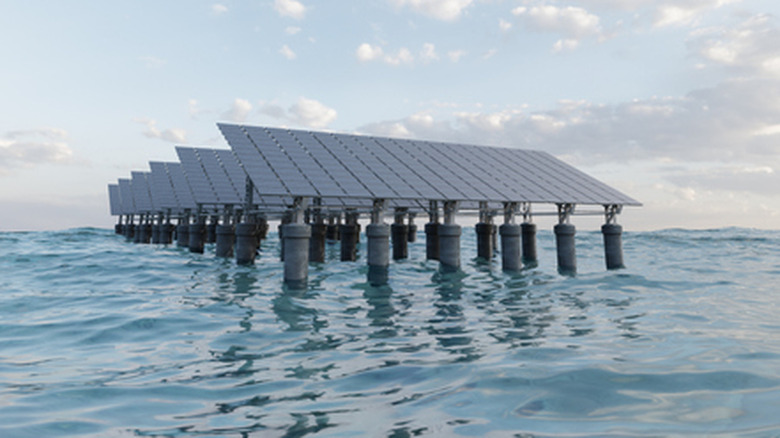
Even though over 70% of the Earth is covered in water, only an extremely small percentage of our planet's water is drinkable; the rest is too salty to drink. If we want to make more, there is a process called desalination which can remove salt from seawater and make it potable, but the issue comes down to scalability. However, some people believe specialized solar panels could be the solution.
Recently, researchers from the University of Rochester in New York published a study in Light: Science & Applications that outlined a new desalination technique. The technique revolves around an aluminum panel etched using femtosecond lasers (lasers that pulse so fast they can only be measured in one-quadrillionth of a second). Thanks to the laser etching, the aluminum panel not only absorbs light but also becomes superwicked: It attracts water to an almost supernatural degree.
When the panel comes into contact with salt water, a thin film of water is pulled up, completely defiant of gravity, and evaporates using solar energy, leaving behind crystallized salt and other minerals. While the evaporated gas is recollected as salt-free water, the superwicked surface also moves salt crystals onto the edge of the panel, keeping the main surface clean and efficient. Not only is the process self-sufficient, but it also solves the problem of other desalination projects: It doesn't discharge brine (a highly saline water that is poisonous to sea life). Normally, brine pools in at the bottom of the ocean and forms underwater lakes that kill anything that enters, so you can imagine the threat a sudden stream of brine in open waters can pose.
Superwicking could revolutionize ocean mining operations
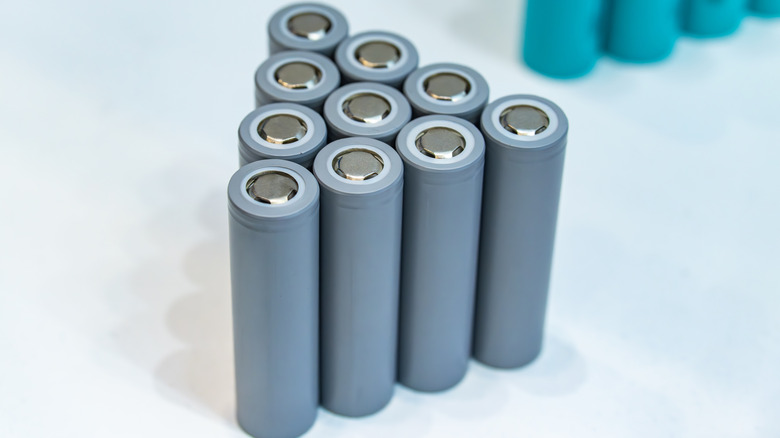
Contrary to popular belief, saltwater doesn't contain only salt and water. Oceans also house tons of minerals (figuratively and literally), many of which have commercial applications. If only we could safely and effectively extract them. That's where superwicking comes in.
After the University of Rochester's specialized panel is done desalinating seawater into drinkable water, it is still left with crystallized salt. People can harvest this leftover material and turn it into something useful, like table salt, and this is also true of other dissolved minerals, including lithium. The researchers at the University of Rochester touch on the potential for using superwicked panels to collect valuable elements such as lithium and uranium.
Utilizing superwicked panels to "mine" for minerals has several potential advantages over traditional mining operations. For starters, the University of Rochester's process would require far less energy and water. Plus, we could mine more of these materials from the ocean than we ever could from dry land — it's all there, just mixed in with the water. And then there's the fact that superwicking lithium and other materials out of the ocean is more environmentally friendly than standard mining. With enough superwicked solar panels, we could get all the lithium for batteries we would ever need. That is, unless emerging battery innovations remove the need for lithium in batteries, at least.