

10 Emerging Battery Innovations That Could Change The World
It's probably not an exaggeration to say that the world has become battery-powered. We're long past the days of batteries being something you needed for a flashlight or a Walkman. Our computers, smartphones, and even our cars rely on battery technology to work. Energy storage matters on an industrial scale, too. Renewable energy from solar and wind, for example, has to be stored if you can't use it right away. Solar power isn't much use when the sun goes down, but with great battery technology, you can store it for later.
The problem is that our mass-produced lithium-ion battery technology has a few significant issues. It's pretty volatile and requires robust safety measures to prevent violent flameouts. It's why you should know the warning signs that your lithium-ion battery might catch fire!
Current lithium-ion batteries also have relatively low durability, which is why you need to replace your phone or laptop battery every few years, since each recharge wears it out a little. All around the world, scientists and engineers are working on battery technologies to improve safety, durability, charging speeds, and other aspects of battery technology. These 10 emerging technologies are either already entering the market or appear poised to revolutionize our lives.
Solid state batteries have been a long time coming
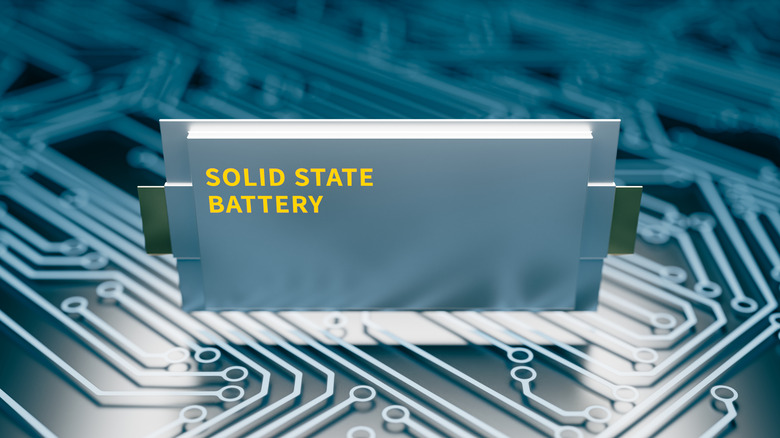
Your first question, of course, is probably "What is a solid-state battery?" and the answer is both simple and complicated. For the long answer, you should check out our more in-depth explainer, but the short, simple definition is that it is a battery without a liquid electrolyte. The electrolyte is the medium through which ions pass from the anode to the cathode and back again, as the battery charges and discharges.
Most of the problems with current batteries stem from the use of a liquid electrolyte. If you could replace it with a solid material, you would get a battery that's safe, extremely durable, and with an even higher energy density. We've been able to make these batteries for some time; the challenge comes from mass production. Whoever cracks the nut of cheap, mass-produced solid-state batteries has the potential not only to become an enormously successful company almost overnight but also to literally change the world.
As of this writing, a company called Donut Labs claims to have made the "World's first all-solid-state battery in production vehicles." There's a lot of skepticism around this claim, though, and third-party verification has yet to fully happen with the batteries not yet on sale. A Chinese firm named Greater Bay Technology has produced samples of solid-state EV batteries and claims they are headed for mass production. Likewise, a company called Prologium is also fielding this tech, so hopefully we'll see it in things we can actually buy sooner rather than later.
Sodium-ion batteries are here
Lithium-ion batteries use, well, lithium ions to function. However, lithium is a problematic metal for a number of reasons. It's energy-intensive and polluting to mine, and there are questions about the exploitation of workers in some developing parts of the world where lithium is mined. It's also not clear whether the world's lithium supply can even meet future demand if, for example, all cars became electric or most electricity came from renewable sources that have to be stored.
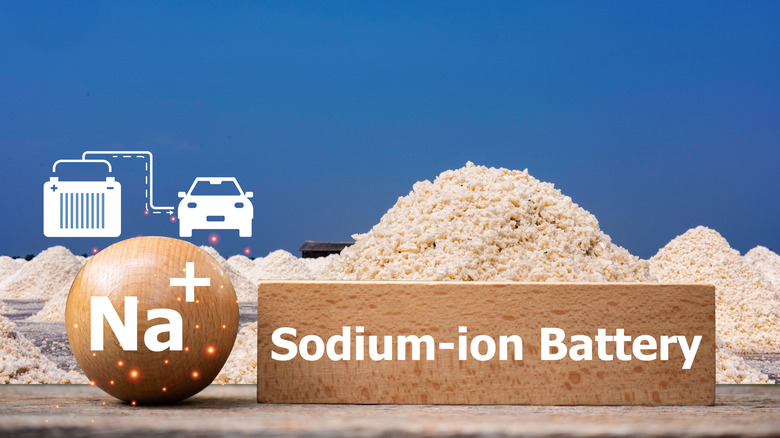
So imagine what a game-changer it would be if you could swap out lithium for sodium, an abundant and cheap metal. We can extract sodium from salt, which isn't in short supply by any measure. The main downside of sodium-ion batteries is that they're not quite as energy-dense as lithium. This means the technology isn't as attractive for devices like smartphones or for high-performance EVs.
However, for mass-market EVs where some extra weight or a little less range doesn't matter much, it's set to be the battery technology of choice. The Chinese battery giant CATL has launched the "world's first mass-production sodium-ion passenger vehicle," which already has some great on-paper numbers. With an energy density of 175 Wh/kg, it's competitive with lithium-ion packs, and as production methods improve, this number is expected to go up. A final piece of the puzzle in sodium-ion battery research was slow charging, but engineers seem to have figured it out.
Silicon-anode batteries are a big upgrade to the batteries we already use
We've mentioned the words anode and cathode, but now's a good time to explain them. These are the battery electrodes, where electric current enters and leaves as it flows through the battery. The anode is the negative terminal, and the cathode is the positive terminal. At least this is the case when the battery is discharging. The labels technically flip when the current flows in the opposite direction.
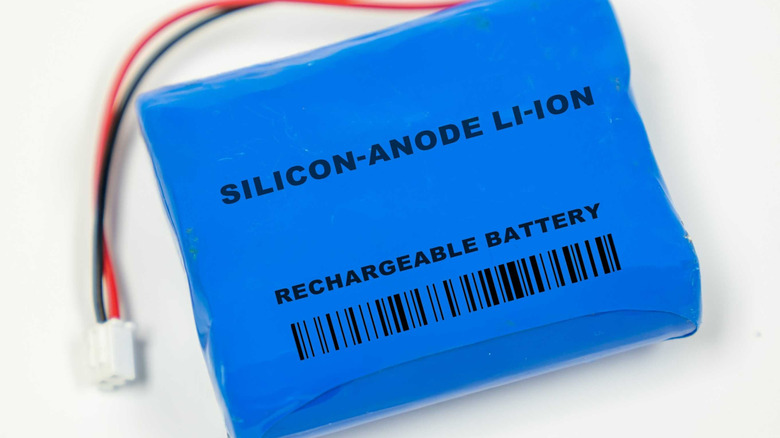
While replacing a battery's electrolyte obviously has a major impact on its performance and character, the materials used for the anode and cathode are also crucial. In a silicon-anode battery, you've probably guessed that the anode material is mainly silicon instead of the more usual graphite. By implementing this, you can increase the energy density of a lithium battery by a huge amount, more than double in practice, though theoretically it could be much more. It's how one company made a 600,000-mile EV battery.
This would be a major advance for EVs, where energy density matters more than anything. Doubling the range of your EV without adding any extra weight is an upgrade most people would take without a second thought. The big problem is that silicon expands and contracts as the battery charges and discharges, which isn't ideal. However, engineers are working on various potential solutions, mainly silicon composites that limit this behavior, such as retaining some graphite in the anode.
Iron-air batteries could transform renewable energy storage
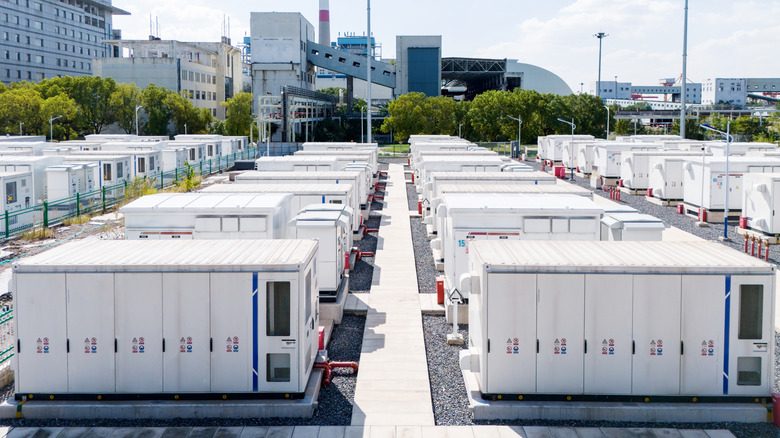
The better we can get at storing energy to use later, the easier it becomes to generate that energy efficiently. After all, you can pick the time and method of generation, and you can avoid using things like diesel-burning emergency generators when the grid is under strain. It makes sense for renewable energy, but even capturing excess energy from nuclear or fossil-fuel generation is on the table if it would otherwise go to waste. A leading candidate for this energy storage solution for power grids is the iron-air or metal-air battery.
These batteries store and release power through a reversible oxidation process. Yes, they rust and then de-rust as iron binds with or releases oxygen. These batteries are enormous and heavy, so they aren't useful for EVs or your laptop, but they are much cheaper and easier to scale on a grid level.
It sounds so simple, but the fact is that rusting (and reversing the process) releases and stores energy. What was too slow and heavy for any other use could now be the answer for storing energy cheaply over multiple days. Air and water are everywhere; iron is abundant and cheap; and we need somewhere to store all the power we're going to generate.
Lithium-sulfur batteries could outperform today's lithium-ion cells
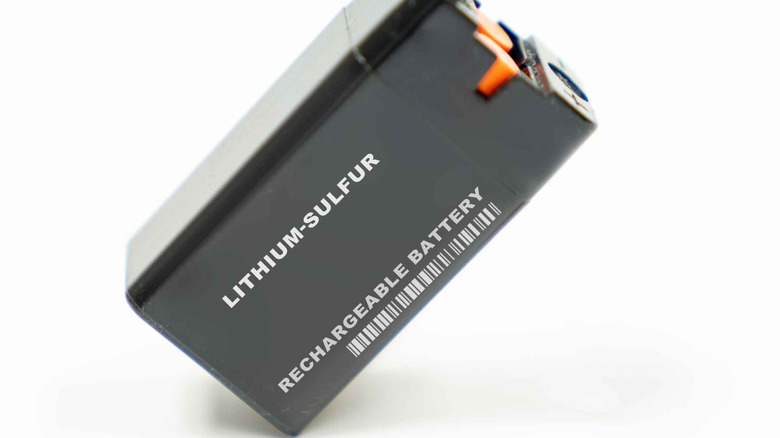
For some inexplicable reason, it seems we've decided not to call these "brimstone batteries," which would have been infinitely cooler. Missed opportunities aside, this variation on lithium battery chemistry holds plenty of promise. Sulfur is cheap, abundant, and perhaps most importantly, very lightweight.
Sulfur also promises a much higher energy density than conventional lithium batteries. One Chinese research team managed to create lithium-sulfur batteries with an energy density of 549 Wh/kg, effectively doubling the flight time of a drone compared to when using just lithium. That wasn't the breakthrough, though. What made this research interesting was the battery's endurance.
So far, a major issue with lithium-sulfur batteries has been rapid degradation, but these batteries claim to retain 82% of capacity through 800 cycles. That puts them on par with the best regular lithium batteries in devices like drones. Given that other technologies have far higher endurance rates than 800 cycles in competition, this is unlikely to be a dominant battery technology. However, for certain applications where density matters much more than total lifespan, sulfur could be a "fire" solution, as the kids like to say.
Structural batteries could turn devices into the battery itself
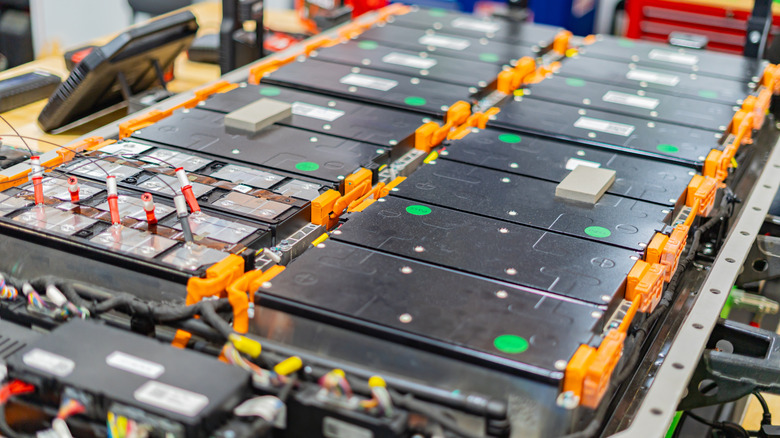
In an EV, batteries are the power source, but they are also heavy. They serve only to store energy. What if you could store that energy in parts of the vehicle that also do other jobs? So parts like the frame, chassis, or even the body panels could store power. It's a similar idea to using engines as a stressed member of the vehicle. The engine provides both power and structural rigidity to the car, saving weight.
In 2024, we first heard about the "world's strongest battery," in which engineers managed to make a battery from carbon fiber. The same light and strong material is used to make components for supercars and professional racing machines. According to these researchers, this battery material is as stiff as aluminum and can store enough energy to be commercially viable.
This type of technology is likely to be crucial for electric airplanes. Weight is still a major issue here, but if you turned the airframe itself into a battery, it would improve the range and performance of these aircraft immensely. Structural batteries aren't just about vehicles either. Scientists are making energy-storing concrete. This means the actual structure of a building could be used to store power from the grid or from solar panels. With this tech, there's no need to have a basement full of enormous batteries. Imagine turning your entire basement into a power-storage medium!
Nuclear microbatteries might power devices for decades
In the "Back to the Future" trilogy, Doc Brown meets his time machine's 1.21 gigawatt energy needs by using nuclear energy, eventually switching to future cold-fusion devices rather than (stolen) plutonium. Here in the real world, far beyond the future dates in the movies, the only vehicles and devices that use nuclear power are naval ships, submarines, and deep-space probes.
However, nuclear batteries could change everything and help solve the nuclear waste problem caused by nuclear fission power stations. Now, nuclear energy doesn't produce much waste in absolute terms, but the material has to be sealed and stored underground, where it remains hazardous for centuries. Some of this waste can be recycled, but scientists' work on nuclear microbatteries suggests we could use some of it more productively.
The batteries work with crystals that emit light when absorbing radiation, which is then converted to electricity using what's essentially a solar panel cell. The power generated is small but potentially sufficient to power sensors or other very small devices, and, most importantly, it can do so for decades. But why go nuclear when you can go quantum? A company called Casimir is making waves with claims of a chip that harvests power from the environment using the Casimir effect. Again, there is some skepticism, except perhaps for the investors pouring money into that project.
Graphene-enhanced batteries could charge incredibly fast
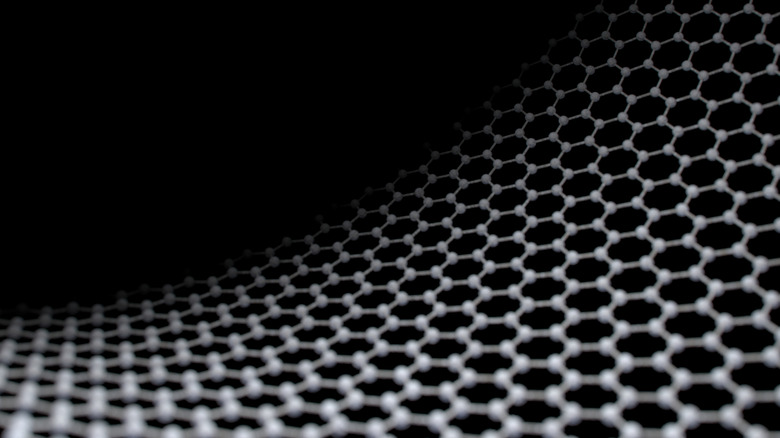
We've been hearing about the wonders of graphene ever since it was discovered over two decades ago. Since then, there have been multiple setbacks to making it work the way science says it's supposed to. One of the big issues is mass production of the stuff, which is something we've only recently started to achieve.
But what's the big deal? Graphene is incredibly conductive, so in theory, if you infused a battery with the stuff, it could charge much faster and dissipate heat far more efficiently. That's useful everywhere, but EVs in particular need a fast-charging solution that doesn't excessively wear out the battery. Graphene would make for a formidable solid-state battery, but so far, this has eluded scientists and engineers.
You can, however, find batteries on the market today that are infused with graphene. Just adding some of this wonder material to, for example, a power bank increases charging speed, reduces battery wear, and helps the battery manage thermals better. Unfortunately, it also makes these devices much more expensive. Arguably more expensive than the benefits of using graphene as an additive. Once cheap mass production becomes possible, expect graphene batteries to be a cornerstone of future energy storage technology.
Flow batteries may become the backbone of renewable grids
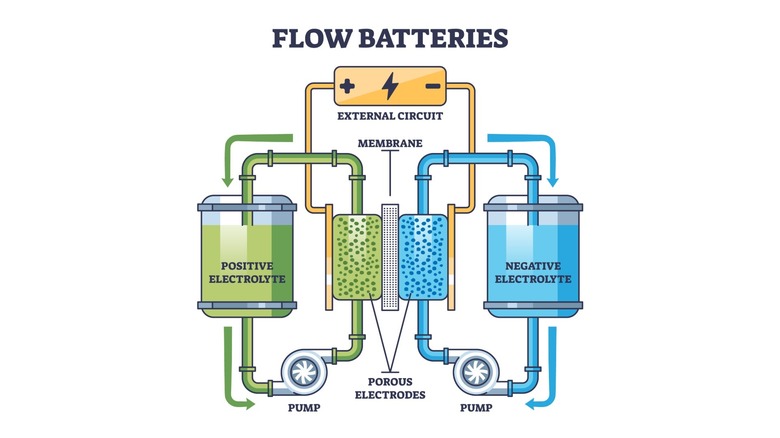
While we're chasing solid-state batteries that eliminate liquid electrolytes, there's another type of battery that, rather ironically, leans into the nature of liquid electrolytes. It's called a flow battery, and instead of having an electrolyte trapped between two electrodes, the electrolytes are kept in tanks. So these batteries look more like small chemical plants than traditional batteries.
Electricity is generated by pumping electrolyte so that it circulates on either side of a membrane, allowing for ion transfer. You can charge a battery like this up with electricity from sources like solar or wind, but you can also instantly get more power by removing the spent electrolyte and replacing it with fresh liquid. If you want the battery to have more storage capacity, all you have to do is make the tanks bigger.
This makes it perfect for a similar job to the iron-air battery we looked at earlier. That is, acting as a grid-scale energy storage system. Like iron-air batteries, flow batteries have not been considered practical for smaller systems like EVs, largely because the energy density doesn't make sense. However, the recent development of nanoelectrofuel, with an energy density 15 to 25 times that of the electrolytes used in flow batteries, could change that. It opens the potential for an EV that can be recharged like any other, or simply topped up with new liquid electrolyte in minutes.
Gravity batteries could store energy without chemicals

Of all the battery technologies on this list, gravity batteries have the most sci-fi name. It sounds like something from "Star Trek," doesn't it? Well, brace yourself, because all a gravity battery is is a huge weight pulling on a cable that turns an alternator. But wait! It's actually even cooler than it sounds.
How it works is that you use an energy source, like solar or wind power, to lift something very heavy, like a few tons of concrete, to a good height. Then, when you want the power back, you slowly release the weight through a geared system that turns the aforementioned alternator. In practical terms, these gravity batteries operate in underground shafts, including reused abandoned mining shafts. You're storing the energy as potential energy instead of chemical energy. You've done work to push against the gravity well of the Earth, and later, you get a good chunk of it back by giving gravity what it wants.
A leading company in this area was Gravitricity, but sadly, it went out of business in 2025. Gravity batteries are just one example of a kinetic battery. There's also the flywheel battery. Here, power is used to spin up a heavy flywheel to immense speeds, carefully balanced inside a container that minimizes friction. Hours later, you can apply the brake to the wheel and use it to generate electricity. Simple, yet ingenious!