

2 Things The '60s Got Right About Space Exploration (And 2 Things They Got Wrong)
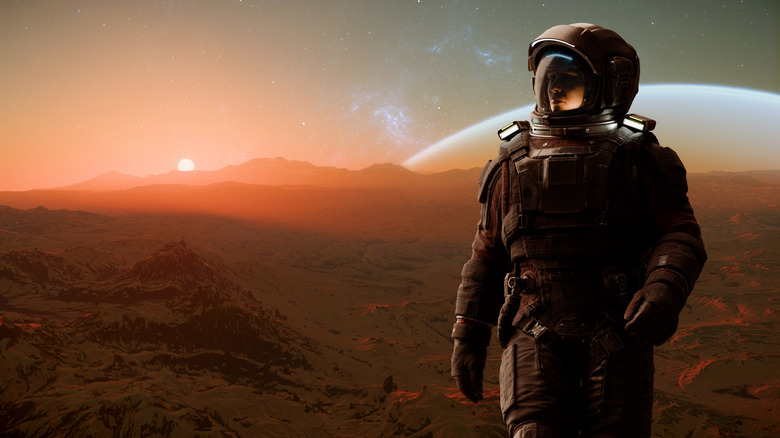
The future of space travel has been a subject of speculation since the early days of science fiction. Naturally, those who predicted what space travel might involve in the 21st century didn't always get everything right. Between genuine scientific theories and pop culture depictions, the 1960s offered no shortage of visions regarding the future of manned (and unmanned) space flight, many fueled by the frenzy around the Space Race between the United States and the Soviet Union. While some of these visions proved inaccurate, it's worth noting that others were surprisingly on the money.
Of course, space operas depicting laser battles between factions of good and evil were probably never even trying to be realistic in their depictions of near-future space voyages. However, those that got certain details right often did so by blending accurate predictions with flights of fancy. It's simply worth keeping in mind that predicting the future trajectory of technological developments has always been a challenge. Even if a given prediction about space travel hasn't come to pass yet, that doesn't mean it never will.
Accurate: Robots playing key roles in space missions
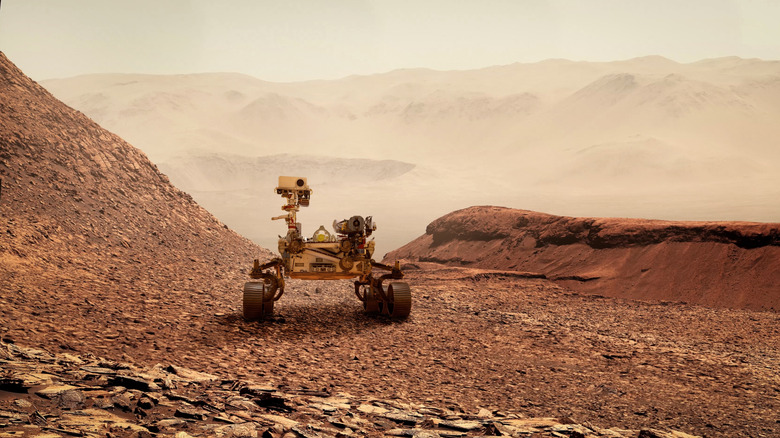
One of the most enduring works of science fiction from the 1960s (or any decade) is "2001: A Space Odyssey." While both Arthur C. Clarke's novel and Stanley Kubrick's film definitely missed the mark with some of their predictions (a topic we'll discuss a little further down), they were right about the notion of space flight relying on the assistance of various types of robots.
Are the robots used in modern space missions murderous, autonomous pseudo-villains like HAL 9000? No, or at least not yet. However, they can be quite sophisticated. Currently, robots in space perform such tasks as exploring the surface of Mars. We may not be able to send humans to the Red Planet just yet, but robots can certainly make the voyage. Without them, exploration of our own solar system would be even more challenging than it already is.
Recently, researchers from Stanford University also demonstrated a method that would allow an AI robot to navigate the International Space Station on its own. Such a development theoretically paves the way for future missions in which advanced robots play critical roles. Although robots serve many purposes on space missions, they can be particularly valuable when it comes to performing tasks and completing missions that might otherwise be too dangerous or impractical for human astronauts.
Accurate: Private companies getting involved in space travel
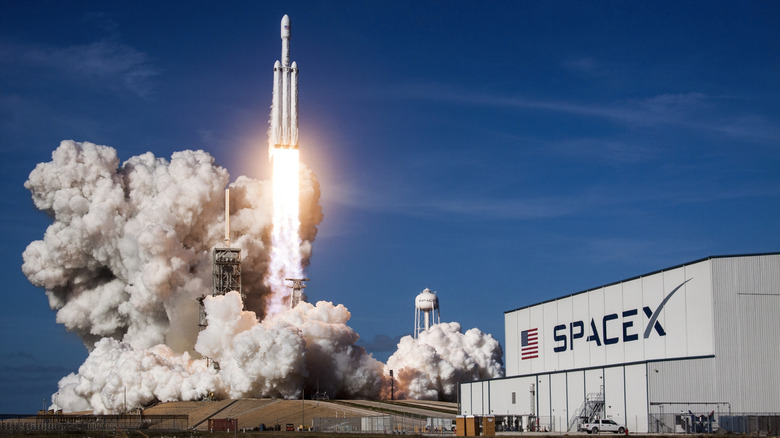
Back in the 1960s, space exploration was strictly reserved for government agencies. NASA and its equivalents throughout the world were the only organizations with the resources necessary to send missions outside the bounds of our planet. However, in works like "2001: A Space Odyssey," sci-fi visionaries depicted a future in which private companies would also join the space race.
Those visions are now common reality. While Kubrick's depiction of Pan Am escorting passengers to and from Earth might not have come to pass, private companies like Blue Origin and SpaceX have actively established their presence in the realm of space travel. With alleged ambitions of sending manned spacecraft on Mars flyby missions, these companies appear to be approaching space travel just as seriously as any government organization. Sure, their rockets may explode on the launchpad from time to time, but the same was true for the early NASA tests. Just don't expect to book a seat on a space plane anytime soon.
Inaccurate: Space travel involving manned missions to other planets
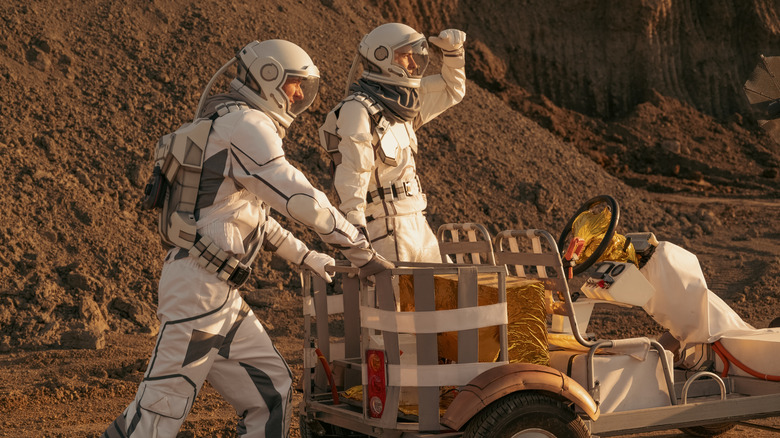
Again, although "2001: A Space Odyssey" may have made a few accurate predictions, its general vision of what space travel would look like at the start of the 21st century fell short of the truth. For example, both the novel and the film depict a future in which manned missions to other planets can and do happen. As of 2026, we haven't quite achieved this milestone.
Many 1960s pop culture depictions of space travel overestimated just how far along the technology would be by this point in time. Consider the example of "Lost in Space." According to this classic TV show, entire families would be seeking refuge on planets outside our solar system as early as 1997. "The Twilight Zone" was another series that assumed the best about humankind's potential to reach other worlds in just a few generations. There's no shortage of classic "Zone" episodes featuring brave astronauts (and, in some cases, their loved ones) venturing to far-off planets that look suspiciously like Earth backlots.
In reality, we may be fortunate enough to see a manned Mars mission in our lifetimes, but we shouldn't expect anything more dramatic than that. Science hasn't quite cracked the warp-speed code just yet. The difficulties of traveling between planets, and keeping humans alive for the voyage, are much more significant than Rod Serling and his fellow '60s TV writers might have had us believe.
Inaccurate: Space colonies being relatively common
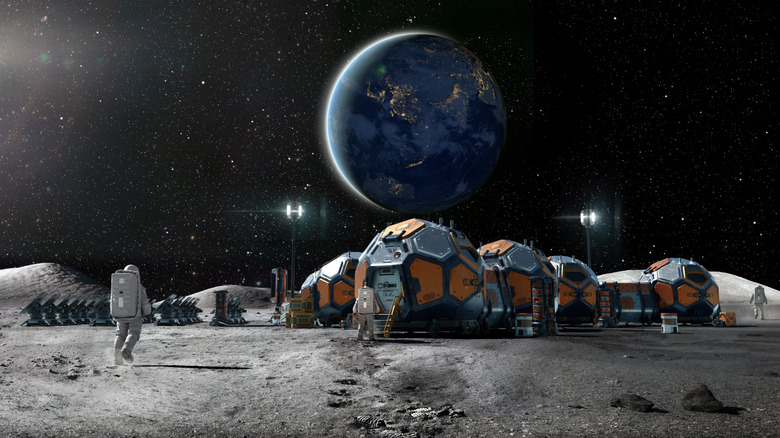
It's possible to argue that a space "colony" already exists in the form of the International Space Station (ISS). However, the ISS isn't nearly as expansive as the space colonies dreamed up by artists and authors depicting the potential future of space travel back in the 1960s. According to pop culture, by now, we'd have colonies on the moon (and on asteroids, and orbiting the planet, and on other planets, etc.) where everyone from trained astronauts to everyday families would experience off-world living.
These visions haven't quite panned out ... yet. That said, this is an example in which artists dreaming up new developments in space travel might have simply been too optimistic regarding the timeline. NASA has announced plans to coordinate with parties throughout the world to establish the first moon base in an effort to set up a permanent human presence on our nearest natural satellite. Although average folk might not be living there in the foreseeable future, such plans do represent a real step in the direction of making science fiction a reality.
None of this is meant to poke fun at the assumptions of yesterday's dreamers. Asking someone to accurately predict how technology will change (and how fast that change will occur) is just a little more reasonable than asking someone to tell your fortune. That said, just as some predictions about space travel have been relatively accurate, it's not uncommon for sci-fi to inspire real-life innovations. As long as visionaries keep imagining where humanity will go, scientists will be inspired to bring those dreams to life.