

Blue Origin's New Glenn Rocket Exploded On The Launch Platform
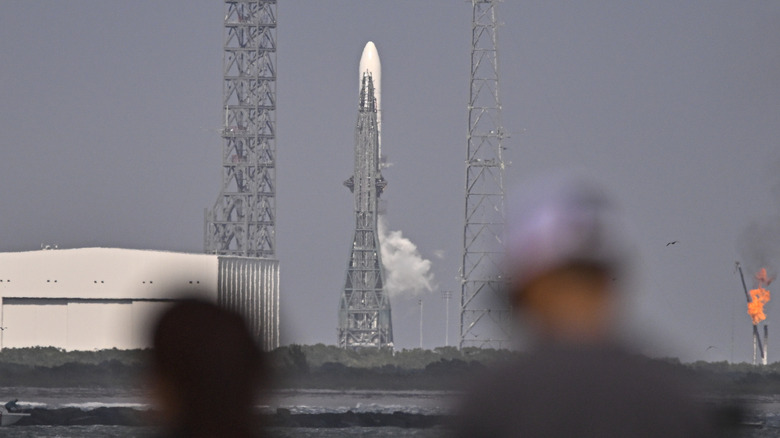
What was supposed to be a routine test for Blue Origin literally went up in flames when one of its New Glenn rockets exploded on the launch pad. Late at night on May 28, Blue Origin was checking to ensure the New Glenn's engines were in working order (also called a "hotfire test") when the vessel transformed into a gigantic fireball. While Blue Origin has yet to disclose the cause of the explosion (its X/Twitter account only stated that an "anomaly" occurred), the company's owner, Jeff Bezos, has confirmed that all personnel were accounted for and safe.
Blue Origin's New Glenn just blew up at LC-36 while attempting to Static Fire ahead of NG-4.https://t.co/tANS0dWyIH pic.twitter.com/PztxFoBqIw
— NSF – NASASpaceflight.com (@NASASpaceflight) May 29, 2026
While the New Glenn rocket had no crew or cargo at the time of the explosion, the hotfire tests were being conducted in preparation for an upcoming launch. According to Reuters, the rocket was scheduled to carry and launch 48 Amazon Leo satellites into low-Earth orbit, and later haul lunar landers and cargo for upcoming Artemis missions that would pick up from where the recent and special Artemis II mission left off.
According to the current NASA Administrator, Jared Isaacman, NASA is working with Blue Origin to investigate the cause of the explosion. Furthermore, Bezos has promised that Blue Origin will help cover the damages the explosion dealt to the launchpad.
Will this explosion affect the future of Blue Origin?
Any time a space rocket explodes is a travesty, but this incident is especially ironic given the timing. On May 26, just two days before the accident, Blue Origin signed a $188 million contract with NASA to deliver lunar rovers to the moon. Given the severity of the explosion, It's too early to tell if Blue Origin will keep this contract or if its Artemis mission plans will be thrown out the airlock, but the loss of this New Glenn rocket definitely throws a monkey wrench into many of Jeff Bezos' plans. One of these agendas was to launch a satellite network that could rival SpaceX.
Not only will Blue Origin have to spend countless hours and cash fixing the launch pad — time and money that would otherwise go into building another New Glenn rocket — but the company will also have to focus on cleanup efforts. The televised test-turned-travesty captured not only the explosion but debris shooting off in all directions. Much of this shrapnel landed in the ocean (one of the advantages of launching rockets near the coast instead of the middle of the U.S.). Blue Origin warned X/Twitter followers that some of this debris might wash up on shore, and people should notify the organization of any they find.
On a side note, even if Blue Origin had another New Glenn ready for testing or launch tomorrow, the company only leased Launch Complex 36 (the launch pad where the explosion occurred). Until the location is repaired — or Blue Origin leases another launch site — all New Glenn projects are effectively grounded.